
c. 292 – 304·Feast December 10
St. Eulalia of Mérida
Child martyr whose dove rose at the stake
Overview
Eulalia of Mérida was a Roman Christian girl, born around 292, who was martyred at Augusta Emerita, the capital of the province of Lusitania in modern Spain, during the persecution of Diocletian. A devout Christian virgin of about twelve to fourteen, she was kept by her mother in the countryside in 304, when every citizen was compelled to swear allegiance to the Roman deities. Escaping her confinement, she appeared before Governor Dacian's tribunal, declared her Christianity, heaped scorn on the idols and on Maximian, and demanded her own martyrdom. Flattery and bribery having failed, the soldiers stripped her, tortured her with hooks and torches, and burned her at the stake, where she suffocated from smoke inhalation — taunting her tormentors to the end. As she died, tradition records that a dove flew from her mouth, driving off the soldiers, and a miraculous snow covered her nakedness, its whiteness read as the sign of sainthood. Her tomb became a shrine within a generation, and her cult was already popular among Christians by 350. The poet Prudentius gave her lasting fame in the third book of his Peristephanon, and her relics were spread through Iberia. Bishop Fidelis rebuilt her basilica around 560; her shrine ranked first in popularity throughout Visigothic Spain; and around 780 her body was carried to Oviedo, where she was named the city's patron in 1639. Before the rise of the cult of St. James, Christian Spain invoked her as protector of its armies in the Reconquista and as patron of its territories.
The Complete Life
A Girl of Augusta Emerita
Eulalia was born around the year 292 at Augusta Emerita, the proud capital of Lusitania in western Spain, a city of colonnades, theaters, and imperial administration. She grew up a Christian in a household of faith at exactly the moment the empire resolved to destroy Christianity. Her name, as an old note explains, means 'well-spoken' — an attribute of orators — and the legend would prove it true: she was, in the poem of Prudentius, an articulate child, capable of arguing before a Roman magistrate. By 304 she was a virgin of about twelve to fourteen, devout beyond her years. When Diocletian's edicts required every citizen to avow faith in the Roman gods, her mother, fearing precisely what her daughter would do, sequestered her in the countryside, away from the courts and altars where the choice between incense and confession would be forced upon her. The precaution was wise and useless. Eulalia heard of the governor's court at Emerita and could not endure that others should suffer for a faith she kept in safety. What happened next made her one of the most celebrated martyrs of the Spanish church.
§ Hagiography
Before Dacian's Tribunal
Eulalia ran away from her place of hiding and appeared at the law court of the governor Dacian at Emerita, where she professed herself a Christian, heaped contempt on the pagan gods and on the emperor Maximian, and challenged the authorities to carry out their threats — demanding the martyrdom her mother had tried to spare her. The judge tried the persecutor's softer weapons first: flattery and bribery. Both failed against a girl who had already given away everything. Prudentius, in the third book of his Peristephanon, puts her answer in words that made her famous: Isis, Apollo, Venus are naught, and Maximian himself is naught, for they are works of men's hands. Then came the torments. The soldiers stripped her, tortured her with hooks and torches, and finally burned her at the stake, where she suffocated in the smoke of the fire that failed to consume her courage. To the end she taunted her torturers. As she expired, a dove flew from her mouth; the soldiers, terrified, fled the scene, and a miraculous snow fell to cover her nakedness — a white mantle that the tradition read as heaven's own verdict on her purity. She died, by the Church's reckoning, on the tenth of December.
§ Hagiography
A Cult Older Than Its Records
Eulalia belonged to the era of the martyrs, when the Church recognized its saints not by decree but by the reverence of the community, and her canonization is dated in the martyrologies simply to the year of her death, 304. Whatever the formal date, the evidence of her cult is early and secure: a shrine was erected over her tomb at Mérida almost immediately, and by 350 her veneration was already popular among the Christians of Iberia — within living memory of the persecution itself. The Church never had to be persuaded of her sanctity; it inherited it. Later tradition dated her differently in one respect: some accounts placed her death not under Diocletian but under the emperor Trajan Decius a half-century earlier, and a persistent debate asks whether the Eulalia honored at Mérida and the Eulalia of Barcelona, whose stories run so strikingly parallel, are one martyr remembered twice. Mérida also honored a companion: Saint Julia of Mérida, often paired with her, as in the twin dedication honoring both martyrs, said to have been another young girl put to death in the same city in 304, in the same persecution, with her feast kept on the very same day, December 10.
§ Eulalia of Mérida
From Visigothic Shrine to the Reconquista
The poet Prudentius fixed Eulalia's fame for all centuries, and the relic distribution that followed spread her presence through Iberia. Bishop Fidelis of Mérida rebuilt her basilica around 560, and by the Visigothic age her shrine was the most popular in Spain. When the Moorish conquest swept over Mérida, her body was carried north: around 780 King Silo transferred it to Oviedo, where it became the treasure of the Cathedral of San Salvador, enclosed in an Arab-silver coffin given by Alfonso VI in 1075 — a reliquary of Islamic craftsmanship guarding the relics of Diocletian's victim, in the mountain redoubt from which the Christian recovery of Spain would begin. There her cult took on a national character. Until the proclamation of James, son of Zebedee, as the patron of the enterprise, the Christian armies of the Reconquista called on Eulalia for protection, and the emerging territories of Spain honored her as patron; Oviedo in 1639 formally proclaimed her its patron saint. Her story entered Thieleman van Braght's Martyrs Mirror in 1660 among the sufferers of the fourth century, and artists have returned to her ever since — most famously John William Waterhouse, whose Saint Eulalia of 1885 shows the snow falling over the martyr's body. She is invoked against inclement weather, and for runaways, torture victims, and widows — the vulnerable whose defender she proved herself to be at thirteen.
§ Hagiography
Timeline
- 292
Was born at Augusta Emerita, capital of the Roman province of Lusitania.
§ Introduction
- 304
Her mother hid her away in the countryside because every citizen was being forced to swear belief in the Roman gods.
§ Hagiography
- 304
A shrine was raised over her tomb at Mérida within a short time of her death.
§ Hagiography
- 10 Dec 304
After torture by hooks and torches she was burned on a stake, dying of smoke inhalation.
§ Hagiography
- 350
Her veneration was already widespread among Christians by this date.
§ Hagiography
- 560
Around this year Bishop Fidelis of Mérida had a basilica in her honor rebuilt.
§ Hagiography
- 780
Around this year King Silo had her body moved from Mérida to Oviedo.
§ Hagiography
- 880
The Sequence of Saint Eulalia, a French hagiographic poem, dates from about this year.
§ See also
- 1075
Alfonso VI provided an Arab silver coffin in which her relics were laid at Oviedo.
§ Hagiography
- 1639
Was formally named patron saint of the city of Oviedo.
§ Hagiography
- 1660
Appeared among the fourth-century sufferers in Thieleman van Braght's Martyrs Mirror.
§ Hagiography
In Their Own Words
Isis, Apollo, Venus … they are naught; Maximian himself too, is naught … both worthless, both naught.
The Record
- Patron of
- Mérida, Spain·Oviedo, Spain·runaways·torture victims·widows·inclement weather
- Symbols
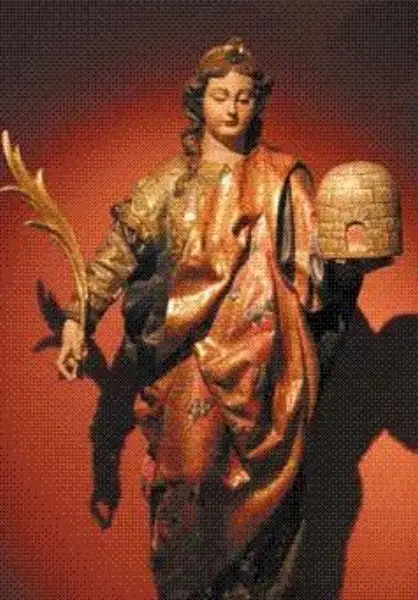
- cross·stake·dove
- Canonization
- Pre-congregation canonization; venerated as a saint from her death in 304, her cult attested by 350
Prayer
Bibliography
Show 6 sources
- Blackburn, Bonnie J.; Holford-Strevens, Leofranc (2000). "10 December". The Oxford Book of Days. Oxford: University Press. ISBN 978-0-19-866260-0.
- Collins, Roger (1998). Spain: An Oxford Archaeological Guide. Oxford: University Press. ISBN 978-0-19-285300-4.
- Dietz, Maribel (2005). Wandering Monks, Virgins, and Pilgrims: Ascetic Travel in the Mediterranean World, A.D. 300-800. Pennsylvania State University Press. ISBN 978-0-271-02677-0.
- Haliczer, Stephen (2002). Between exaltation and infamy: Female mystics in the Golden Age of Spain. Oxford: Oxford University Press. ISBN 0-19-514863-0.
- "CULTO, ORIGEN Y DIFUSIÓN. EULALIA DE MÉRIDA PALADÍN DE LA RECONQUISTA, PATRONA DE LAS ESPAÑAS" (in Spanish).
- Prudentius, Peristephanon, book 3.
Profile text adapted from the Wikipedia article, licensed CC BY-SA 4.0.
Pray with this saint every day
Save St. Eulalia of Mérida to your favorites, read the full profile, and get feast-day reminders in the Saints app.
Get the Saints AppFree on the App Store for iPhone and iPad