
died 608·Feast June 13
St. Eulogius of Alexandria
Patriarch and confessor of the Alexandrian see
Overview
Eulogius of Alexandria, a native of Syria, guided the Greek patriarchate of Alexandria from about 580 until his death on September 13, 608. Before his elevation he had been igumen of the Antiochene monastery dedicated to the Mother of God, and he brought to Egypt the disciplined theology of the Syrian monastic world. His long tenure on the Alexandrian throne coincided with the aftermath of the Chalcedonian controversies, and the sources present him chiefly as a controversialist and teacher: he wrote and acted against the various Monophysite parties, answered the Novatian communities that still lingered in his diocese, and upheld the union of Christ's two natures in one person against both Nestorian and Eutychian misreadings. A warm friendship bound him to Pope Gregory the Great, whose surviving letters to him are unusually affectionate, and the cardinal Caesar Baronius records that Gregory wished Eulogius might outlive him, recognizing in the patriarch the voice of truth. Of Eulogius's considerable literary output — eleven discourses defending Pope Leo I and the Council of Chalcedon, a commentary on the Monophysite sects, and a treatise against the Agnoetae — all but a single sermon and a few fragments have perished. He is honored as a saint on June 13.
The Complete Life
From an Antiochene Cloister to an Ancient Throne
Eulogius emerged from the monastic world of Roman Syria, and his first office in the church was that of igumen — the head — of the monastery of the Mother of God at Antioch, the city where the followers of Jesus had first been called Christians. This formation mattered for everything that followed. Antiochene monasticism was steeped in the Scripture and in the Christological debates that had shaken the east since the councils of Ephesus and Chalcedon, and the abbot of an important house was a man whose orthodoxy had been tested in public. Around the year 580 he was translated from Syria to Egypt, raised to the Greek patriarchate of Alexandria — some catalogs date his tenure from 581 — one of the most ancient and most troubled thrones of Christendom. The patriarch of Alexandria inherited, with his pallium, a city still divided over the reception of Chalcedon, and the choice of a Syrian monk known for doctrinal firmness was itself a statement. Eulogius held the see for close to thirty years, through the final decades of the sixth century and into the seventh, dying in office in 608.
§ Life
Defender of the Council of Chalcedon
The work that defined Eulogius's patriarchate was the defense of the church's confession that Jesus Christ is one person in two natures, fully divine and fully human. His diocese contained communities of Monophysites of several allegiances — Severans, Theodosians, Gaianites, and the Acephali — and he composed a commentary against these factions in their various phases. Within the imperial city itself ancient sects persisted, and he refuted the Novatians, whose rigorist communities still survived in his day. Against the extremes of both Nestorius and Eutyches he vindicated the hypostatic union, the teaching that the divine and human natures of Christ are united in one divine person. The centerpiece of this literary campaign was a set of eleven discourses written in defense of Pope Leo I, whose tome to Flavian had anchored the Chalcedonian settlement, and of the council that received it. He also wrote against the Agnoetae, a party that denied Christ's full human knowledge, and — a measure of the trust he enjoyed — submitted this work to Pope Gregory the Great before publishing it; the pope offered some observations but authorized it to appear unchanged.
§ Life
The Friendship of Two Shepherds
Among the most attractive features of Eulogius's career is his friendship with Pope Gregory the Great, the pope whose letters and sermons shaped the medieval church. The two corresponded, and Gregory's surviving epistles to the Alexandrian patriarch carry many flattering expressions of esteem and admiration — a remarkable thing, coming from a writer as chary of praise as Gregory. The friendship was not merely sentimental; it was a working alliance between two pastors who shared the same theological convictions and the same sense of the church's needs at the turn of the seventh century. Gregory consulted and was consulted; when Eulogius wished to publish his treatise against the Agnoetae he sent it first to Rome, and Gregory's authorization of the work unchanged shows how completely he trusted the patriarch's judgment. The cardinal Caesar Baronius later preserved a report that Gregory had wished Eulogius to survive him, recognizing in the Alexandrian the voice of truth. In an age when Rome and Alexandria had not always been at ease, the affection between these two bishops stands as a small monument to what orthodoxy joined to charity can accomplish.
§ Life
A Writing That Mostly Perished
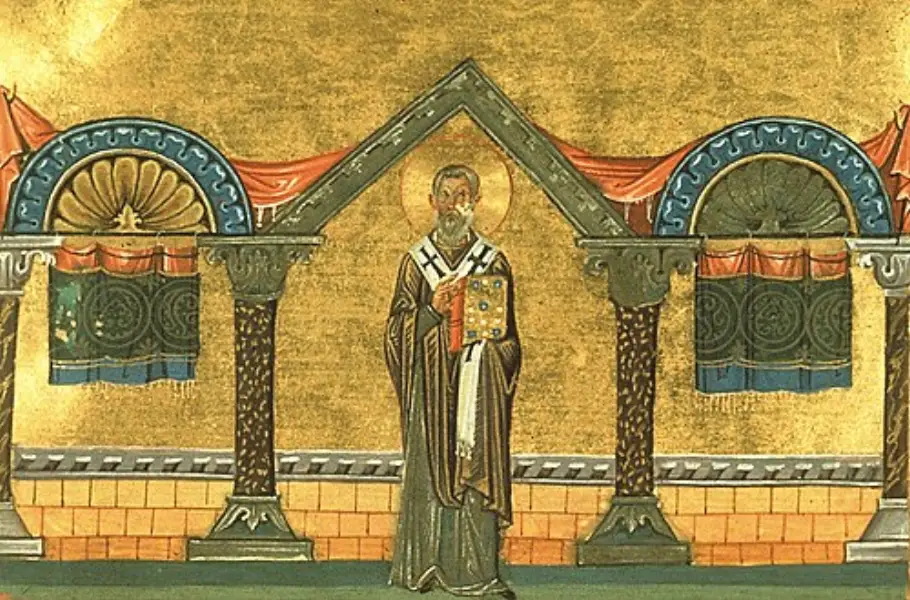
It has been said that Eulogius restored, for a brief period, life and youthful vigor to the church of Alexandria — a striking epitaph for a patriarch whose city was in doctrinal disarray and whose era preceded by a generation the Arab conquest of Egypt. Yet his literary legacy is almost entirely lost. Of the eleven discourses in defense of Leo and Chalcedon, of the commentary against the Monophysite parties, and of the treatise against the Agnoetae that Gregory had approved, nothing substantial remains: except for one sermon and a few fragments, all of Eulogius's writings have perished. What survives is his reputation. The Greek church reckoned him among its saints, the Roman church joined in his veneration, and the Roman Martyrology of 2004 keeps his name on June 13. The Menologion of Basil II, the great illustrated manuscript of the tenth and eleventh centuries, preserved a miniature of him that remains the customary image of the patriarch. He is remembered, finally, through his succession: the lists of the Greek patriarchs of Alexandria pass from John IV through Eulogius to Theodore I, a tenure bridging two centuries.
§ Life
Timeline
- 580
Around this year he became Greek Patriarch of Alexandria, having earlier been igumen of the Antiochene monastery of the Mother of God.
§ Introduction
- 607
Final year given for his tenure on the patriarchal throne in the article's succession table.
§ Life
- 13 Sep 608
Died at Alexandria on this date after roughly three decades governing the patriarchate.
§ Introduction
The Record
- Major works
- Eleven discourses defending Pope Leo I and the Council of Chalcedon·Commentary against the Monophysite sects — Severans, Theodosians, Gaianites, and Acephali·Treatise against the Agnoetae, approved unchanged by Pope Gregory I·Refutation of the Novatian communities of Alexandria
- Canonization
- Pre-congregation; venerated as a saint by the Catholic Church and the Eastern Orthodox Church
Prayer
Bibliography
Show 5 sources
- Martyrologium Romanum (2004). Vatican City: Administrationem Patrimonii Sedis Apostolicae in Civitate Vaticana, 2004, pp. 335–337. Retrieved 7 September 2026.
- Saint Eulogius, Archbishop of Alexandria. Orthodox Church in America (OCA).
- McNeal, Mark. St. Eulogius of Alexandria. The Catholic Encyclopedia, Vol. 5. New York: Robert Appleton Company, 1909.
- Eulogius (581–608). Official web site of the Greek Orthodox Patriarchate of Alexandria and All Africa. Archived from the original on 2021-01-19. Retrieved 2011-02-07.
- Gregory the Great. Epistles, Vol. VIII.30. Retrieved 27 Oct 2012.
Profile text adapted from the Wikipedia article, licensed CC BY-SA 4.0.
Pray with this saint every day
Save St. Eulogius of Alexandria to your favorites, read the full profile, and get feast-day reminders in the Saints app.
Get the Saints AppFree on the App Store for iPhone and iPad