
c. 819 – 859·Feast March 11
St. Eulogius of Córdoba
Martyr priest and chronicler of the Córdoba confessors
Overview
Eulogius of Córdoba was a priest, scholar, and martyr of the ninth-century church in Muslim Spain, put to death on March 11, 859, under the emirs Abd ar-Rahman II and Muhammad I, who ruled the city through the mid-ninth century. Born into a senatorial family that had held land at Córdoba since Roman times, he was educated at the monastery of St. Zoilus and under the celebrated master Speraindeo, was ordained by Bishop Reccafred and then given charge of the principal school of the Córdoban church. His friendship with the Latin writer Paulus Alvarus produced a celebrated scholarly partnership, and a journey to the monasteries of northern Iberia in 848 brought Augustine, Horace, Juvenal, and Virgil back to Andalusian libraries. When the emir's government turned from tolerance to persecution and Christians were imprisoned for speaking against Mohammed, Eulogius was jailed with the clergy of the city and read the Bible to his fellow prisoners. His writings preserve the lives of the martyrs of Córdoba from 848 to 859, and his Liber apologeticus contains the earliest known rendering of a Quranic verse in any language other than Arabic. In 859 he sheltered the convert Leocritia from her family; both were discovered, condemned, and beheaded. He had been chosen for the vacant see of Toledo but died before consecration.
The Complete Life
A Senatorial House of Old Córdoba
The date of Eulogius's birth cannot be fixed with certainty, but it must fall before the year 819, for by 848 he was already a priest of high standing among the Christians of Catalonia and Navarre, and holy orders were not conferred on men younger than thirty. His family belonged to the senatorial class and had possessed land at Córdoba since the Roman era. His mother, Isabel, oversaw the education of her children, and the saint and his five brothers received the schooling that befitted their rank. The family spread across the public and commercial life of occupied Andalusia: the youngest brother, Joseph, held high office in the palace of Abd ar-Rahman II; two others, Alvarus and Isidore, were men of commerce whose dealings reached deep into Central Europe. As for his sisters, Niola stayed at their mother's side, while Anulona was educated from infancy in a monastery and later took the veil there. The household thus illustrates the uneasy accommodation of ninth-century Spain, in which Christian families served the Muslim state, prospered in its markets, and still produced children for the church — in Eulogius's case, a son who would give his life for the faith of his fathers.
§ Early life
Priest and Schoolmaster of the Andalusian Church
Eulogius was formed in the monastery of St. Zoilus; he afterwards remained in the family home, partly to care for his aging mother and partly to pursue advanced study with the famous masters of the day, foremost among them Abbot Speraindeo, an illustrious writer of that generation. His virtue and learning marked him out, and on his ordination he was entrusted with Córdoba's foremost school for churchmen — a post from which he shaped the clergy of the Andalusian church in its hardest century. The decisive friendship of his life began in these years with Alvarus Paulus, a fellow student; together the two cultivated every branch of sacred and profane learning within reach, and the letters they exchanged, in prose and verse, grew into whole volumes, until the two friends — in a charming act of shared self-criticism — judged them too exuberant and unpolished and destroyed them. When Alvarus married, Eulogius chose the ecclesiastical path definitively and was ordained by Bishop Reccafred of Córdoba. In 848 he traveled north to the monasteries of Iberia, among them San Zacharias, from which he brought back texts of Augustine, Horace, Juvenal, and Virgil for the Christian schools of the south.
§ Career
Faith Under the Emirs
To understand Eulogius's mission one must understand the Córdoba of his century. The Moorish conquerors of southern Iberia had made the city their capital, and Christians lived there in a subaltern position, subject to a monthly tax yet allowed to keep their worship, their churches, and their property, yet a tribute was levied on every parish, cathedral, and monastery, and the levy could be raised at the ruler's pleasure — frequently, indeed, the survivors were made to cover the cost of burying their dead. In the great cities, Christians sometimes still observed the civil law of the Visigothic era, administered by a count presiding over a council of senators. Many of the faithful emigrated to northern Spain or took refuge in the monasteries of the sierras, and the Christian population dwindled. Under Abd ar-Rahman II the rulers' attitude hardened, and a fierce persecution broke out in which Christians found themselves charged with dishonoring Mohammed's memory, with trespassing in mosques, and with plotting against the state. Within this crisis Eulogius found his calling as chronicler and comforter: his extant writings preserve what mattered most in Iberian Christianity from 848 to 859, above all the lives of the martyrs of that persecution, of whom he could write that he had seen these terrible things and played a great part in them.
§ Background
Gentleness, Humility, and the Gift of Encouragement
Paulus Alvarus, Eulogius's friend and biographer, left an affectionate portrait of the man: a man of gentle and reverent character, deeply versed in Scripture, whose humility made him defer readily even to those who knew less than he did. His manner was pleasant, his kindness in relationships so constant that everyone regarded him as a friend. His chief charisma, in Alvarus's judgment, was the gift of encouragement, which as a priest in an occupied land he used to steady his friends in the face of danger. Two episodes display his humility concretely. In youth he resolved to make a walking pilgrimage to Rome, out of devotion to the tomb of the Prince of the Apostles — itself a sign of the tie between the Mozarabic church and the Roman see — but yielded to the counsel of prudent friends and gave up the journey. In 850, in the midst of the persecution, he read a passage of St. Epiphanius and resolved to pause, for a while, from celebrating the Eucharist, so as to give himself wholly to defending the martyrs' cause; his scruples were set aside at the request of Bishop Saul of Córdoba. Alvarus did not exaggerate: the saint's surviving writings bear out the portrait.
§ Character
Prison, Protection, and the Sword
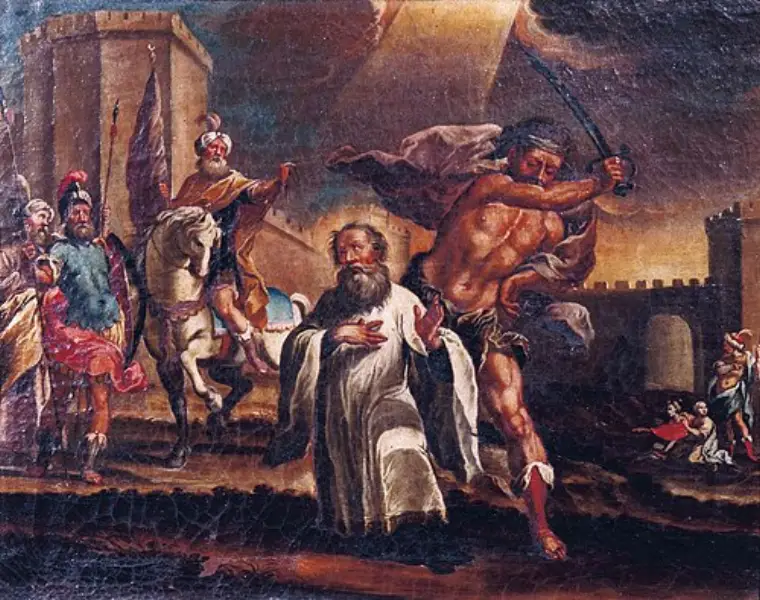
In 850 the persecution reached Eulogius himself: the Muslims jailed the bishop and priests of Córdoba, and in prison the saint read the Bible aloud to his companions, exhorting them to remain faithful. A decade later came the act that cost him his life. In 859 a young woman of noble Moorish family, Leocritia, was converted to Christianity and, fleeing the fury of her parents, sought his protection. Eulogius hid her for a time among friends, but the fugitives were eventually discovered, and all were condemned to death. On March 11, 859, he was beheaded; Leocritia followed him four days later, on March 15. Alvarus's life of the saint tells of a dove seen circling over the martyr's body, an image of the peacefulness and innocence that his persecutors could not kill. Eulogius had already been chosen to fill the vacant archiepiscopal see of Toledo, but he could never be consecrated, for his imprisonment preceded his execution. Thus the man who had chronicled the deaths of the Córdoba confessors ended among them, sealing with blood the account he had written in their honor.
§ Character
Writings, Relics, and a Feast
In his writings Eulogius bequeathed a flawless exposition of the orthodox doctrine he defended, the intellectual culture he propagated, and the imprisonments and sufferings he endured — a body of writing that follows St. Paul's exhortation to be an imitator of Christ. His Liber apologeticus, composed around 857, preserves what is reckoned the first presentation of the Quran in any tongue besides Arabic: a rendering of Sura al-Ahzab, verse 37, drawn from the Storia de Mahometh. His records of the martyrs of 848 to 859 remain the principal source for that generation of Spanish confessors. His relics, together with those of St. Leocritia, rest in a silver reliquary in the Cámara Santa of the Cathedral of Oviedo, where he is buried; the cathedral remains his principal shrine. The church fixed his feast on the day of his death, March 11, and both the Orthodox and Roman Catholic traditions honor him. Among the Christians of Córdoba his memory was inseparable from that of the friends he had defended in life and in writing — the community of martyrs whose stories would otherwise, humanly speaking, have been lost.
§ Career
Timeline
- 848
Toured the monasteries of northern Iberia, including San Zacharias, and brought texts of Augustine, Horace, Juvenal, and Virgil home to Córdoba.
§ Career
- 850
Was jailed with the bishop and clergy of Córdoba when persecution began, and read the Bible to fellow prisoners.
§ Character
- 850
Resolved to suspend saying Mass so as to defend the martyrs' cause, but yielded at Bishop Saul's request.
§ Character
- 857
Copied a verse of Sura al-Ahzab from the Storia de Mahometh into his Liber apologeticus, the earliest rendering outside Arabic.
§ Character
- 859
Took in the convert Leocritia, a noble Moorish maiden fleeing her parents; the fugitives were found and condemned to death.
§ Character
- 859
Was chosen for the vacant archiepiscopal see of Toledo but remained unconsecrated because of his imprisonment.
§ Character
- 11 Mar 859
Was beheaded at Córdoba; his biographer Alvarus records a dove flying above his body.
§ Character
- 15 Mar 859
Leocritia, the convert he had sheltered, followed him in martyrdom four days later.
§ Character
In Their Own Words
and those terrible things I saw, and in which I played a great part
The Record
- Major works
- Account of the martyrs of Córdoba, 848–859·Liber apologeticus, containing an early Latin rendering of Sura al-Ahzab 37·Memorial of the saints of Córdoba (Documentum martyriale tradition)
- Canonization
- Pre-congregation; honored as a martyr since his death in 859
Prayer
Bibliography
Show 8 sources
- Christys, Ann (2002). Christians in Al-Andalus, 711–1000. London: Psychology Press, pp. 52–53.
- Ghezzi, Bert. Voices of the Saints. Loyola Press. ISBN 978-0-8294-2806-3.
- Osuna, Manuel Garcia. Cordova. The Catholic Encyclopedia, Vol. 4. New York: Robert Appleton Company, 1908.
- Fita y Colomé, Fidel. St. Eulogius of Cordova. The Catholic Encyclopedia, Vol. 5. New York: Robert Appleton Company, 1909.
- Shea, John Gilmary. Little Pictorial Lives of the Saints. Benziger Brothers, New York, 1894.
- Butler, Alban. Lives of the Saints. Benziger Bros., 1894.
- Hoever, Hugo, ed. (1949). Lives of the Saints: For Every Day of the Year. New York: Catholic Book Publishing Co., p. 104.
- Tolan, John. Medieval Christian Perceptions of Islam. New York: Routledge, 2000. ISBN 0-8153-1426-4.
Profile text adapted from the Wikipedia article, licensed CC BY-SA 4.0.
Pray with this saint every day
Save St. Eulogius of Córdoba to your favorites, read the full profile, and get feast-day reminders in the Saints app.
Get the Saints AppFree on the App Store for iPhone and iPad