
7th century (some sources say 3rd)·Feast September 18
St. Eumenes
Bishop of Gortyna in Crete and wonderworker
Overview
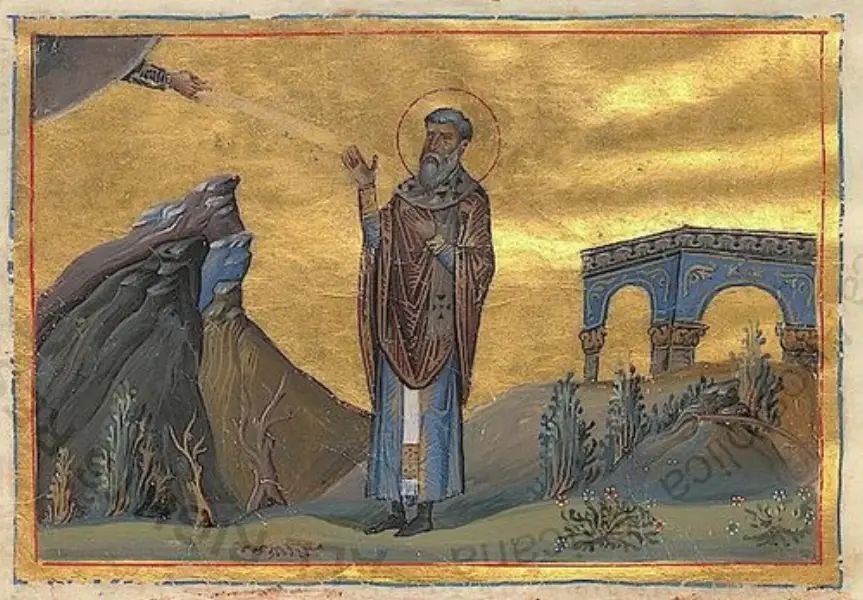
Eumenes, in the Greek tradition Hagios Eumenis, was bishop of Gortyna in Crete, remembered as a wonderworker and honored on 18 September by the Orthodox church. Most sources place him in the seventh century, though some put him as early as the third. While still a young man he gave away his wealth and embraced the ascetic life, and his virtue led to his election to the episcopal throne of Gortyna, the ancient metropolitan see of the island. The Synaxarion and the tradition of the church attach to him a series of celebrated miracles: he destroyed a venomous snake, expelled demons from the afflicted, and cured the sick, wonders said to have been worked at Gortyna itself, in the city of Rome, and in the Thebaid of Egypt. His life ended in exile in the Thebaid, far from the Cretan see he had governed, and the church keeps his memory on 18 September, styling him in the Greek menologia the wonderworking bishop of Gortyna.
The Complete Life
Life
Eumenes belonged to the church of Crete, and the sources disagree about the century of his life, the majority setting him in the seventh while some traditions reach back to the third. What the oldest accounts agree on is the shape of his vocation: in his youth he renounced his possessions, a renunciation that marked him out for the ascetic path and, in time, for the episcopate. The church of Gortyna, the ancient capital and metropolitan see of the island, chose him as its bishop, and in that office his reputation for sanctity was sealed by works of power attributed to his prayers.
§ Introduction
Miracles
The memory of Eumenes in the Orthodox church is above all that of a healer and exorcist. The Synaxarion records that he killed a venomous snake, drove demons out of those they possessed, and cured the sick. His wonders are said not to have been confined to his Cretan see: the same tradition locates miracles worked by him at Gortyna, in the city of Rome, and in the Thebaid, the desert region of upper Egypt whose monasteries sheltered so many holy men of the early church.
§ Introduction
Death and Veneration
The close of Eumenes's life came in exile: he died in the Thebaid of Egypt, far from Crete and the flock he had governed. The circumstances of his banishment are not preserved, but the place of his death joined him to the long line of confessors associated with the Egyptian desert. His feast is kept on 18 September, and the Greek Synaxariste and the calendar of the Orthodox Church in America both commemorate him on that day as bishop of Gortyna and wonderworker.
§ Introduction
Timeline
- 650
As a young man he distributed his riches to the poor and took up the ascetic life; most sources place his career in the seventh century, while a minority date it to the third.
§ Introduction
- 660
Chosen bishop of Gortyna, the metropolitan see of Crete; his fame as a healer spread, and he is recorded to have killed a venomous snake, driven out demons, and healed the sick.
§ Introduction
- 670
Worked wonders beyond his island, at Gortyna, in Rome, and in the Thebaid of Egypt, where he died in exile.
§ Introduction
The Record
- Major works
- Miracles recorded of him: the destruction of a venomous snake, the expulsion of demons, and the healing of the sick·Honored in the Great Synaxaristes as the wonderworking bishop of Gortyna
- Patron of
- Diocese of Gortyna and the church of Crete·Those delivered from evil spirits
- Symbols
- Episcopal vestments·Serpent beneath his feet, in memory of the venomous snake
- Canonization
- Pre-congregation; venerated in the Orthodox Church
Prayer
Bibliography
Show 2 sources
Profile text adapted from the Wikipedia article, licensed CC BY-SA 4.0.
Pray with this saint every day
Save St. Eumenes to your favorites, read the full profile, and get feast-day reminders in the Saints app.
Get the Saints AppFree on the App Store for iPhone and iPad