
6th century·Feast February 1
St. Euny
Cornish patron of Lelant and Redruth
Overview
Saint Euny, whose name was long written Uny, was a sixth-century evangelist of west Cornwall and remains the patron of the churches of Lelant and Redruth and joint patron of Crowan. The earliest surviving account of him comes from William Worcester, who toured Cornwall in 1478 and recorded that St Uny, the brother of St Herygh, lay buried at the parish church near Lelant and that his feast was kept on the first of February. Worcester also reports the family tradition of the Cornish saints: Euny and Herygh, patron of St Erth, were brothers of St Ia, the Irish princess who evangelized part of Cornwall and gave her name to St Ives. Lelant, then an important port at the northern end of the land crossing to St Michael's Mount, was the center of Euny's missionary labor and the focus of his cult after his death; Redruth's church stands below Carn Brea, whose prehistoric settlement suggests a chieftain's capital, and the siting of the church hints that Euny won the local ruler to the faith and was granted the ground. Holy wells bearing his name survive across the far west, and two Breton parishes may preserve his memory in their names.
The Complete Life
A Brother Among the Cornish Saints
Euny belongs to the group of holy men and women whom tradition makes the first evangelists of Cornwall. William Worcester, traveling in the county in 1478, recorded the family into which the saint was born: Euny and Herygh were brothers, and their sister was St Ia, the Irish princess who crossed to Cornwall and evangelized part of it, leaving her name on St Ives. Herygh in turn was remembered at St Erth. Whether the kinship is biological or the fiction of a common mission is a question the sources do not settle, but the tradition binds the three cults together from an early date. Of Euny's own call and formation nothing is recorded; he appears in history only through the places that kept his name. That silence is itself informative, for it belongs to a generation of Celtic evangelists whose work was remembered locally in church dedications, wells, and parish feasts rather than in written lives. The memory of such missionaries lived where they had preached, and in west Cornwall the place that remembered Euny most strongly was Lelant. What can be recovered of him, therefore, is not a biography but a map: a harbor at one end of a portage, a church beneath an ancient stronghold, a feast on the first of February, and a brother and sister whose own cults grew up within sight of his.
§ Life
Lelant, Redruth, and the Chieftain of Carn Brea
Lelant was the center of Euny's missionary work and, after his death, the focus of his cult. In the early middle ages it commanded the brief overland route to St Michael's Mount and served as a busy port, a hinge of travel and trade between the Channel and the Atlantic; a church planted there served a whole network of coastal communication. Some twenty miles inland the church of Redruth stands below Carn Brea, a granite hill crowned by the remains of a prehistoric town that must have been the capital of the surrounding district two thousand years ago. The collocation of church and ancient stronghold has suggested to students of the Cornish church that Euny was able to convert the chieftain of that land, who then granted the site for the church — the familiar pattern by which a mission took root when a ruler yielded. He is also the joint patron of Crowan, and in all three parishes the feast has been kept on the Sunday nearest February 1, the day William Worcester recorded for the saint in 1478, when he found the missionary buried at the parish church that bears his name near Lelant.
§ Life
Wells, Wayside Chapels, and Two Breton Parishes
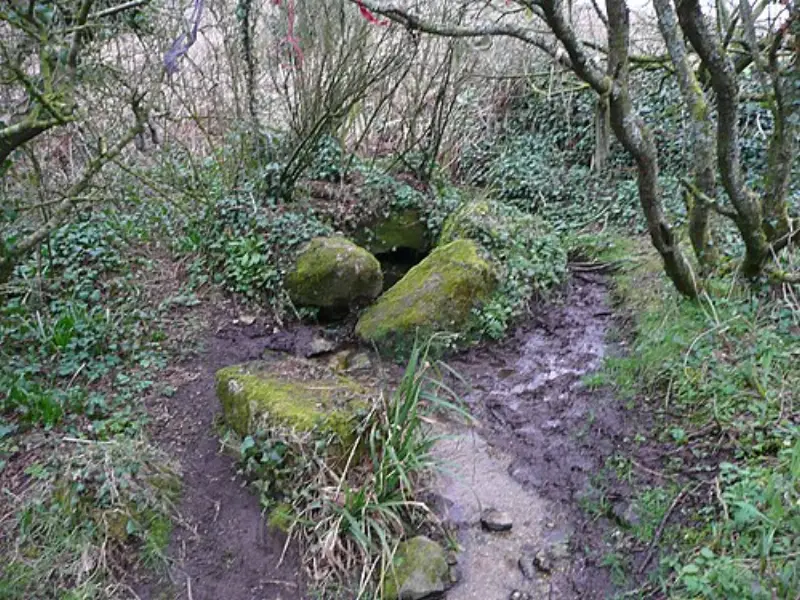
Euny's name clings to the landscape of the far west long after the circumstances of his life were forgotten. Several holy wells are dedicated to him across west Cornwall, most famously the spring and chapel bearing his name at Sancreed, together with a well at St Buryan — water sources whose dedication marks the saint as the Baptizer's servant in the districts he evangelized. In the parish of Wendron Marooney farm — which appears in the records of 1751 as Mertharuny and in 1756 as Metheruny — keeps in its very name the memory of a merther, a martyr-field or consecrated burial ground: in a rounded enclosure that locals call the churchyard, where excavation has turned up human bone, stand the remains of a small chapel beside a magnificent Celtic cross of enriched and original design. The chapel marks a very ancient church in Euny's honor, allowed to decay after the Reformation. Even abroad his name may survive: the Breton parishes of Plevin and Plouyé the philologist Joseph Loth read as preserving those of Euny and Ia, as though the Cornish mission sent memory, if not missionaries, across the Channel. At Truro Cathedral an honorary canon's stall of St Euni keeps his title in the church of Cornwall today.
§ Legacy
Timeline
- 500
Evangelizes west Cornwall in the sixth century, with Lelant as the center of his missionary work
§ Life
- 1478
William Worcester records Euny's burial at Lelant and his February 1 feast, giving the first written form of the name Uny
§ Life
- 1550
The spelling Uny comes into general use from the middle of the sixteenth century, though Euny is the older form
§ Life
- 1751
The Wendron farm later called Marooney is recorded as Mertharuny, marking the site of an ancient chapel of St Euny
§ Legacy
- 1756
The same farm appears in documents as Metheruny, a variant of the name preserving the saint's memory
§ Legacy
The Record
- Patron of
- Patron saint of Lelant·Patron saint of Redruth·Joint patron of Crowan
- Canonization
- Pre-congregation saint of the Celtic church
Prayer
Bibliography
Show 2 sources
- Doble, Gilbert H. (1960). The Saints of Cornwall, part 1. Truro: Dean and Chapter, pp. 79–88, 97–99, 70–86.
- St Euny Feast. Kernow Bys Vyken!.
Profile text adapted from the Wikipedia article, licensed CC BY-SA 4.0.
Pray with this saint every day
Save St. Euny to your favorites, read the full profile, and get feast-day reminders in the Saints app.
Get the Saints AppFree on the App Store for iPhone and iPad