
died 303·Feast September 16
St. Euphemia
Great martyr of Chalcedon, all-praised
Overview
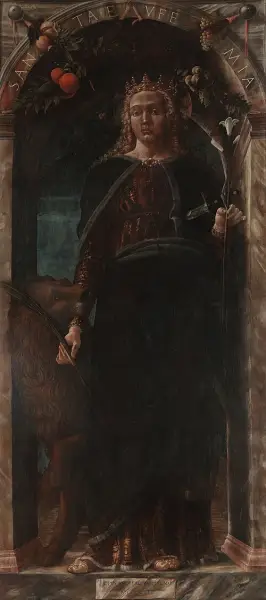
Euphemia — her name means well-spoken-of, and in the East she is called the Great Martyr, the All-praised — was killed for her faith at Chalcedon in the year 303, which opened Diocletian's assault on the church. Her name and the year of her death stand in the fifth-century Martyrologium Hieronymianum, the earliest surviving list of the church's martyrs, and the Fasti vindobonenses fix the day as October 16; beyond this, no verifiable historical information about her exists, yet her cult became one of the most celebrated in Christendom. Tradition remembers her as a young woman of Chalcedon, on the Asiatic shore of the Bosporus, consecrated to virginity from her youth, who refused the governor's command to sacrifice to Ares. Arrested with forty-nine fellow Christians at worship, tortured, and at last condemned to the beasts in the arena, she died from a beast's blow, which the accounts describe as a merciful end. Pilgrims came to her tomb, the church built over her relics housed the Council of Chalcedon in 451, and a famous legend tells how, from her tomb, she ratified the council's confession. Her relics rest today chiefly in the Patriarchal Cathedral of St. George in Istanbul, and East and West keep her feast on September 16.
The Complete Life
A Daughter of Chalcedon
The historical record of Euphemia is a narrow one, and what is known of her youth comes entirely from the hagiographical tradition. Her name and the year of her death are entered in the Martyrologium Hieronymianum of the fifth century, the earliest list of Christian martyrs now extant, and the Fasti vindobonenses — liturgical records compiled between the fourth and sixth centuries — fixes her death on October 16 — in the year 303, the opening year of the Great Persecution under Diocletian. Everything beyond this belongs to the legend that grew around a famous tomb. The story tells of a family of standing in Chalcedon, the city across the Bosporus from Byzantium: her father a senator named Philophronos, her mother Theodosia, and a daughter given to God from her earliest years, for from her youth she was set apart in consecrated virginity. The hagiographers of the Golden Legend and the eastern synaxaria would elaborate the account; the kernel they preserve is of a young Christian woman of Chalcedon whose virginity and whose confession of Christ proved inseparable when the trial came.
§ Hagiography
Refusal Before the Altar of Ares
The crisis of Euphemia's life came when Priscus, governor of Chalcedon, decreed that every inhabitant of the city must take part in sacrifices offered to the god Ares. At the very time of the decree, Euphemia was found in the company of forty-nine fellow believers, assembled for worship in a private house against the governor's command. Because they refused to sacrifice, all fifty were tortured over a number of days; then all except Euphemia were sent on to the emperor for trial. She alone — the youngest of the company — was kept behind and subjected to torments of exceptional cruelty, among them the wheel, the instrument on which the executioners hoped to break her spirit. The tradition presents her response as prayer rather than protest: she prayed, and accepted death for her Christian faith. The scene, as the hagiography frames it, sets a single young woman against the whole apparatus of civic religion; her companions are taken from her, and the choice left to her is between incense and agony. She chose agony, and her endurance became the reason Chalcedon remembered her above all its other martyrs.
§ Hagiography
Mercy in the Arena
Condemned to die in the arena among wild beasts, Euphemia received the blow that ended her life from one of the animals set upon her — the accounts differ, some naming lions and others a bear. The hagiographers record a detail they found decisive: the beast struck her down quickly yet would not mutilate her remains, a restraint the hagiographers read as testimony to the universal resurrection of the flesh. She died on October 16, 303, according to the western calendars, and her tomb at Chalcedon became a goal of pilgrimage while the memory of the persecution was still fresh. The pilgrim Egeria, traveling the East about 381 to 384, records being shown the site of the martyrdom at Chalcedon — evidence that within a lifetime of the last great persecution the place of her death had already become a monument. Stories continued to gather: the Golden Legend of about 1260 carries her passio to the medieval West, and iconographers from Ravenna to Rovinj portrayed her with the lions and the wheel that the tradition gave her. The date, the place, and the pilgrim's itinerary are the three hard facts; everything else in her story is the growth of devotion around a death the church never forgot.
§ Hagiography
Feasts of a Martyr and Her Miracle
Euphemia's veneration is among the widest in Christianity, honored across the Catholic, Eastern Orthodox, Oriental Orthodox, and Anglican traditions. The principal feast, kept by East and West alike, falls on September 16 and commemorates her martyrdom. The Coptic Orthodox church keeps her on Abib 17, corresponding to July 11, and the Eastern Orthodox church keeps the same day, July 11, for a different reason: the anniversary of the miracle said to have occurred at the Council of Chalcedon. According to the Synaxarion of Constantinople, during the fifth-century controversies the Chalcedonian and non-Chalcedonian parties each wrote a confession of faith and laid the documents on the breast of the saint within her tomb; when the tomb was opened after three days, the scroll holding the Chalcedonian confession lay in her right hand and the other at her feet. The Oriental Orthodox churches contest the account as a late legend — the Synaxarion was not published until the eleventh century, and the council's own letter to Pope Leo mentions Euphemia without any miracle — but the feast remains fixed in the Orthodox calendar. Churches in her honor stand in many lands, including the Church of the Holy Martyr Euphemia in Istanbul.
§ Veneration
The Tomb That Held a Council and Outlived Empires
After her death, Christians gathered Euphemia's remains and kept them in a reliquary in a church raised in her honor at Chalcedon. That church became, in 451, the meeting place of the Council of Chalcedon — the assembly of more than five hundred bishops whose definition of the two natures of Christ remains the shared confession of East and West, and whose fathers could look upon the martyr's tomb as they deliberated. In 617 the Sasanian conquest of Chalcedon put the shrine in peril, and around 620 the relics were moved to a new church in Constantinople. There, during the Byzantine Iconoclasm, her reliquary was, by report, hurled into the sea; the brothers Sergios and Sergonos, shipowners loyal to the Orthodox cause, drew it out again and gave it to a bishop who hid it in a secret crypt; the relics were later taken to the island of Lemnos and in 796 returned to Constantinople. The majority remain in the Patriarchal Cathedral of St. George in Istanbul today. A reliquary believed to hold her head and body stood by 1479 in the Church of St John of the Collachium of the Knights Hospitaller on Rhodes, and the Croatian town of Rovinj keeps a church and sarcophagus in her name.
§ Relics
Timeline
- 16 Oct 303
Died a martyr at Chalcedon on this date, in the first year of Diocletian's Great Persecution, per the Fasti vindobonenses.
§ Historical background
- 381
The pilgrim Egeria, traveling about 381 to 384, was shown the place of her martyrdom at Chalcedon.
§ Historical background
- 451
The Council of Chalcedon held its sessions in the church that housed her remains.
§ Relics
- 617
The Sasanian Empire captured Chalcedon, putting her shrine there in danger.
§ Relics
- 620
Around this year her relics were moved to a new church in Constantinople after the conquest.
§ Relics
- 796
After time on Lemnos, her relics were brought back to Constantinople.
§ Relics
- 1260
The Golden Legend, assembled about this time, included an account of her martyrdom.
§ Historical background
- 1479
A reliquary said to contain her head and body stood in the Knights Hospitaller church on Rhodes by this year.
§ Relics
The Record
- Symbols
- surrounded by one or a few lions·holding a wheel·holding a cross
- Canonization
- Pre-congregation martyr, venerated since the fourth century
Prayer
Bibliography
Show 7 sources
- Castelli, Elizabeth A. (July 15, 2000). Chapter 39: Asterius of Amasea, Ekphrasis on the Holy Martyr Euphemia. In Valantasis, Richard (ed.), Religions of Late Antiquity in Practice. Princeton University Press, p. 464. ISBN 978-0691057507.
- St. Euphemia the All-Praised. Antiochian Orthodox Christian Archdiocese. Archived from the original on 2018-02-08. Retrieved 2026-09-16.
- Great Martyr Euphemia the All-praised. Orthodox Church in America (oca.org). Retrieved 2026-09-16.
- Record. The Cult of Saints, csla.history.ox.ac.uk. Retrieved 2026-09-16.
- Church of St. Euphemia. The Byzantine Legacy. Retrieved 2026-09-16.
- Catholic Encyclopedia: Council of Chalcedon. New Advent. Retrieved 2026-09-16.
- Zoitou, Sofia (2021). Staging Holiness: The Case of Hospitaller Rhodes (ca. 1309–1522). Mediterranean Art Histories, Vol. 3. Leiden: Brill, pp. 25–26. ISBN 97890-04444225.
Profile text adapted from the Wikipedia article, licensed CC BY-SA 4.0.
Pray with this saint every day
Save St. Euphemia to your favorites, read the full profile, and get feast-day reminders in the Saints app.
Get the Saints AppFree on the App Store for iPhone and iPad