
380 – 410·Feast March 13
St. Euphrasia of Constantinople
Virgin nun of the Thebaid at the imperial court's edge
Overview
Euphrasia, also called Eupraxia, was born at Constantinople in 380 and died in the Thebaid of Egypt on March 13, 410, a nun whose life joined the highest circles of the imperial capital to the earliest tradition of Egyptian monasticism. Her father Antigonus, a nobleman related to Emperor Theodosius I, died while she was a child, and her mother brought her to Egypt and made their home beside a convent of one hundred and thirty nuns, in the desert region where monastic life had first flourished within living memory of Anthony the Great. At the age of seven the girl begged to take vows, consecrating herself to Christ before the abbess; soon afterward her mother died, and the emperor, who had promised the orphan in marriage to a young senator, sent for her. She answered by letter, declining the marriage and asking instead that her estate be sold for the poor and her slaves set free. The emperor granted her request shortly before his death in 395. For the rest of her short life she practiced obedience, meekness, and hidden charity in the monastery, famously carrying heavy stones as a labor against temptation. She was thirty when she died, and the church venerated her as a saint.
The Complete Life
An Orphan of the Golden City
Euphrasia was born at Constantinople in the year 380, the only daughter of Antigonus, who served at the court of Theodosius the Great and counted the emperor among his kin, and of his wife, also named Euphrasia. She lost her father in early childhood, and the widow, withdrawing from the capital, carried her daughter off to Egypt and made their home next door to a convent of one hundred and thirty nuns. The choice of country was deliberate and timely: less than a century had passed since Anthony the Great had established his first monastery, and the monastic movement, once a solitary experiment on the Nile, had spread with astonishing speed through the deserts of Egypt. In that landscape the little girl from the palace grew up within sight of a community wholly given to prayer. An alternative telling of her life places her instead in the court of Theodosius, raised amid imperial luxury until her mother entered the monastery and the child followed her there. In either version the pattern is the same: the daughter of the eastern aristocracy exchanged the court of the most powerful Christian emperor for the enclosed life of Egyptian nuns.
§ Life
A Vow at Seven Years Old
When she was seven, Euphrasia began begging to be admitted to vows and to share the nuns' life of the monastery near which she lived. The account of her presentation has been cherished precisely because of its childhood simplicity: when her mother brought her before the abbess, the girl took up an image of Christ, kissed it, and said, By vow I consecrate myself to Christ. Her mother answered with a prayer that the tradition has kept as the model of a parent's surrender of a child: Lord Jesus Christ, hold this child beneath your watchful care; you are the one she loves and seeks; into your hands she commends herself. The abbess received the child, and before long the mother fell ill and died, leaving the seven-year-old wholly to the house she had chosen. A different version of the story says her mother had already become a nun and the child joined her there. In both tellings the vow of the little girl is the hinge of the life, and the emperor's later guardianship never displaced it: the promise made to Christ at seven outlasted every plan made for her at court.
§ Life
Stones Against Temptation
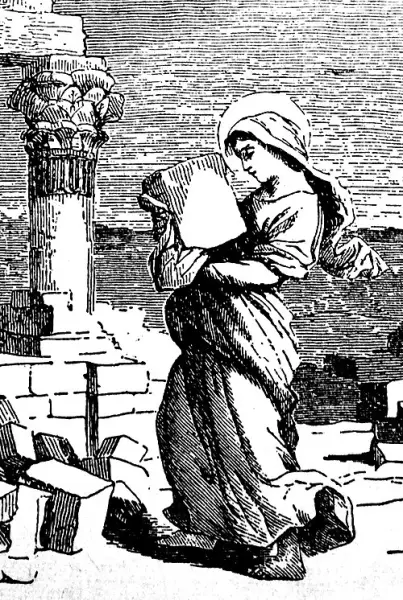
The emperor Theodosius — in the alternative version, his successor Arcadius — had promised the orphaned Euphrasia in marriage to a young senator, and summoned her for that purpose. Her reply has become the most-quoted act of her life: a letter declining the match and asking instead that her property be liquidated for the relief of the poor and her slaves released from bondage. The emperor did as she asked, shortly before his own death in 395, and the child of the court was thereby stripped of everything but her vow. Within the monastery she was known for humility, meekness, and charity. Her abbess, watching over her struggles, gave her a counsel that became her signature practice: when burdened with temptation, she should take up manual labor. Obediently she hauled heavy stones from spot to spot — on one occasion keeping the work up for thirty days straight. The discipline was not self-punishment but prayer made physical — a way of turning restless struggle into service. The image of the small nun bearing her stones has made her, for later generations, a patron of those who fight temptation with humble work.
§ Life
Thirty Years and a Quiet Death
Euphrasia's life closed in 410, when she was only thirty years old, still in the Thebaid where she had spent her whole monastic life. The date of her death fell in the same year in which Alaric's Goths entered Rome — a coincidence the sources do not remark, but one that places her quiet ending at the hinge of an age, in the last years of the world whose structures had formed her family. The Roman Martyrology commemorates her with the brief formula proper to the desert saints: In the Thebais, the death of Saint Euphrasia, virgin. Of her last illness and her deathbed nothing is recorded; the tradition preferred to remember instead the vision her abbess reported before the end, in which the young nun seemed already carried up to the throne of God and surrounded by angels. She had entered the monastery as a child of seven and died before she reached middle age, yet the span of her life had contained, in the judgment of the church that venerated her, everything necessary for sanctity: a vow kept, a fortune renounced, obedience practiced, and labor offered in the hidden places of the desert.
§ Life
Enrolled Among the Virgins
The veneration of Euphrasia followed quickly upon her death, for the church of her age honored as saints those whose lives had been conspicuously conformed to the gospel without any formal process of canonization. The Roman Martyrology preserves the notice of her death in the Thebaid, and western calendars kept her memory for centuries: the Roman Martyrology as reformed after the Second Vatican Council assigns her feast in the West to July 24, while the traditional Roman Catholic date recorded for her is March 13, and the Eastern churches celebrate her on July 25. She stands in the Catholic Church's company of consecrated virgins, and the Orthodox Church in America commemorates her as St. Eupraxia, virgin, of Tabenna — a dedication that links her to the monastic federation founded by Pachomius on the upper Nile. No cult, relics, or great shrine gathered around her name; her canonization rests entirely on the life as the tradition received it, a testimony that the desert church counted holiness, not monuments, as the fitting memorial of its dead. Her persistence in the calendars is itself a small history of how such saints traveled: recorded first in the desert, carried west in collections like Shea's Little Pictorial Lives, catalogued by the learned Kirsch in the Catholic Encyclopedia, and kept alive in the East by the synaxaria of the Orthodox churches.
§ Veneration
Signs and Wonders Remembered
The tradition that carried Euphrasia's memory attached to her name the works of mercy that the desert expected of its saints: she was said to work miracles both before and after her death. Among the wonders recounted of her are the healing of a child who was deaf, dumb, and crippled, and the deliverance of a woman possessed by the devil — works that in the hagiographical convention mark the Virgin not as a wonder-worker by ambition but as one through whom the power of God visited the poor. After her death the veneration of the monastery centered on the vision her abbess had reported: Euphrasia transported to the throne of God and surrounded by angels, an image that confirmed for her sisters the hidden glory of the life she had led among them. Through the centuries her story traveled in the collections that carried the desert fathers to later ages — the Little Pictorial Lives of the Saints, the Catholic Encyclopedia, and the Orthodox synaxaria — and she remains one of the few saints whose biographies place a woman of the eastern court at the very springs of Egyptian monasticism, a bridging of two worlds remembered each year on her feast.
§ Veneration
Timeline
- 380
Is born at Constantinople, the only child of the court nobleman Antigonus and his wife Euphrasia
§ Life
- 387
At the age of seven begs to take vows and consecrates herself to Christ at the Egyptian monastery
§ Life
- 395
Declines marriage to a senator by letter; her estate is sold for the poor and her slaves manumitted at her request, shortly before the emperor's death
§ Life
- 13 Mar 410
Dies in the Thebaid at the age of thirty
§ Life
In Their Own Words
By vow I consecrate myself to Christ.
Lord Jesus Christ, receive this child under your special protection. You alone doth she love and seek: to you doth she recommend herself.
The Record
- Canonization
- Pre-congregation; venerated as a saint after her death for her piety and charity
Prayer
Bibliography
Show 5 sources
- Shea, John Gilmary (1925). Little Pictorial Lives of the Saints. New York: Benziger Brothers, pp. 163–164.
- St. Euphrasia. Catholic Online. Retrieved June 2, 2010.
- March 13. The Roman Martyrology. Confraternity of Ss. Peter & Paul. Archived from the original on October 30, 2010. Retrieved June 2, 2010.
- St. Eupraxia, Virgin, of Tabenna. Orthodox Church in America. Retrieved June 2, 2010.
- Kirsch, Johann Peter (1909). St. Euphrasia (Eupraxia). The Catholic Encyclopedia, Vol. V. Robert Appleton Company. Retrieved June 2, 2010.
Profile text adapted from the Wikipedia article, licensed CC BY-SA 4.0.
Pray with this saint every day
Save St. Euphrasia of Constantinople to your favorites, read the full profile, and get feast-day reminders in the Saints app.
Get the Saints AppFree on the App Store for iPhone and iPad