
1st century·Feast May 15
St. Euphrasius of Illiturgis
Missionary Bishop Among the Seven Apostolic Men of Spain
Overview
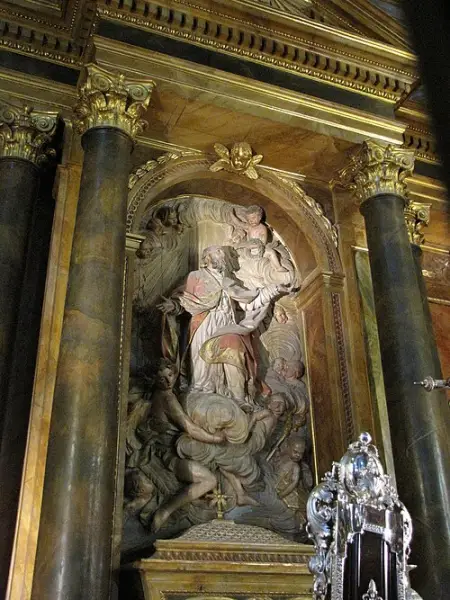
Euphrasius of Illiturgis, called San Eufrasio in Spanish, belongs to the founding generation of Spanish Christianity. Tradition numbers him among the Seven Apostolic Men, the seven clerics whom Saints Peter and Paul ordained in Rome and dispatched to preach the Gospel across Spain; his assigned field was the town of Illiturgis, set in the hills between Bailén and Andújar in what is now the province of Jaén. There he labored as missionary and bishop, and there, according to the same tradition, he shed his blood for the faith in the first century. His cult followed his relics on a long journey: in the seventh century the Visigothic king Sisebut built a church over his grave at Illiturgis, and when the Moorish armies overran Spain in the eighth century his remains were carried north to the valley of the Mao River in Galicia, where they rest in the church of Santa María do Mao near the monastery of San Xulián de Samos. A secondary translation carried his name to Corsica, where he is honored as patron of Ajaccio, and the diocese of Jaén guards a relic and a rich cycle of legend connecting him with Our Lady of Cabeza. He is patron of the diocese of Jaén and of Andújar, with a feast on May 15.
The Complete Life
Ordained by Peter and Paul
The Spanish church loved to trace its beginnings to a single dramatic moment, and in that moment Euphrasius stands. According to a tradition of great antiquity, seven men were ordained to the episcopate in Rome itself by the Apostles Peter and Paul and sent out together to sow the Gospel through the provinces of Spain. The company is remembered as the Seven Apostolic Men — the siete varones apostólicos — and their names are still recited in the liturgical books: Hesychius, Ctesiphon, Torquatus, Indaletius, Secundius, and Euphrasius among them. Each was assigned a different city, and to Euphrasius fell Illiturgis, an ancient Iberian-Roman town standing on the road between Bailén and Andújar, in the hill country of upper Andalusia. Whether the seven were historical disciples of the Apostles or a devotional figure for the earlier, undocumented preaching of the faith in Spain, their cult is at least as old as the Mozarabic liturgy, which kept their common feast for centuries. What the tradition asserts with the church's full voice is this: that the faith of Jaén is apostolic in origin, planted by a man sent for the purpose at the cost of everything he had, and that Euphrasius was that man.
§ Introduction
Bishop of a Frontier Town
Illiturgis became Euphrasius's diocese and his destiny. The town, whose ruins lie between Bailén and Andújar, had been a stronghold in the wars of Rome and a bishopric in the age of the martyrs, and it was there that the tradition fixes both his pulpit and his tomb. To preach in the first century in the Spanish interior was to labor without letters, without successors guaranteed, without any assurance that the little churches gathered in a hostile world would outlive their founders — and yet the diocese that claims him, Jaén, has kept the faith without interruption for two thousand years, an answer to his labor more eloquent than any chronicle. The memory of his pastoral office is preserved in his iconography: he is shown in episcopal attire, the bishop among the seven, and the diocese of Jaén venerates him as its own. Alongside the sober history runs a vein of beloved legend. The people of Jaén tell of the kerchief preserved in a chapel situated behind the high altar of Jaén's cathedral, awarded him, so the tale runs, after he vanquished Satan on a miraculous journey to free the Pope from temptation — a journey made, with the help of a captive goblin and some leftovers from supper, in the space of half an hour.
§ Introduction
The Virgin of the Mountain
The tenderest strand of Euphrasius's cult binds him to Our Lady of Cabeza, the dark image of the Virgin venerated on the mountain above Andújar, one of the great Marian shrines of Spain. The legend tells that when Euphrasius set out from Rome for his Spanish diocese he carried with him an image of the Mother of God, to which he gave his own devotion along the roads. That image, the tradition continues, was no ordinary painting: it had been given to Euphrasius by Saint Peter himself, and it was the very portrait that Saint Luke had painted from the living face of the Virgin. Whether or not any picture could carry such a pedigree, the legend declares what the people of the Sierra Morena believed about their apostle — that he came among them not as a stranger but as a servant of the Lord's Mother, bringing her with him to guard the church he planted. The brotherhood of the Virgen de la Cabeza keeps the memory to this day, and the shrine on the mountain remains one of the destinations of Andalusian pilgrimage. Through this devotion the first century touches the present: the apostle's love for Mary has outlasted empires, languages, and the town where he first preached it.
§ Veneration
Martyrdom and the First Tomb
The tradition of the Spanish church is unanimous that Euphrasius ended his apostolate as a martyr, put to death at Illiturgis in the first century for the faith he had preached there. His grave became the center of his cult, and for six centuries the faithful of the region prayed at the sepulcher of the apostle of their hills. In the seventh century the Visigothic king Sisebut — a king remembered as much for his church-building as for his severity — raised a proper basilica over the saint's resting place, an act of royal piety that fixed Illiturgis as a pilgrimage site of the Visigothic church. The communal feast of the Seven Apostolic Men, Euphrasius among them, was kept in the Mozarabic liturgy, the ancient Spanish rite that survived even the transformations of later centuries. When the Moorish conquest swept through Spain in the eighth century and Illiturgis lay in the path of the armies, Christians carried the saint's relics north to safety in Galicia. The flight of 711 stripped Andalusia of its founding martyr but saved him for the church: in the green valley of the Mao River, in the province of Lugo, the bones of the apostle of Jaén found a second home from which his cult would radiate across half of Europe.
§ Veneration
Galicia, Corsica, and Jaén
From his refuge in Galicia the cult of Euphrasius spread along the pilgrim roads of the north. His remains are kept today at the church of Santa María do Mao in the parish of O Incio, close by the great monastery of San Xulián de Samos — a quiet Galician parish that guards the bones of Andalusia's apostle. Another, later translation of his relics explains a second and stranger branch of his devotion: the island of Corsica, and the city of Ajaccio above all, honor Euphrasius as their patron, a distinction that scholars attribute to the arrival of some portion of his remains on the island in the course of the troubled centuries after the Moorish conquest. The first cathedral of Ajaccio stood under his protection. Meanwhile in Spain his memory never faded from the south for which he died. He is principal patron of the diocese of Jaén and of the city of Andújar; the cathedral of Jaén keeps the chapel of the kerchief tied to his legend; and the mountain shrine of Our Lady of Cabeza keeps the image the tradition says he carried from Rome. Two countries, an island, and a diocese thus share one first-century martyr, apostle to them all.
§ Veneration
Timeline
- 50
Tradition holds that he was ordained in Rome by the Apostles Peter and Paul and sent to evangelize Spain as one of the Seven Apostolic Men.
§ Introduction
- 50
Worked as a first-century missionary bishop at Illiturgis, the town between Bailén and Andújar linked with his diocese.
§ Introduction
- 50
By tradition he was martyred at Illiturgis in the first century.
§ Introduction
- 600
In the seventh century King Sisebut of the Visigoths erected a church above the saint's tomb at Illiturgis.
§ Veneration
- 700
During the eighth-century Moorish invasion his relics were carried to the Mao River valley in Galicia.
§ Veneration
In Their Own Words
this seems to have been due to a secondary translation of his relics
The Record
- Patron of
- Diocese of Jaén·Andújar·Corsica·Ajaccio
- Symbols
- episcopal attire
- Canonization
- Pre-congregation martyr, honored as one of the Seven Apostolic Men since the earliest centuries of Spanish Christianity
Prayer
Bibliography
Show 5 sources
- Alfonso Lowe, Hugh Seymour-Davies, The Companion Guide to the South of Spain (Companion Guides, 2000), p. 369.
- "San Eufrasio". Sagrada Familia. Archived from the original on April 8, 2012. Retrieved November 9, 2011.
- Monks of Ramsgate. "Torquatus, Ctesiphon, Secundus, Indaletius, Hesychius and Euphrasius". Book of Saints, 1921. CatholicSaints.Info, 8 May 2017.
- David Hugh Farmer, The Oxford Dictionary of Saints (Oxford University Press, 2004).
- "Cofradía Virgen de la Cabeza; Historia". Cofradía Virgen de la Cabeza. Archived from the original on April 26, 2012. Retrieved November 23, 2011.
Profile text adapted from the Wikipedia article, licensed CC BY-SA 4.0.
Pray with this saint every day
Save St. Euphrasius of Illiturgis to your favorites, read the full profile, and get feast-day reminders in the Saints app.
Get the Saints AppFree on the App Store for iPhone and iPad