
died after 472·Feast August 3
St. Euphronius
Bishop of Autun in Fifth-Century Gaul
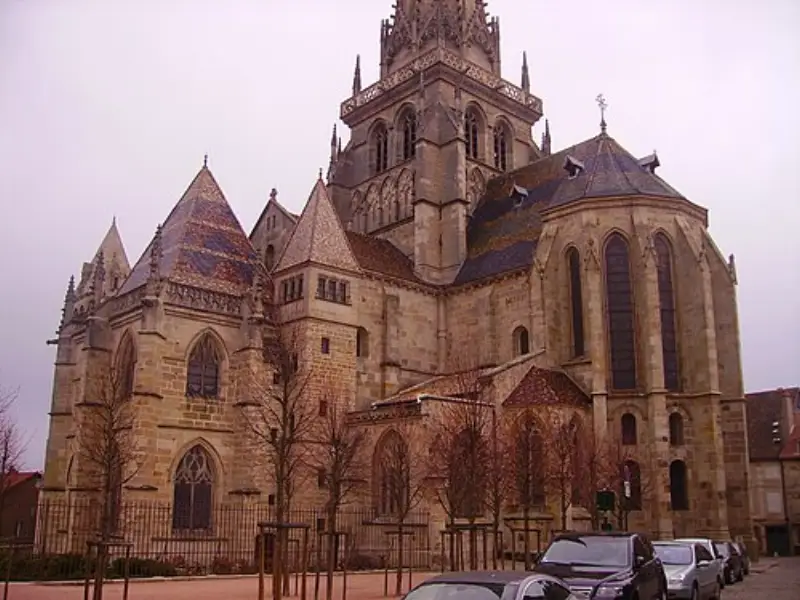
Overview
Euphronius led the see of Autun during the third quarter of the fifth century, the generation in which Roman Gaul was dissolving and the church was becoming the last stable framework of public life. He took office by 451 at the latest and held it for decades, long enough to earn from the Benedictine scholar Basil Watkins the judgment that he stood among the greatest bishops Gaul produced in that century. The sources that preserve his memory are the great witnesses of the age: Gregory of Tours recalls the church he raised in honor of Saint Symphorian at Autun, and the correspondence of Sidonius Apollinaris shows him in motion across the ecclesiastical landscape of the Rhone valley, joining his fellow prelates at Chalon-sur-Saône for an episcopal ordination and being courted by letter for another at Bourges. His learning was active rather than decorative: he composed a letter to Talasius of Angers that circulated in the conciliar collections, and he sent marble for the covering of the tomb of Martin of Tours when Perpetuus was rebuilding the saint's basilica. He was laid to rest in the cemetery of the abbey of Saint Symphorian in his own city, and his name is read in the Roman Martyrology on August 3.
The Complete Life
Called to the See of Autun
Euphronius was elevated to the bishopric of Autun by 451 at the latest, taking charge of one of the ancient churches of central Gaul at a moment when the western empire was visibly failing. Autun, the old Augustodunum, had been a storied city of learning and senatorial families, but the fifth century brought it sack, decline, and the steady withdrawal of imperial protection. In such a world the bishop became the true magistrate of the city, its defender before kings and its provider in famine, and the man chosen in 451 would need every gift of statesmanship and faith. How Euphronius was formed for the office the sources do not say; what they show is what he made of it. He was a friend of Bishop Lupus of Troyes, one of the stout confessors of the faith in Gaul, and that friendship places him in the company of the churchmen who were holding Roman civilization together under its new masters. Later judges of the episcopate have ranked him high: Dom Basil Watkins could describe him without hesitation as one of the greatest bishops of the Gaul of his century, a tribute won not by a single act but by a long, competent, and holy administration.
§ Life
A Pastor at Work in a Breaking World
The recorded acts of Euphronius's long episcopate sketch a bishop entirely engaged with the life of the Gallican church. Within it, he built: Gregory of Tours preserves the memory of a church he raised in Autun in honor of Saint Symphorian, the city's own martyr, giving his people a new house of prayer around the memory of their patron. Beyond his diocese, he served the wider church as its business required. Around the year 470 he traveled with the bishop of Lyon and a company of other prelates to Chalon-sur-Saône to take part in the consecration of a newly chosen bishop, and in 472 Sidonius Apollinaris wrote to urge his presence at another consecration, this one for the church of Bourges — evidence that his colleagues counted his presence a gift to any ordination. His pen was equally at the service of the church: in 453 he composed a letter to Talasius, bishop of Angers, now lost but recorded in the collections of the ancient councils of Gaul. And when Perpetuus of Tours raised a new basilica to receive the remains of Saint Martin, Euphronius sent marble for the covering of the saint's tomb, a bishop adorning the shrine of Gaul's most beloved intercessor.
§ Life
Memory and Rest
Euphronius died some time after 472, the year of Sidonius's last surviving letter to him, and was buried in the graveyard of the abbey of Saint Symphorian at Autun, beneath the patron whose church he had built. There was no formal canonization in his age; the memory of a good bishop passed by natural process from the grief of his flock into the gratitude of the universal church. His name found a place in the Roman Martyrology for August 3, where the church remembers him year by year. His more durable monument, however, is historical: the glimpses of him in Gregory of Tours and in the correspondence of Sidonius Apollinaris have made him one of the fixed points by which scholars reconstruct the episcopate of fifth-century Gaul, a period otherwise starved of sure chronology. Every study of the councils, the ordinations, and the shrine-building of that age passes through his orbit — the prelate at Chalon-sur-Saône, the correspondent of Angers, the donor of marble to the tomb of Martin. Modern hagiographers have kept the old verdict: among the bishops who governed Gaulish churches in that iron century, Euphronius of Autun stands in the first rank, a shepherd whose competence was itself a form of holiness.
§ Life
Timeline
- 451
Takes up the bishopric of Autun, his elevation dating no later than this year
§ Life
- 453
Writes a letter to Talasius, bishop of Angers, which survives only through its copying into the Concilia Antiquae Galliae
§ Life
- 470
Joins the prelate of Lyon and a company of Gaulish bishops at Chalon-sur-Saône, taking part in an episcopal ordination there
§ Life
- 470
Sends marble for the covering of the tomb of Martin of Tours while Perpetuus builds the saint's new church
§ Life
- 472
Receives a letter from Sidonius Apollinaris asking him to be present when Bourges ordains its next bishop
§ Life
- 490
Dies some time after 472, later catalogs giving about this year; laid to rest in the cemetery of the Abbey of St. Symphorian at Autun
§ Life
In Their Own Words
was one of the greatest bishops of Gaul
The Record
- Major works
- Church of Saint Symphorian, Autun·Letter to Talasius of Angers (now lost, preserved in the Concilia Antiquae Galliae)
- Canonization
- Pre-congregation; his name is entered in the Roman Martyrology for August 3
Prayer
Bibliography
Show 6 sources
- I.-F. Grégoire and F.-L. Collombet, Œuvres de C. Sollius Apollinaris Sidonius, vol. I, Lyon: Impr.-libr. Rusand, 1836.
- Watkins OSB, Basil (2015). Euphronius of Autun. The Book of Saints: A Comprehensive Biographical Dictionary. Bloomsbury Publishing. p. 220. ISBN 9780567664150.
- Gregory of Tours, Historia Francorum, vol. II, p. 15.
- Sidonius Apollinaris, Letters, vol. IV, n°25; vol. VII, n°8; vol. IX, n°2.
- Sirmond, P. (1629). Christian Gaul. Literary History of France. Vol. II. p. 465.
- Van Dam, Raymond (2011). Saints and Their Miracles in Late Antique Gaul. Princeton University Press. p. 18. ISBN 9781400821143.
Profile text adapted from the Wikipedia article, licensed CC BY-SA 4.0.
Pray with this saint every day
Save St. Euphronius to your favorites, read the full profile, and get feast-day reminders in the Saints app.
Get the Saints AppFree on the App Store for iPhone and iPad