
410 – c. 470·Feast September 25
St. Euphrosyne of Alexandria
Ascetic Who Lived Thirty-Eight Years as a Monk
Overview
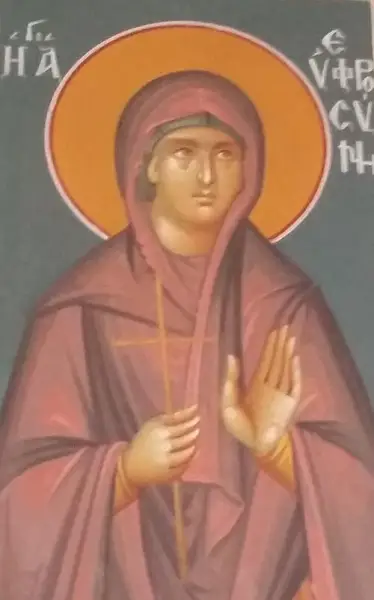
Euphrosyne of Alexandria, whose Greek name means good cheer, was born in 410 into a wealthy and devout household, the child for whose birth her father Paphnutius had begged the prayers of a monastery. Destined by her father for an advantageous marriage, she chose instead the hidden life: advised by monks, she had her head shaved, disguised herself as a man, and entered the very monastery her father frequented, taking the name Smaragdus and passing for a eunuch. For thirty-eight years she lived there unrecognized, distinguished first by the speed of her advance in asceticism and then, when dissension over her beauty stirred the community, by a solitude so complete that she saw almost no one but her director and the abbot. Providence arranged a meeting stranger than fiction: her father, desolate over the loss of his only child, came to the monastery for consolation, and the abbot assigned the monk Smaragdus to comfort him — the daughter directing her own father's soul without revealing herself. Only in the last year of her life did she disclose her identity; they reconciled, and after her death around 470 Paphnutius gave away his wealth, took the habit in her monastery, and lived ten years in her cell. Her tomb became a place of prayer credited with miracles, and her story, which the church historian Johann Peter Kirsch classed among the legends of virgins who donned male dress for the ascetic life, is told by Greek Orthodox, Byzantine Catholic, Roman Catholic, and — since 2022 — Episcopal Christians alike.
The Complete Life
The Answered Prayer of Paphnutius
Euphrosyne's story opens with her father's longing. Paphnutius, a wealthy and deeply believing Christian of Alexandria, and his wife had wanted a child for years without success, and in their need they turned to the monastery Paphnutius often visited: there he begged the abbot, who served as his spiritual advisor, and the brethren to pray that God would give them a son or daughter. The prayers were answered with a daughter, born in the year 410, and the couple named her Euphrosyne — good cheer — as though the joy of the answered request were written into her very name. She was baptized at seven and educated in the Scriptures, and the sources stress two gifts that set her apart early: unusual wisdom and a genuine love of learning. Her childhood was shadowed only once. When she was twelve her mother died, and Paphnutius raised his only daughter alone, doubling, perhaps, the tenderness and the expectations he poured into her. The household was prosperous and prominent, the girl accomplished and devout; by every outward measure she was being prepared for a brilliant marriage in the Christian aristocracy of Alexandria. No one, least of all her father, foresaw that the monastery he visited so often had already, in God's economy, marked her for itself.
§ Life
Flight Into Disguise
When Euphrosyne reached eighteen the suitors gathered, and her father, doing what loving fathers of his class did, selected the noblest and wealthiest of them for her hand. As was customary, father and daughter visited the monastery to obtain the abbot's blessing on the marriage — but the visit worked upon the girl like a spark on dry timber, and instead of a betrothal she came away with a calling. A year of inner struggle followed. When a monk of the house came to her father's home with an invitation to the anniversary of the abbot's ordination, she confessed to him her longing for the ascetic life and her terror of disobeying her father. His counsel was drastic: disguise herself as a man to escape the marriage hanging over her. A second advisor, a hermit brought from Scete at her request, gave the same counsel, and at her request a monk of the desert tonsured her and clothed her in the habit. Seizing the interval of another of her father's spiritual retreats, she fled — not to a convent, where he might think to look, but to his own monastery, announcing herself as a eunuch named Smaragdus. The abbot, suspecting nothing, welcomed the newcomer, and the daughter of the house vanished into the community her father loved.
§ Life
The Hidden Ascetic
As Smaragdus, Euphrosyne astonished the abbot by the speed with which she advanced toward perfection in the ascetic discipline — an achievement all the more remarkable because she lived it under a false identity, every prayer and fast offered behind a mask. But the disguise carried a cost she had not foreseen. Dissension broke out in the community over her beauty, and the abbot, to quell it, ordered the young monk into seclusion. Smaragdus obeyed, taking a hermit's cell still farther out in the wasteland, where the hours were marked only by prayer said alone. What might have been punishment became, in the strange arithmetic of grace, her true vocation: the writer Laura Swan observes that in exile she grew to love the intense solitude itself, until almost no human face entered her life except her spiritual director's and the abbot's. For the better part of four decades she lived thus, a woman unknown among men, her name given to God under another name. Modern students of the tradition, like David Clark, have read her story alongside the tale of Joseph in Egypt and the legends of other women such as Eugenia of Rome who fled unwanted marriages into male disguise — tales in which, as Clark puts it, the lover is Christ and the prize is the celibate life.
§ Life
The Daughter Who Directed Her Father
Providence then wove the two broken halves of the family back together. Paphnutius, grieving without remedy over the disappearance of his only daughter, came to the monastery for solace, and the abbot, knowing nothing, assigned the recluse Smaragdus to give the sorrowing man spiritual direction. Daughter faced father across the mystery of the veil she wore and the name she wore with it; he did not recognize her, and she never told. Yet the counsel he received was genuinely helpful, the exhortation genuinely comforting, and he returned again and again, until the man who had begotten her was being fathered by her — as David Clark has observed, a complete reversal of the order of nature and grace. Only in the last year of her life did she open the secret, revealing herself to Paphnutius and binding him to two requests: that the secret stay with him, and that he attend with his own hands to the burial of her body. They were reconciled in tears. After her death around 470 he carried out her wishes in his own fashion: he distributed his entire fortune to the poor and to the monastery, received the monastic habit, and settled into his daughter's cell, living there in her memory for ten further years, dying at last and being laid to rest in the grave beside her.
§ Death and legacy
Miracles, Feasts, and the Long Afterlife of a Story
The tomb of Euphrosyne became a place of prayer, and wonders were attributed to her intercession there — the normal testimony of antiquity that a soul had arrived at glory. Her cult spread through the whole church: the Greek Orthodox keep her feast on September 25, together with Byzantine-rite Catholics, while the Roman Catholic Church remembers her on January 16. Her Life circulated in multiple literary forms, testimony to its popularity — one early version composed in iambic pentameter, another in prose, and, centuries later, an Old English account known to scholars of medieval England. Her story also entered the learned conversation of modern Christianity: the church historian Johann Peter Kirsch placed it among the legends of virgins who adopted male dress to pursue the ascetic life, and contemporary writers like Laura Swan and David Clark have made her a central figure for reflection on gender, disguise, and desire in the desert tradition. In 2022 the Episcopal Church added her officially to its calendar of saints, with a feast on September 27 — the newest chapter of a veneration now sixteen centuries old. She remains what her name promised: good cheer for all who seek God under obscurity, and proof that a soul wholly given can be hidden from the world and never from God.
§ Death and legacy
Timeline
- 410
Born in Alexandria to Paphnutius and his wife, the child born after the abbot of a local monastery and his monks prayed for the childless couple
§ Life
- 417
Baptized at age seven, then schooled in the scriptures and admired for her intelligence and eagerness to learn
§ Life
- 422
Loses her mother at the age of twelve and is raised from then on by her father alone
§ Life
- 428
Visits the monastery with her father to receive a blessing before her arranged marriage, and comes away resolved on the monastic life instead
§ Life
- 429
Has her head shaved by a monk, disguises herself as a man named Smaragdus claiming to be a eunuch, and enters her father's monastery unrecognized
§ Life
- 469
Reveals her identity at last to her father, who has been receiving her spiritual direction under the name Smaragdus, and the two are reconciled
§ Death and legacy
- 470
Dies around this year after thirty-eight years of hidden ascetic life, asking her father to prepare her body for burial
§ Death and legacy
- 480
Her father, who became a monk in her monastery and lived in her cell, dies and is buried beside her
§ Death and legacy
- 27 Sep 2022
Added to the Episcopal Church's liturgical calendar, with her feast assigned to 27 September
§ Death and legacy
In Their Own Words
Her story belongs to that group of legends which relate how Christian virgins , in order the more successfully to lead the life of celibacy and asceticism to which they had dedicated themselves, put on male attire and passed for men
Dissension arose in the community over Euphrosyne's beauty, and the same abbot ordered her into seclusion
the lover is Christ, and the aim is not conjugal bliss but the celibate life
The Record
- Canonization
- Pre-congregation; venerated from antiquity in the Eastern Orthodox, Catholic, and Anglican traditions; added to the Episcopal Church calendar in 2022
Prayer
Bibliography
Show 6 sources
- Kirsch, Johann Peter (1913). "St. Euphrosyne". In Charles G. Herberman et al. (eds.). Catholic Encyclopedia. 5. New York: Encyclopedia Press, Inc. p. 11.
- Swan, Laura (2001). The Forgotten Desert Mothers: Sayings, Lives, and Stories of Early Christian Women. New York: Paulist Press. ISBN 0-8091-4016-0.
- Clark, David (2009). Between Medieval Men: Male Friendship and Desire in Early Medieval English Literature. Oxford: Oxford University Press. ISBN 978-0-19-955815-5.
- Dunbar, Agnes B.C. (1901). A Dictionary of Saintly Women. Vol. 1. London: George Bell & Sons. p. 294.
- "Venerable Euphrosynē of Alexandria". Orthodox Church in America, Syosset, New York. Archived from the original on 2026-09-25. Retrieved 1 January 2021.
- "Authorize Lesser Feasts and Fasts 2022, General Convention Virtual Binder". vbinder.net. Archived from the original on 2022-09-13. Retrieved 2022-07-22.
Profile text adapted from the Wikipedia article, licensed CC BY-SA 4.0.
Pray with this saint every day
Save St. Euphrosyne of Alexandria to your favorites, read the full profile, and get feast-day reminders in the Saints app.
Get the Saints AppFree on the App Store for iPhone and iPad