
1104 – 1167·Feast May 23
St. Euphrosyne of Polotsk
Princess, Abbess, and Patron Saint of Belarus
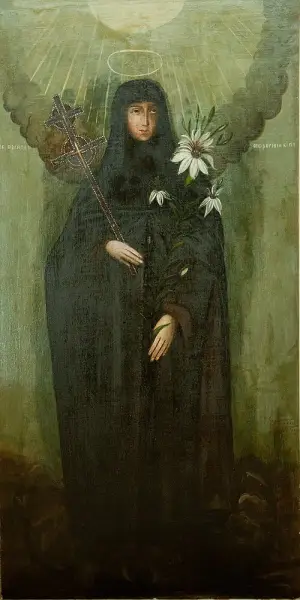
Overview
Euphrosyne of Polotsk was born Predslava around 1104 into the Rurik princely house that ruled Polotsk, granddaughter of the famed Vseslav the Sorcerer and daughter of Prince Svyatoslav Vseslavich of Vitebsk. Refusing every marriage proposed to her, she fled to the convent of her aunt the abbess and received the tonsure under the name Euphrosyne. With the bishop's blessing she settled alongside the Sophia cathedral, copying books for her bread and giving her earnings to the poor. Around 1128 Bishop Elias entrusted her with a convent at Seltse, where she taught young women to copy manuscripts, sing, sew, and practice the crafts of the cloister; her efforts bore fruit in the cathedral consecrated there in 1161, still prized as the crowning survival of early Belarusian architecture. She founded a monastery honoring the Mother of God and two churches, and at her request the master Lazar Bohsha made the gem-studded cross given in 1161 to the Church of the Holy Saviour, a relic treasured for eight centuries until it vanished in 1941. Near the end of her life she made a pilgrimage to Constantinople and the Holy Land, receiving from Patriarch Michael II the icon called the Virgin of Korsun and an audience with King Amalric I of Jerusalem, and dying at Mar Saba. After Saladin took Jerusalem, monks carried her remains to the Monastery of the Caves at Kiev; only in 1910 did they return to Polotsk. Venerated by Orthodox and Catholics alike, she is remembered on May 23 and, since 1984, honored among the fifteen heavenly patrons of Belarus.
The Complete Life
A Princess of the Rurikids
The girl who became Euphrosyne was born Predslava, between 1101 and 1104, into the senior noble house of the principality of Polotsk, in the lands of what is now Belarus. Her family was Rurikid royalty: her grandfather was Vseslav, called the Sorcerer, prince of Polotsk and for a brief season grand prince of Kiev, the most colorful figure of eleventh-century Rus; her father was his second son, Prince Svyatoslav Vseslavich of Vitebsk, who also bore the Christian name Georgy — though the meager sources leave unsure whether Georgy was Svyatoslav's own baptismal name or belonged to his elder brother. She grew up amid the wealth, dynastic marriage politics, and fierce piety of the princely class, in a city whose cathedral of Holy Wisdom proclaimed its place among the great churches of the Rus lands. Her education would have fitted a princess of her rank: the Scriptures, the liturgy, and the arts of a great household. To judge from her later life, what the formation left deepest was the love of books and of God. When the time came for the customary bargain of dynastic politics — her marriage to some neighboring prince's heir — Predslava made the decision that turned a court chronicle into a hagiography: she refused them all.
§ Life
Flight to the Convent
Euphrosyne's break with her princely destiny was absolute and deliberately concealed. Suitors were proposed and refused, and fearing that refusal would not be permitted a second time, she slipped away from her father's house without telling her parents and took refuge in the convent where her aunt served as abbess. There she received the monastic habit and a new name, Euphrosyne, meaning joy — the name under which history would know her. Her next choice shows a will quite beyond her years: with the blessing of the Bishop of Polotsk she settled not inside the convent walls but beside the great Sophia cathedral, where she took up the work of a copyist of books. In the Rus of the twelfth century a scribe's labor was a sacred craft; each manuscript of Scripture or of the fathers was produced letter by letter, and the abbeys that could produce them were treasured. The princess-turned-nun earned her bread this way, and what her pen earned she did not keep: she distributed the money among the poor. Thus the granddaughter of Vseslav lived in the shadow of the cathedral, a scribe and almsgiver, unknown to the court she had abandoned and already, in the eyes of the local church, a mother among the virgins of the city.
§ Life
Builder of Convents and of a Cathedral
Around 1128 the church of Polotsk placed its confidence in her publicly: Bishop Elias entrusted Euphrosyne with the founding of a convent at Seltse, and the scribe of Sophia became an abbess and a builder. At the newly constructed Savior-Transfiguration convent she gathered young women and taught them herself — to copy books as she had learned to do, to sing the offices, to sew and practice the other handicrafts by which a convent lived. Her ambition for the house was architectural as well as spiritual: through her efforts a cathedral rose there, completed in 1161, the church of the Transfiguration of the Savior, which endures to the present and is judged the most precious surviving monument of early Belarusian architecture — stone testimony that a princess's convent in twelfth-century Polotsk could command the finest builders of the age. Nor was this all: she founded a monastery dedicated to the Mother of God and built two churches. For the Church of the Holy Saviour she commissioned the work by which her name is fixed in the memory of her land: the six-armed golden cross wrought by the local master Lazar Bohsha, enamel and precious stones covering a reliquary of the true faith, presented to the church in 1161 with her own hands.
§ Life
Pilgrimage to Constantinople and Jerusalem
Toward the close of her life the abbess of Polotsk set out on the pilgrimage of a lifetime, traveling to Constantinople and onward to the Holy Land. In the imperial city Patriarch Michael II of Constantinople received her and gave her an icon of the Theotokos — the image venerated ever after as the Virgin of Korsun, itself destined for a long history in the Rus lands. In the crusader kingdom she was received by King Amalric I of Jerusalem, an audience placing the princess-nun from the forests of Polotsk at the very court of the Latin East, and there, in the monastery of Mar Saba in the desert near Jerusalem, her pilgrimage ended and her life with it. The date of her death is given as circa 1173 in the narrative of her life, though her traditional chronology fixes it in 1167. After her death came a last exile and a homecoming delayed for centuries: when Saladin took Jerusalem in 1187, monks carried her remains out of the crusader kingdom and deposited them in the Monastery of the Caves at Kiev, the great mother-house of Rus monasticism. There the daughter of Polotsk lay for more than seven hundred years, until 1910, when her relics were brought back in triumph to the city of her birth.
§ Life
Patron of Belarus and the Lost Cross
Euphrosyne is remembered on May 23, and the Orthodox tradition counts her the only virgin saint of East Slavic origin — a distinction that makes her the firstfruits of her peoples' holiness. In 1984 the Belarusian Orthodox Church ranked her among the fifteen heavenly protectors of Belarus, whose memory the church keeps together each year on the Sunday after Pentecost, and she has long been among the most beloved saints of Orthodox devotion in Belarus, Ukraine, and Russia. Her cult lives in stone as well: the Convent of Saint Euphrosyne stands in Polotsk, a church bears her name in Minsk, and dedications to her rise in London, Toronto, Vilnius, and South River, New Jersey — a map of the Belarusian dispersion drawn in her honor. Her most famous relic tells a more haunting story. The six-armed cross wrought by Lazar Bohsha at her bidding and offered in 1161 for the Church of the Holy Saviour endured eight centuries of war and upheaval, a national treasure of gem-studded gold; in 1941, during the evacuation of the museum where it was kept, it disappeared, and it was last seen in Mogilev. The Belarusian government's searches in the early 1990s, including inquiries into private collections in the United States, found nothing. The patron saint of Belarus awaits, with her people, the return of her cross.
§ Veneration
Timeline
- 1104
Born Predslava into the Rurik princely family of Polotsk, granddaughter of Vseslav the Sorcerer and daughter of Prince Svyatoslav Vseslavich
§ Life
- 1128
At Bishop Elias's request founds the convent at Seltse, where she trains the young women in manuscript copying, singing, needlework, and other crafts
§ Life
- 1161
The cathedral she labored to build is completed at Seltse, and Lazar Bohsha's gem-studded cross is presented to the Church of the Holy Saviour
§ Cross of Saint Euphrosyne
- 1167
Dies at the monastery of Mar Saba near Jerusalem, after a pilgrimage to Constantinople and the Holy Land and an audience with King Amalric I
§ Life
- 1187
After Saladin's conquest of Jerusalem, monks carry her remains to the Monastery of the Caves at Kiev
§ Life
- 1910
Her relics are at last returned to her native Polotsk
§ Veneration
- 1984
Ranked among the 15 heavenly protectors of Belarus, honored together each year on the Sunday following Pentecost
§ Veneration
The Record
- Major works
- Savior-Transfiguration convent at Seltse·Cathedral of the Savior-Transfiguration, consecrated 1161·Monastery dedicated to the Mother of God·Cross of Saint Euphrosyne, wrought by Lazar Bohsha
- Patron of
- Belarus
- Canonization
- Pre-congregation saint of the Eastern Orthodox Church; ranked among the 15 patron saints of Belarus in 1984
Prayer
Bibliography
Show 8 sources
- Kasaty, Peter. "Saint Euphrosyne of Polatsk (1104-1167)". Archived from the original on 2000-12-15. Retrieved 2012-07-16.
- "Euphrosyne of Polotsk", Republic of Belarus. Archived from the original on 2020-10-25. Retrieved 2014-02-27.
- Мельников А. А. «Жыціе» і жыціё Еўфрасінні, ігуменні Полацкай. Адраджэнне: Гіст. альманах. (бел.). Минск: Універсітэцкае, 1995. 259 с. ISBN 985-09-0088-1.
- "Euphrosyne Abbess of Polotsk". Church of the Mother of God, Mays Landing, New Jersey.
- Keck, Karen Rae. "Euphrosyne of Polotsk". The Ecole Glossary. The Ecole Initiative. Archived from the original on 2012-07-17. Retrieved 2012-07-16.
- "Ἡ Ὁσία Εὐφροσύνη. 23 Μαΐου". ΜΕΓΑΣ ΣΥΝΑΞΑΡΙΣΤΗΣ (in Greek).
- "Venerable Euphrosyne the Abbess of Polotsk". OCA - Feasts and Saints.
- Nadson, Alexander (1969). "The Life of Saint Euphrosyne of Połack". The Journal of Byelorussian Studies. II (1): 3–24. Retrieved 30 May 2024.
Profile text adapted from the Wikipedia article, licensed CC BY-SA 4.0.
Pray with this saint every day
Save St. Euphrosyne of Polotsk to your favorites, read the full profile, and get feast-day reminders in the Saints app.
Get the Saints AppFree on the App Store for iPhone and iPad