
c. 1386 – 1481·Feast May 15
St. Euphrosynus of Pskov
Monk and Father of the Yelizarov Community
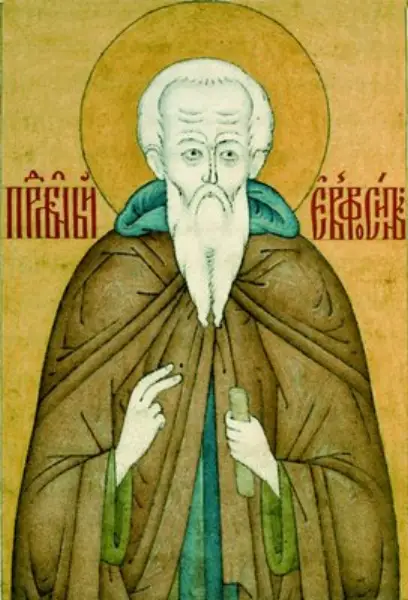
Overview
Euphrosynus of Pskov, born Eleazar around 1386 in the village of Videlebe near Pskov, was a Russian monk whose patient fidelity founded one of the region's enduring monastic houses. He embraced the monastic life at the Snetogorsky Monastery in Pskov, where he received the name Euphrosynus in religion. Around 1425 he withdrew from the common life into a hermitage, seeking the silence in which the visions he reported were granted him; the silence did not last, for the reputation of his holiness began to pull disciples into the wilderness after him. Novices gathered one by one, and out of their gathering the future Yelizarov Convent slowly took shape, a community raised on the discipline and example of its founder. In 1477, in extreme old age, he built a church for the brotherhood, gave it a written monastic rule, and set his follower Ignatius over it as hegumenos, securing its governance beyond his own strength. He died on May 15, 1481, having lived nearly a century. The church of Russia enrolled him among its saints at the Makaryev Sobor of 1549, and he is commemorated on May 15 in the Eastern Orthodox Church.
The Complete Life
Eleazar of Videlebe
The man the church would honor as Euphrosynus of Pskov first bore the name Eleazar, born around the year 1386 in Videlebe, a village lying near the old merchant republic of Pskov. He came to maturity in a formative hour of the Russian north: Pskov was then a proud and quasi-independent city, ringed by monasteries, its piety expressed in stone churches and in the hermits who prayerfully guarded the forests around it. The fourteenth and fifteenth centuries were the age of great Russian ascetics, when the example of Saints Sergius of Radonezh and his disciples sent waves of monks into the wilderness to found houses of prayer across the northern lands. Into that current the young Eleazar was drawn. Of his parents, his schooling, and the inner conversions of childhood the sources are silent; the tradition records only the decisive turning — that he left the village of his birth for the cloister, seeking the monastic habit in the city's ancient Snetogorsky Monastery. There, following the custom that marks a second birth, he laid aside the name his parents gave him and received in religion the name Euphrosynus, meaning joy or delight, the name under which the church would one day glorify him.
§ Life
From the Cloister to the Hermitage
At the Snetogorsky Monastery, a house carved into the limestone bank of the Velikaya River, Euphrosynus learned the discipline of the common life — the hours of prayer, the labor, the obedience that grounds every later flight toward God. But around 1425, when he was nearly forty, he made the characteristic move of the northern Russian ascetic: he withdrew from the monastery into a hermitage, seeking the deeper solitude of the desert tradition within Russia's forests. In that retreat the account of his life records religious visions, disclosures of God granted to a man who had made himself empty enough to receive them. Yet the hermitage followed the paradox that governs nearly every holy solitude: the vision did not remain private for long. Word of the recluse of Pskov spread, and those hungering for the same life began to appear at his door asking for direction and a place beside him. What he sought as escape from the world became, against his intention, the seed of a new community. The disciples who gradually collected around the hermit formed the nucleus of what would be known as the Yelizarov Convent, and the monk who had fled common life found himself its father.
§ Life
A Church, a Rule, and a Successor
For half a century the community around Euphrosynus grew by the slow, unspectacular work of prayer and example, until in 1477 the founder, then in his ninety-first year, set its permanence in order. In that year he built a church for the brotherhood, giving the gathered novices at last a proper liturgical heart, and he instituted a monastic rule to govern their common life — the written constitution by which a Russian house survived its founder. Then he did what the wisest of elders know to do: he took the governance out of his own failing hands and placed his follower Ignatius over the community as hegumenos, the abbot who would carry the work forward. The gesture completed his vocation. He had drawn no power to himself in fifty years of leadership; the community he had gathered was handed to another as freely as it had been begun. He died a few years afterward, on May 15, 1481, close to a century old, his last breath marking more than sixty years since he had first withdrawn into the hermitage. The brethren buried him as their founder and father, and the memory of his sanctity did not leave the house.
§ Life
Enrolled Among the Saints
The church of Russia gave official voice to the devotion that had grown around Euphrosynus when the Makaryev Sobor of 1549 decreed his canonization. That great council of the Russian church, held under Metropolitan Macarius in the reign of Ivan the Terrible's regency years, undertook a sweeping review of the holy men and women whose local veneration had flourished in the northern lands, and it raised many of them to the rank of saints honored throughout Russia. Euphrosynus of Pskov stood among those whose cult was thus confirmed for the whole church — a judgment rendered sixty-eight years after his death, when the community he founded was still young enough for living memory of him to have passed into tested tradition. The Orthodox Church commemorates him on May 15, the day of his repose, according to the Julian calendar. He belongs to that company of northern Russian founders — the desert fathers of Pskov, Novgorod, and the forests beyond — by whom the monastic map of Russia was drawn, men whose names the villages still cherish. His Yelizarov house endured after him, carrying his rule, his church, and his memory into the centuries he never saw.
§ Life
Timeline
- 1386
Born Eleazar in the village of Videlebe, near the city of Pskov
§ Life
- 1425
Withdraws to a hermitage, where reported visions begin to draw the first followers to him
§ Life
- 1477
Builds a church for the growing brotherhood, institutes a monastic rule, and installs his follower Ignatius as hegumenos
§ Life
- 15 May 1481
Dies on 15 May, a few years after placing the community under its first head
§ Life
- 1549
Is enrolled among the saints of the Russian church at the Makaryev Sobor
§ Life
The Record
- Major works
- Yelizarov Convent, the monastic community gathered around his hermitage
- Canonization
- Canonized at the Makaryev Sobor, the church council of 1549
Prayer
Bibliography
Show 2 sources
- "Евфросин, псковской чудотворец". Brockhaus and Efron Encyclopedic Dictionary (in Russian). 1906.
- Michael Walsh (2007). "Euphrosynus of Pskov". A New Dictionary of Saints. Liturgical Press. p. 188. ISBN 978-0-8146-3186-7.
Profile text adapted from the Wikipedia article, licensed CC BY-SA 4.0.
Pray with this saint every day
Save St. Euphrosynus of Pskov to your favorites, read the full profile, and get feast-day reminders in the Saints app.
Get the Saints AppFree on the App Store for iPhone and iPad