
died c. 304·Feast August 12
St. Euplius
Deacon Martyred for Possessing the Scriptures
Overview
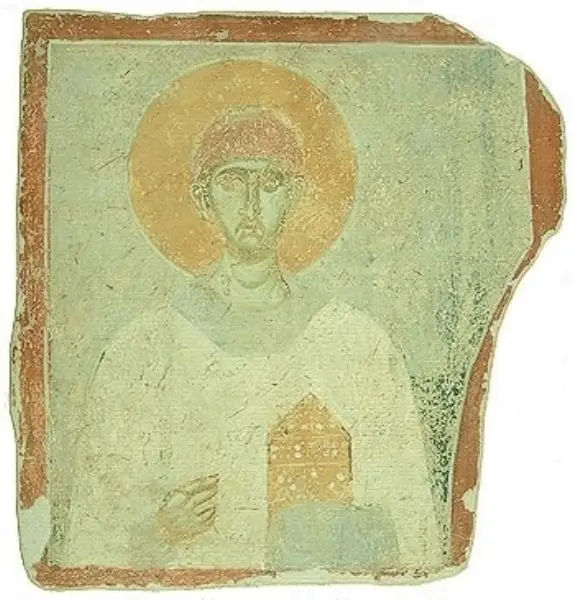
Euplius, also called Euplus, was a deacon of Catania in Sicily who died in the great persecution of Diocletian, around the year 304. His Greek name means good sailing, a word his church still plays upon in the verses of the Vespers service composed for him. The account of his passion relates that he was seized because he owned a copy of the Bible and dared to read from it in public, an act that the edicts of the persecution had made a capital crime. Hauled before the city's governor, Calvinianus, he was ordered to read out extracts from the forbidden book — and read he did, the Scriptures themselves serving as both the evidence against him and his confession of faith. For that testimony he was tortured and beheaded, a clerk of the Gospel killed by the very book he carried. His cult spread quickly through Sicily and far beyond: an ancient church rose in Catania near the site of his execution, and he became co-patron of the city alongside Saint Agatha. His remains were later moved to Trevico in Campania, and a church in far-off Moscow was raised in his honor in the fifteenth century. The Latin Church keeps his feast on August 12, the Orthodox and Eastern Catholics on August 11.
The Complete Life
A Deacon of the Sicilian Church
Euplius served the church of Catania as a deacon, an office that in the early centuries meant far more than liturgical assistance: the deacon was the bishop's right hand, custodian of the community's goods, and above all bearer of the Book. It was in that capacity that his destiny found him. His Greek name, meaning good sailing, carries a seafaring blessing that his church never forgot — the Orthodox Vespers in his honor turns the word into praise, finding in the martyr's passage through torture a voyage safely made to the harbor of God. When Diocletian's edicts against the Christians descended on the empire at the turn of the fourth century, the surrender of the sacred books became the first test imposed on the faithful: hand over the Scriptures and burn incense, or lose everything. Euplius did not wait to be searched. The Passion of the saint tells that he was arrested precisely because he possessed a copy of the Bible and was reading from it, a public act of defiance in a Sicily still governed by Roman law. A man whose whole vocation was the service of the Gospel answered the empire's demand in the only way a deacon could — by holding on to the book.
§ Biography
The Gospel Read in Court
The scene of Euplius's martyrdom, preserved in his Passion, is one of the most quietly dramatic in the acts of the martyrs. Brought before Calvinianus, the governor of Catania, the prisoner was not merely accused: he was ordered to read aloud extracts from the forbidden volume that had been taken with him. The governor meant the exercise as humiliation, the book brandished as evidence; the deacon turned the courtroom into a church. What he read we are not told, but the irony of the record is unmistakable — the state condemned him out of the very Scriptures, and he died with the words of eternal life ringing in the ears of judge and crowd alike. Sentence followed: torture first, then the sword. He was beheaded around the year 304, in the last and fiercest storm the old empire ever raised against Christianity. Eight years later Constantine's edicts would make the book he died for the foundation charter of a Christian Europe, a vindication the martyrs never saw but on which they had staked everything. Sicily numbered him at once among its own, and Catania, which had watched its deacon die, received the honor of his blood as a permanent gift, ranking him beside Saint Agatha as a father of the city.
§ Biography
From Sicily to Trevico to Moscow
The cult of Euplius traveled far from the place of his death. In Catania itself a church was dedicated to him as early as the fifth century, standing near Piazza Stesicoro on the ground where tradition locates his execution; rebuilt in later ages, it was reduced to rubble by an American bomb during the Second World War, and only the crypt of the original fifth-century building survives beneath the modern city. His remains left Sicily, plausibly in the tenth century as the Arab armies closed on the island, and came to rest in the Cathedral of the Assumption at Trevico, a mountain town in Campania that took him for its patron; on February 5, 1654, the bishop of Trevico, Donato Pascasio, authorized a bone of the saint to be translated for the diocese of Catania, a fragment returning home after six hundred years. He is honored as well at Francavilla di Sicilia. Strange as any part of his story is the Russian chapter: in 1471 a wooden church was raised in his name in Moscow to celebrate peace between Ivan III and Novgorod, rebuilt in stone by Tsar Alexei I in 1657, given a majestic facade in the eighteenth century, and torn down in 1926 on Stalin's orders. Sicily, Campania, and Moscow alike keep his memory.
§ Veneration
Timeline
- 304
Arrested at Catania during the Diocletianic Persecution because he possessed a copy of the Bible and read from it
§ Biography
- 304
Interrogated by the governor Calvinianus, who orders him to read the book aloud, then tortured and beheaded
§ Biography
- 450
An ancient church is dedicated to him in Catania, on the ground near Piazza Stesicoro where his martyrdom took place
§ Veneration
- 900
His remains are brought to Trevico in Campania, most likely ahead of the Arab invasion of Sicily
§ Biography
- 1471
A wooden church is erected in his honor in Moscow to celebrate peace between Ivan III and the Novgorod Republic
§ Veneration
- 5 Feb 1654
The bishop of Trevico, Donato Pascasio, authorizes the transfer of a bone of the saint to the diocese of Catania
§ Biography
- 1657
Tsar Alexei I Romanov has the Moscow church rebuilt in stone
§ Veneration
- 1926
The Church of St. Euplius the Archdeacon on Myasnitskaya Street is demolished on the orders of Stalin
§ Veneration
- 1943
An American bomb during the Second World War levels the eighteenth-century church of St. Euplius in Catania, leaving only the ancient crypt
§ Veneration
The Record
- Patron of
- Catania (co-patron with St. Agatha)·Trevico·Francavilla di Sicilia
- Canonization
- Pre-congregation martyr, venerated since antiquity by the Catholic Church and the Eastern Orthodox Church
Prayer
Bibliography
Show 3 sources
- "Trevico: Le reliquie di Sant'Euplio al centro del turismo religioso". irpinianews.it. Archived from the original on 17 December 2022.
- Montieri, Giuseppe (1829). Memoria storica sopra S. Euplio diacono e martire protettor principale della città di Trevico. Tipografia di M. Criscuolo, Napoli.
- Олег Гончаренко (2008). Москва, которую мы потеряли. p. 352.
Profile text adapted from the Wikipedia article, licensed CC BY-SA 4.0.
Pray with this saint every day
Save St. Euplius to your favorites, read the full profile, and get feast-day reminders in the Saints app.
Get the Saints AppFree on the App Store for iPhone and iPad