
864 – 880·Feast June 25
St. Eurosia
Virgin martyr and patroness of Jaca in the Pyrenees
Overview
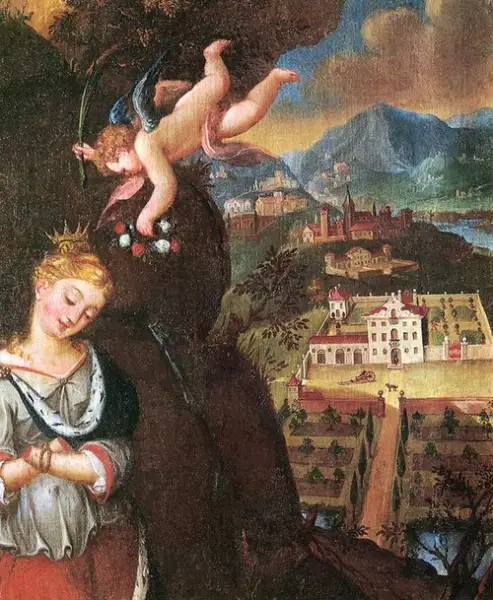
Eurosia, whose name also appears as Orosia, watches over the Pyrenean city of Jaca in the province of Huesca, northeastern Spain, the heart of her cult since the early Middle Ages. Tradition makes her a noblewoman of the ninth century who died a martyr's death at Jaca in 880. One account has her born at Bayonne; another, more detailed legend identifies her as Dobroslava, a princess of the ducal family of Bohemia, converted to the Christian faith by Saint Ludmila and sent to Spain in 880 as the intended bride of Prince Fortún, heir to the thrones of Aragon and Navarre. While crossing the Pyrenees she was attacked by a Moorish captain who wished to marry her, escaped into the mountains, was pursued and captured, and was executed by amputation and beheading. Her relics were discovered in the eleventh century and brought to Jaca by King Sancho Ramírez, whose rerouting of the Way of St. James through the city made her shrine famous. Her cult spread through Béarn and northern Italy, and until 1947 she was invoked as patroness of the demonically possessed.
The Complete Life
A Noblewoman of Two Traditions
The origins of Eurosia are preserved in two overlapping traditions. The simpler account states that she was born at Bayonne, in the Basque country near the western Pyrenees. The fuller legend gives her the Bohemian name Dobroslava and declares her a daughter of the ducal family of Bohemia, born in 864. Left an orphan, she was taken into the household of the succeeding duke, Borivoj I, whose wife was Saint Ludmila; and her conversion to Christianity came at Ludmila's hands. In these years the political fortunes of Bohemia were themselves unsettled: Borivoj was deposed by pagans, then restored to his duchy through the efforts of Saint Methodius, the apostle of the Slavs. If the Bohemian tradition is followed, the girl who would die in the Spanish Pyrenees was thus a Slavic princess raised at a Christian court, connected by adoption and faith to two of the great figures of the early medieval conversions. Whichever birthplace is preferred, both traditions agree that she was of noble birth and that her life ended far from it, in the mountains of Aragon, in the year 880.
§ Eurosia as Bohemian princess
A Bride for the Frontier Kingdoms
The Bohemian legend explains how a Slavic princess came to cross Europe. In 880 a papal commission reached Saint Methodius: Pope John VIII charged him with seeking out a fitting bride for the son of the Pamplonan king, the Prince Fortún, whose inheritance united the thrones of Aragon and Navarre and whose part in the contest with the Moors would be decisive. Eurosia, now sixteen years old, was judged a good candidate for the alliance, and she set out for the Iberian peninsula in the company of an escort. The marriage for which she was destined was more than a family arrangement: it bound the Christian house of Bohemia, converted only a generation earlier, to the embattled frontier kingdoms of northern Spain, where the future of the Christian presence depended on such unions and on resistance to Moorish power. Her journey therefore carried the weight of diplomacy and of war alike. Her meeting with the prince she had never seen was set for Jaca, the Pyrenean city that would afterward guard her memory as its patron, but the country she had to cross had already been turned into a war zone, and the journey turned from a bridal procession into a pursuit.
§ Eurosia as Bohemian princess
Flight, Capture, and Martyrdom
As Eurosia crossed the Pyrenees toward her meeting at Jaca, a Moorish captain named Aben Lupo conceived the design of taking her as a wife for himself, and he attacked the Bohemian party. Her escort fought back with such courage that a path of flight opened through the mountains, and for a time she eluded those hunting her. According to one version of the legend she concealed herself in a cave, where the smoke from her fire betrayed her presence and led to her capture. Dragged from her hiding place by her hair, she invoked the heavens, and a lightning bolt struck the ground near her captors. The intervention did not save her life. The sentence was carried out at once: executioners cut away her limbs and struck off her head, a violence that later images recall of the saint that show her with severed hands, such as the seventeenth-century picture preserved at Colle Umberto in Italy. The legend closes with a further sign: after the beheading a storm broke over the place, terrorizing her tormentors. She had reached the neighborhood of Jaca, the city she never entered alive, and there she died in 880.
§ In Spain
The Finding of the Relics
Veneration of Eurosia took root at Jaca and was confirmed by the church in modern times: her cult was formally approved by Pope Leo XIII in 1902. The turning point in the history of her relics came in the eleventh century, when a shepherd of Yebra de Basa learned their hiding place, so the story runs, because the Virgin Mary appeared to him and named the spot. Her head stayed at the humble first shrine, but her body was carried by King Sancho Ramírez to Jaca, the city he had chosen as the seat of his Aragonese rule. The translation served both devotion and policy, for the king drew pilgrims to his city and reinforced them with publicized miracles at the urban shrine. A chapel dedicated to her was established in the La Seo Cathedral at Zaragoza, and devotion to Saint Eurosia spread beyond the Pyrenees into Béarn and northern Italy during the Middle Ages, borne across those lands by the wars of the Spanish crown. The confirmation of 1902 thus sealed a devotion already more than a thousand years old, rooted in the mountains where the young pilgrim bride had died and honored in the churches of three countries.
§ Veneration
Patroness of Jaca and the Camino
The cult of Eurosia reshaped the religious geography of the Pyrenees. When Sancho Ramírez established her relics at Jaca, he turned the pilgrim road away from its former course along the old Roman military way by the Puerto del Palo, which ran past the Monastery of San Pedro de Siresa to Berdún, and established a new route through Somport and Jaca so that pilgrim traffic passed through his capital. The publicized miracles at her urban shrine placed the saint directly on the Camino de Santiago, and her fame traveled with the pilgrims into Béarn and northern Italy. The Fiesta de Santa Orosia is celebrated at Jaca on 25 June each year. Her intercession was sought above all for those believed to be afflicted by demonic possession; the custom endured until 1947, when the bishop of Jaca finally forbade it; until then, those judged possessed had walked in procession behind the urn that bore her relics. The memory of the martyr of the mountains thus endured for more than a thousand years, binding a Bohemian princess, a Pyrenean city, and the pilgrim roads of Europe into a single story of faith.
§ Veneration
Timeline
- 864
Was born, by the Bohemian tradition, as Dobroslava into the ducal family of Bohemia.
§ Eurosia as Bohemian princess
- 880
Pope John VIII charged Saint Methodius to find her as spouse for Prince Fortún, heir of Aragon and Navarre.
§ Eurosia as Bohemian princess
- 880
At sixteen she was brought to Spain as the prince's intended bride.
§ Eurosia as Bohemian princess
- 880
Attacked by the Moorish captain Aben Lupo, she fled, was caught, and was beheaded after mutilation near Jaca.
§ Eurosia as Bohemian princess
- 1000
In the eleventh century a shepherd of Yebra de Basa found her relics after an apparition of the Virgin Mary.
§ Veneration
- 1000
King Sancho Ramírez translated her body to Jaca, his capital, and drew the Way of St. James through the city.
§ Veneration
- 1902
Pope Leo XIII formally confirmed her centuries-old cult.
§ Introduction
- 1947
The bishop of Jaca ended the processions in which the possessed followed the urn holding her relics.
§ Veneration
The Record
- Patron of
- Patron saint of Jaca·Patroness of the demonically possessed
- Symbols
- Depicted with severed hands, as in the seventeenth-century image at Colle Umberto, Italy·Palm of martyrdom
- Canonization
- Cultus confirmed by Pope Leo XIII in 1902
Prayer
Bibliography
Show 4 sources
- "St. Eurosia", FaithND.
- "Sant' Eurosia di Jaca". Santiebeati.it. 2004-12-16. Retrieved 2012-08-03.
- "Antropologia/Santa Orosia". Andarines.com. Retrieved 2012-08-03.
- "Eurosia". Andarines.com. Retrieved 2012-08-03.
Profile text adapted from the Wikipedia article, licensed CC BY-SA 4.0.
Pray with this saint every day
Save St. Eurosia to your favorites, read the full profile, and get feast-day reminders in the Saints app.
Get the Saints AppFree on the App Store for iPhone and iPad