
c. 260 – 339·Feast May 30 (Syrian Church and Roman Catholic); February 29 (Syrian Orthodox)
St. Eusebius of Caesarea
Father of Church History and bishop of Caesarea
Overview
Eusebius of Caesarea (c. 260/265 – 30 May 339), also known as Eusebius Pamphilius, was a Christian historian, exegete, and polemicist of the Roman province of Syria Palaestina who became bishop of Caesarea around the year 314. Educated in the Christian school and famous library of Caesarea founded by Origen's circle and led by his master Pamphilus, from whom he took the surname Pamphilius, he emerged as one of the most learned Christians of late antiquity. The persecutions of Diocletian and Galerius turned his attention to the martyrs, and from there to the history of the whole Church: his Ecclesiastical History, the first surviving chronologically ordered narrative of Christianity from the Apostles to his own day, earned him the title Father of Church History. His other works include the Chronicle, a universal history in parallel columns; the Preparation for the Gospel and Demonstration of the Gospel; the Onomasticon, a biblical geography of the Holy Land; the Life of Pamphilus; On the Martyrs; and, after the emperor's death, the Life of Constantine. He attended the Council of Nicaea in 325, presided over the synod of Tyre that condemned Athanasius in 335, and died at Caesarea on 30 May 339.
The Complete Life
A Youth in Caesarea
Little is known about the life of Eusebius, and even his own surviving works preserve only a fraction of what he wrote; his successor Acacius composed a Life of Eusebius that has been lost. Most scholars place his birth between about 260 and 265, most likely in or around Caesarea Maritima, the great port city of Roman Palestine. Of his parents history says nothing. Baptized and schooled within the city, he later recorded for his readers that he learned the creed of the Caesarean church in childhood and accepted it at baptism. He was still living in Syria Palaestina in 296, when Diocletian's army passed through the region; in his Life of Constantine he recalls seeing the young Constantine traveling with that army, an eyewitness memory that would matter half a lifetime later. He heard the presbyter Dorotheus of Tyre expound the Scriptures in the church, and some scholars, among them John Henry Newman, have understood this to mean that he studied under Dorotheus at Antioch, though others find the evidence too ambiguous. What is certain is that the city of his youth housed one of the chief centers of Christian learning in the world, and that its school would form the rest of his life.
§ Early life
The School of Pamphilus
Through Origen and his follower Pamphilus, Caesarea had become a center of Christian scholarship built around a legendary library. On his deathbed Origen had bequeathed his private library to the Christian community of the city; these, added to the books of his patron Ambrosius, became the seed of the library Pamphilus built up, whose treasures included the Hexapla and the Tetrapla of Origen, an Aramaic text of Matthew's Gospel in its original form, and numerous autographs of Origen's own works. Soon after Pamphilus settled in Caesarea in the 280s he began teaching Eusebius, then a man of twenty to twenty-five. The bond became so close that Eusebius was called Eusebius Pamphili, son of Pamphilus, whether as favored spiritual son, adopted heir, or by some biologists' stranger theories; Pamphilus also gave him his lasting admiration for the thought of Origen, whom neither of them had known in person. The two devoted themselves to the textual criticism of the Scriptures, correcting and revising the biblical books of the library, and Eusebius helped expand the collections. It was probably in this school that he was made presbyter by Bishop Agapius, and there in the 290s that he began the twin literary labors of his life: the Ecclesiastical History and the Chronicle.
§ Early life
Bishop in the Age of Nicaea
Eusebius succeeded Agapius as Bishop of Caesarea soon after 313, as the era of persecution gave way to the era of Constantine, and at once found himself inside the Arian controversy. The excommunicated Arius appealed to him, and an episcopal council at Caesarea pronounced Arius blameless. Yet Eusebius enjoyed the favor of the emperor, and in 325 he stood before the 318 fathers gathered at Nicaea to set out the confession of the Caesarean church; the anti-Arian creed from Palestine prevailed there and became the basis of the Nicene Creed. He was afterward reproached by Eustathius of Antioch for deviating from the Nicene faith as an admirer of Origen, yet the verdict fell his way, and Eustathius lost his see when a synod at Antioch deposed him. A stronger adversary then appeared in Athanasius of Alexandria, who in 334 was summoned before a synod in Caesarea and refused to attend, and in 335 was summoned again to the synod of Tyre, over which Eusebius of Caesarea presided. Athanasius carried his cause to the emperor at Constantinople, but condemnation followed, and his exile came at the close of 335. Through all of this Eusebius kept his standing with Constantine, more than once exonerated with the emperor's explicit approval.
§ Bishop of Caesarea
Doctrine and Method
The theology of Eusebius is that of Origen's tradition carried into the fourth century. From the absolute sovereignty, or monarchia, of God he argued that God is the cause of all beings, the source of every good, life, and virtue, who sent Christ into the world so that it might partake of the blessings included in the divine essence; he expressly distinguished the Son from the Father as a ray is distinct from the sun that casts it, a formulation that left him open to the charge of Arianizing. He held that human beings are sinners by free choice and not by necessity of nature, since every rational soul is formed for the choice of the good. He was unusual in holding a preterist eschatology, reading the scriptural signs of Christ's coming as fulfilled in the ceasing of the Mosaic worship and the desolation of Jerusalem. As a scholar his method was the excerpt and the parallel column: the Chronicle set universal history in synchronism, the Ecclesiastical History arranged the church's story by the reigns of emperors, and his canon tables, dividing the four Gospels into matching passages, remained in use throughout the Middle Ages as the most richly illuminated pages of medieval Gospel books.
§ Doctrine
The Emperor's Eulogist
The final years of Eusebius were bound to the person of Constantine. After the emperor's death around 337 he composed the Life of Constantine, an unfinished work assembled from eyewitness accounts and primary documents, valuable to historians precisely for the materials incorporated into it, though it is a eulogy rather than a history, and Socrates Scholasticus judged that its author cared more for rhetorical finish and the emperor's praise than for accuracy. To the same period belongs the treatise Against Marcellus of Ancyra, dating from about 337, with its supplement the Ecclesiastical Theology, in which he defended his doctrine of the Logos. His Tricennial Oration on the thirtieth anniversary of Constantine's reign in 336 also survives, as does his discourse for the dedication of the church at Tyre; the rest of his sermons, and nearly all his correspondence, have perished, though letters to Carpianus and Flacillus exist complete. He died at Caesarea on 30 May 339, aged between seventy-four and seventy-nine, after about twenty-five years as metropolitan of the see, and was succeeded by his pupil Acacius. The historian of the church's peace died in the imperial church he had done so much to describe.
§ Life of Constantine
Veneration and Feast Days
Eusebius was never formally canonized; his cult belongs to the early centuries when bishops and scholars were honored by the devotional practice of the churches. The earliest recorded feast of Eusebius appears in the oldest known Syrian Martyrology, dating to 411, which lists his commemoration on 30 May as the commemoration of Eusebius, bishop of Palestine. He is still venerated as a saint by the modern Syrian Orthodox Church, which keeps his memory on 29 February. In the West his position has always been ambiguous: for centuries he held a place in the Martyrologium Romanum under 21 June, and the Gallican service books commemorated the historian as a saint, one breviary lesson praising him as bishop of Caesarea who, after a season of favoring the Arian party he came to Nicaea, and, under the guidance of the Spirit, accepted the ruling of the Fathers, keeping the orthodox faith to the end of his days. In the revision of the Martyrology under Pope Gregory XIII his name was struck out and Eusebius of Samosata substituted, through a supposed confusion between Caesarea and Samosata. Catholic theology today lists him among ecclesiastical writers rather than Fathers, and a relic of his bone rests at the Shrine of All Saints in Morton Grove, Illinois.
§ Veneration
Father of Church History
Posterity has judged Eusebius with extraordinary severity and needed him with equal urgency. Edward Gibbon called him the gravest of the ecclesiastical historians yet distrusted his accounts of the martyrs, noting that he resolved to relate only what vindicated the divine judgment; Jacob Burckhardt went further still, branding him the most unreliable writer antiquity had yet produced. Against these verdicts, Joseph Barber Lightfoot observed that the manner in which Eusebius handles his quotations, wherever they can be tested, is a sufficient vindication, though he concedes the loose and uncritical spirit with which he sometimes treats his materials. Modern scholars such as Michael Hollerich argue that the standard assessment has exaggerated his political motives and failed to do justice to him as churchman and scholar. What no critic denies is his indispensability: by excerpting his sources comprehensively he preserved countless documents, martyrologies, and fragments of lost historians and philosophers that survive nowhere else. The Ecclesiastical History made him the first historian of Christianity, the Chronicle shaped all subsequent universal chronography through Jerome's Latin continuation, the Onomasticon founded biblical geography, and the Eusebian canons organized the Gospels for a thousand years of readers. Benedict XVI called him the Father of Church History.
§ Assessment
Timeline
- 260
Born, most likely in or around Caesarea Maritima; nothing is known of his parents
§ Early life
- 285
Pamphilus settled in Caesarea and began teaching Eusebius, then aged about twenty to twenty-five
§ Early life
- 290
Began his Ecclesiastical History and his Chronicle, completing first editions of both before 300
§ Early life
- 296
Living in Syria Palaestina, saw Constantine traveling with Diocletian's army through the region
§ Early life
- 309
His master Pamphilus died; Eusebius later wrote the Life of Pamphilus and completed the Apology for Origen
§ Apologetic and dogmatic works
- 313
Succeeded Agapius as Bishop of Caesarea soon after 313
§ Bishop of Caesarea
- 325
Laid the Caesarean confession before the assembled fathers at Nicaea, where the anti-Arian creed prevailed
§ Bishop of Caesarea
- 334
Athanasius is summoned before a synod at Caesarea amid their quarrel, but declines to appear
§ Bishop of Caesarea
- 335
Presided at the synod of Tyre before which Athanasius was condemned, and stood in Constantine's favour at Constantinople
§ Bishop of Caesarea
- 336
Delivers an address marking the thirtieth anniversary of Constantine's reign
§ Exegetical and miscellaneous works
- 337
After the death of Constantine, wrote the Life of Constantine from eyewitness accounts and primary documents
§ Life of Constantine
- 30 May 339
Died at Caesarea on 30 May, aged about seventy-four to seventy-nine
§ Introduction
- 411
The earliest known Syrian Martyrology records his feast for 30 May, the oldest witness to his commemoration
§ Veneration
In Their Own Words
Every rational soul has naturally a good free-will, formed for the choice of what is good. But when a man acts wrongly, nature is not to be blamed; for what is wrong, takes place not according to nature, but contrary to nature, it being the work of choice, and not of nature.
He that will deserve the name of a Christian must be such a man as excelleth through the knowledge of Christ and His doctrine; in modesty and righteousness of mind, in constancy of life, in virtuous fortitude, and in maintaining sincere piety toward the one and the only God, who is all in all.
[Christ's] character is twofold: like the head of the body in that he is regarded as God and yet comparable to the feet in that he put on humanity for the sake of our salvation, a man of passions like ours.
All of these credited for righteousness, going back from Abraham to the first man, could be described as Christians in fact if not in name, without exceeding the truth. For the name means that the Christian, through the knowledge and teaching of Christ, excels in self-control and righteousness, in disciplines and virtue, and in the confession of the one and only God over all, and in all this they showed no less zeal than we.
While the saving message spread day by day, some providence brought from Ethiopia an officer of the queen, for that nation is still traditionally ruled by a woman.
The Record
- Major works
- Ecclesiastical History·Chronicle (Chronography and Canons)·Preparation for the Gospel (Praeparatio evangelica)·Demonstration of the Gospel (Demonstratio evangelica)·Onomasticon, a geographical lexicon of biblical place-names·On the Martyrs of Palestine·Life of Pamphilus·Life of Constantine·Theophania (On Divine Manifestation)·Against Marcellus and Ecclesiastical Theology·Commentary on the Psalms and Commentary on Isaiah·Eusebian canons for the four Gospels
- Patron of
- Church historians
- Symbols
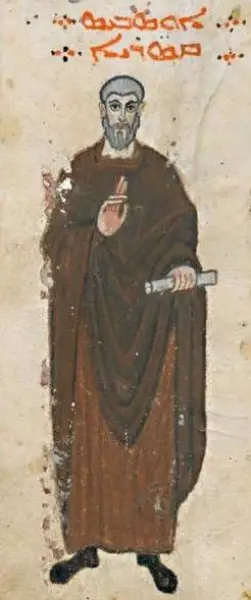
- Bishop's crozier·Book or scroll of the Ecclesiastical History·Depicted in sixth-century Syriac portrait in the Rabbula Gospels
- Canonization
- Pre-congregation; venerated in the Catholic Church and the Oriental Orthodox Church
Prayer
Bibliography
Show 7 sources
- Barnes, Timothy D. (1981). Constantine and Eusebius. Cambridge, MA: Harvard University Press. ISBN 978-0-674-16530-4.
- Eusebius (1999). Life of Constantine. Averil Cameron and Stuart G. Hall, trans. Oxford: Clarendon Press. ISBN 978-0-19-814924-8.
- Gonzalez, Justo L. (10 August 2010). The Story of Christianity: Volume 1: The Early Church to the Dawn of the Reformation. Zondervan. pp. 149–150. ISBN 978-0-06-185588-7.
- Wallace-Hadrill, D. S. (1960). Eusebius of Caesarea. London: A. R. Mowbray.
- Louth, Andrew (2004). "Eusebius and the Birth of Church History". In Young, Frances; Ayres, Lewis; Louth, Andrew (eds.). The Cambridge history of early Christian literature. Cambridge: Cambridge Univ. Press. pp. 266–274. ISBN 978-0-521-46083-5.
- Beatrice, Pier Franco (June 2002). "The Word "Homoousios" from Hellenism to Christianity". Church History. 71 (2): 243–272.
- "General Audience of 13 June 2007: Eusebius of Caesarea | BENEDICT XVI". www.vatican.va. Retrieved 2021-06-01.
Profile text adapted from the Wikipedia article, licensed CC BY-SA 4.0.
Pray with this saint every day
Save St. Eusebius of Caesarea to your favorites, read the full profile, and get feast-day reminders in the Saints app.
Get the Saints AppFree on the App Store for iPhone and iPad