
died 8 August 462·Feast August 12
St. Eusebius of Milan
Archbishop of Milan in the age of Attila's invasions
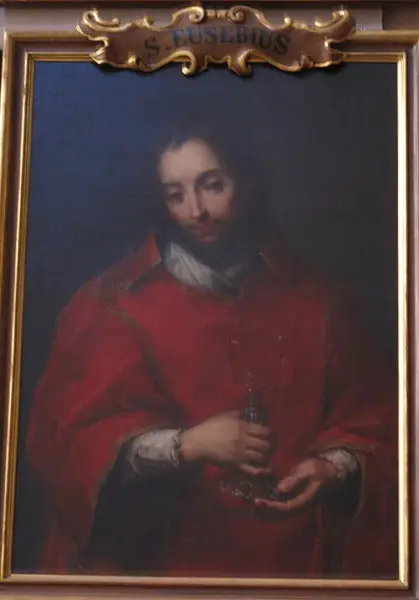
Overview
Eusebius was Archbishop of Milan from 449 to 462, honoured as a saint by the Catholic Church and the Orthodox Church, with a feast on 12 August. According to the early sixth-century bishop Ennodius, he was a Greek by origin. His episcopate fell in the last violent decades of the Roman West. He probably took part in the Roman synod of 449 that condemned the doctrines of Eutyches, and in 451 he was the addressee of a letter from Pope Leo the Great, carried to Milan by Abundius of Como and Senator. That same year he convened a provincial council of eighteen bishops in Milan at which the Tome of Leo was read and approved and Eutyches was condemned. In 452 the Huns under Attila stormed into Italy, destroying Aquileia and sacking Milan, where the cathedral of Saint Tecla was burned. Eusebius fled with many citizens and returned only after Attila withdrew, whereupon he led the rebuilding of the city and the reconstruction of the cathedral, brought back to consecration in 453. His death came on 8 August, most likely in the year 462, and his body found a grave in the basilica of Saint Lorenzo Maggiore.
The Complete Life
A Greek Shepherd for Milan
The earliest account of Eusebius comes from Ennodius, bishop of Pavia in the early sixth century, who records that he was Greek by origin; a late tradition, possessing no historical basis, later attached him to Milan's family of the Pagani. Nothing else is known of his early life before he appears in 449 as archbishop of the great see of Milan, where he succeeded Lazarus. His first years in office were consumed by the christological crisis that convulsed the church of the fifth century. He probably took part, as bishop of Milan, in the Roman assembly of 449 that passed judgment on Eutyches and his doctrine, the teaching which dissolved the humanity of Christ into his divinity. In 451 he stood among the correspondents of Pope Leo the Great, receiving a letter carried to Milan by Abundius, bishop of Como, and Senator as they returned from Constantinople to northern Italy. In the same year Eusebius gathered a Provincial Council in Milan, attended by eighteen bishops, at which the Tome of Leo was read and approved and the doctrines of Eutyches were formally condemned, binding the Ambrosian church to the orthodox position.
§ Life
Fire, Flight, and Rebuilding
The dominant event of Eusebius's episcopate was the invasion of Italy by the Huns under Attila in 452. The Huns razed Aquileia, moved westward, and sacked numerous cities, among them Padua, before turning toward Milan itself. There Attila took up residence in the imperial palace and put much of the town to the flames, leaving the cathedral of Saint Tecla in ruins, the principal church of the see. Eusebius, together with many of his citizens, fled the city and left it to the occupiers. He returned only when Attila, persuaded by Pope Leo, abandoned his Italian campaign and retired. The archbishop then set himself to the work of restoration, leading the reconstruction of the stricken town and of its ruined cathedral. The labor bore fruit within a year: in 453 the rebuilt cathedral was brought back to consecration by Maximus II, bishop of Turin, who for the occasion preached the homily known as De reparatione ecclesiae mediolanensis, on the repair of the church of Milan. Eusebius thus appears in the sources as both a confessor of doctrine and a rebuilder, the shepherd who brought his flock home to a burned city and gave it back its churches.
§ Life
Death and Burial
Eusebius governed Milan until his death on 8 August, probably in the year 462, after roughly thirteen years as archbishop. His episcopate had carried the church of Milan through the condemnation of Eutychianism, the correspondence of Pope Leo, a provincial council of its own, and the catastrophe and recovery of the Hunnish invasion; the sources record no further troubles in his last years. His body received burial in the basilica of Saint Lorenzo Maggiore, among the great churches of late Roman Milan, so that the bishop who had rebuilt one cathedral was laid to rest in another that had survived the storms of the age. In the episcopal lists of Milan he stands between Lazarus, his predecessor, and Gerontius, who succeeded him in 462, within the long line of holy bishops that runs from Saint Barnabas and Saint Ambrose down through the centuries. A late tradition, without historical foundation, sought to attach him to the noble Milanese family of the Pagani, a sign of the honor in which his memory was held long after the facts of his life had faded.
§ Life
Veneration of a Saintly Archbishop
Eusebius was never the subject of a formal canonization process; he belongs to the early generations of Milanese bishops whose sanctity was recognized by the continuing devotion of the church. He is honoured as a saint both by the Catholic Church and by the Orthodox Church, and his feast is celebrated on 12 August, a few days after the anniversary of his death on 8 August. His name is preserved in the catalogues of the bishops and archbishops of Milan, where he is styled Saint Eusebius, holding his place among the ancient episcopal saints of the see between Saint Lazarus and Saint Gerontius. The memory of his achievement was kept alive by the literature of the Ambrosian church: the account of his Greek origin derives from Ennodius of Pavia, the details of his council and rebuilding from later historians of the diocese, and the story of the cathedral's re-consecration from the surviving homily of Maximus of Turin. Later centuries added legends of their own, including the groundless association with the family of the Pagani, but the core of his cult has always been the historical bishop who condemned heresy and rebuilt his shattered city.
§ Life
The Church He Rebuilt
The legacy of Eusebius belongs to the history of Milan in its most fragile hour. The northern Italian sees of the mid-fifth century faced simultaneous pressures: doctrinal confusion radiating from the eastern disputes over Eutyches, and the military collapse before the armies of Attila. Eusebius's response to the first was the Provincial Council of 451, in which eighteen bishops of the province, gathered under his presidency, read and approved the Tome of Leo and condemned the Eutychian doctrines, aligning the Ambrosian church with the teaching that would be confirmed at Chalcedon. His response to the second was the reconstruction of Milan itself, and above all of the cathedral of Saint Tecla, whose re-consecration in 453 by the bishop of Turin was commemorated in the homily De reparatione ecclesiae mediolanensis, a rare surviving testimony to the restoration of a sacked Italian city. He is remembered as the successor of Lazarus and the predecessor of Gerontius in the episcopal catalogue of Milan, as the recipient of Pope Leo's letter of 451, and as a saint whose feast on 12 August is still kept in the churches of East and West.
§ Life
Timeline
- 449
Appointed Archbishop of Milan, succeeding Lazarus
§ Introduction
- 449
Probably took part, as bishop of Milan, in the synod held in Rome that condemned the doctrines of Eutyches
§ Life
- 451
Was addressee of a letter from Pope Leo the Great, carried to Milan by Abundius of Como and Senator
§ Life
- 451
Convened a Provincial Council in Milan of eighteen bishops, where the Tome of Leo was approved and Eutyches' doctrines condemned
§ Life
- 452
Fled Milan as Attila's Huns sacked the city, burned the cathedral of Saint Tecla, and occupied the imperial palace
§ Life
- 452
Returned to Milan with the citizens after Attila, persuaded by Pope Leo, retired from Italy, and led the town's reconstruction
§ Life
- 453
Saw the rebuilt cathedral re-consecrated by Maximus II of Turin, who preached the homily De reparatione ecclesiae mediolanensis
§ Life
- 8 Aug 462
Died, probably in this year, and was buried in Milan's basilica of St. Lorenzo Maggiore
§ Life
The Record
- Major works
- Provincial Council of Milan of 451, convened with eighteen bishops against Eutychianism·Reconstruction of Milan and its cathedral after the Hunnish destruction of 452
- Patron of
- Archdiocese of Milan
- Symbols
- Archbishop's pallium·Model of the cathedral of Milan
- Canonization
- Pre-congregation; honoured as a saint in the Catholic Church and the Orthodox Church
Prayer
Bibliography
Show 4 sources
- Ruggeri, Fausto (1991). I Vescovi di Milano. Milano: NED. pp. 14–15. ISBN 88-7023-154-2. (in Italian)
- Pasini, Cesare (1988). "Eusebio di Milano, santo". Dizionario della Chiesa Ambrosiana. Vol. 2. Milano: NED. pp. 1151–1154. ISBN 88-7023-102-X. (in Italian)
- Cazzani, Eugenio (1996). Vescovi e arcivescovi di Milano. Milano: Massimo. pp. 28–29. ISBN 88-7030-891-X. (in Italian)
- Tolfo, Maria Grazia. "Cronologia di Milano dal 451 al 500". Santi e Beati. Retrieved 27 Sep 2011. (in Italian)
Profile text adapted from the Wikipedia article, licensed CC BY-SA 4.0.
Pray with this saint every day
Save St. Eusebius of Milan to your favorites, read the full profile, and get feast-day reminders in the Saints app.
Get the Saints AppFree on the App Store for iPhone and iPad