
died 423·Feast May 5
St. Eusebius of Cremona
Disciple of Jerome and abbot of the Origenist controversy
Overview
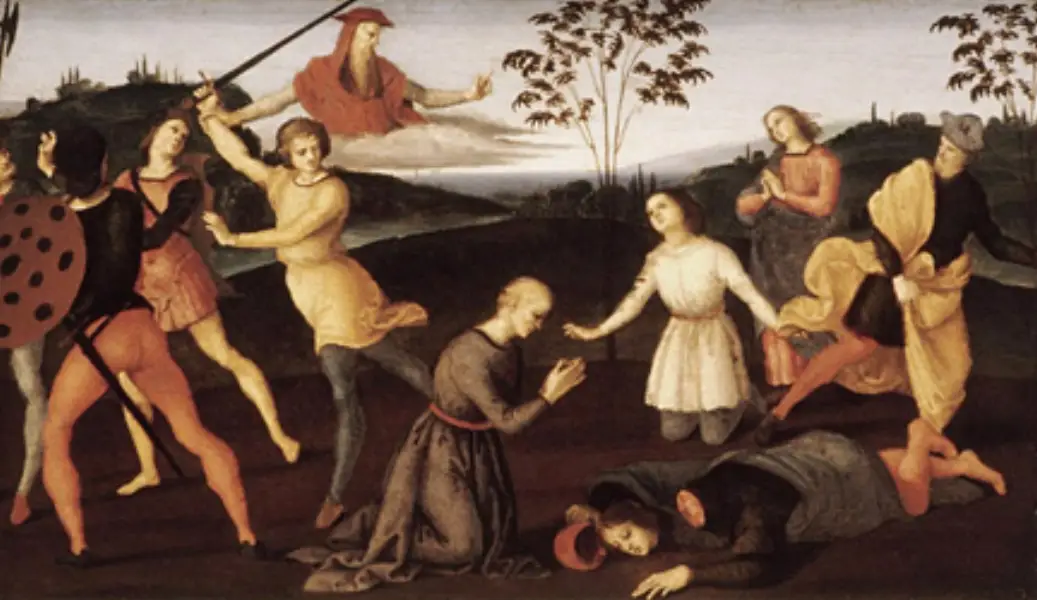
Eusebius of Cremona was a fifth-century monk, a pre-congregational saint, and one of the closest disciples of Jerome. Born at Cremona, he reached Rome in his youth and attached himself there to Jerome, who was then serving as secretary to Pope Damasus, and joined the informal ascetic circle that gathered around Marcella, Oceanus, and Pammachius. He followed Jerome to the Holy Land, met Saint Paula and Saint Eustochium, and founded a monastery in Bethlehem over which he ruled as abbot for a time. His journey back to Italy in 400, routed through Dalmatia, had as its object the collection of money for a hostel serving pilgrims, and in the course of it he spoke at Rome on Jerome's behalf and helped bring the Pope to see Origen's error. In the Origenist controversy he was Jerome's most vigorous advocate, credited with persuading Pope Anastasius to condemn Origen's writings, and he stood with Jerome also against Pelagius. He succeeded Jerome as head of his monastery in Italy, and a late tradition credits him with founding Guadalupe Abbey in Spain and with raising three men from the dead, an event painted twice by Raphael. He died in 423; his feast is kept on May 5.
The Complete Life
From Cremona to the Ascetics of Rome
Eusebius was born at Cremona, the Lombard city on the Po, and as a young man traveled to Rome, where his life took the decisive turn that attached it forever to the story of Jerome. In the Rome of the 370s and 380s Jerome served as secretary to Pope Damasus, and around that circle of clerics and aristocratic women a movement of ardent, ascetic Christianity was taking shape. Eusebius became one of Jerome's associates and shared his taste for a strict religious life. With Marcella, the noble Roman widow who founded a community of women on the Aventine, with Oceanus, and with Pammachius, he formed an informal ascetic fraternity within the city, a band of friends bound by common discipline rather than by any formal rule. Jerome wrote for him his commentary on the Book of Jeremiah, a token of the confidence the older scholar placed in him. It was in these Roman years that Eusebius acquired both the learning and the loyalties that would define him: a devotion to the ascetic ideal, a friendship with Jerome that controversy would only deepen, and a place among the men and women who turned late imperial Rome toward monasticism.
§ Life
To the Holy Land and Bethlehem
Eusebius traveled with Jerome to the Holy Land, exchanging the Rome of the ascetic fraternities for the places of the Gospel. In Palestine he met Saint Paula and Saint Eustochium, the Roman women who had established themselves at Bethlehem as Jerome's closest companions in the monastic life, and with them at Jerusalem he made the pilgrimage circuit of the holy places. The decisive act of his eastern years was the foundation of a monastery at Bethlehem, which he himself governed as abbot for a time, standing beside the twin monasteries of Jerome and Paula at the birthplace of Christ. From Jerusalem he may also have traveled to Egypt with Jerome at about this period, following the road that so many pilgrims took to the desert fathers of Nitria and the monasteries of the Nile. The Bethlehem foundation placed Eusebius among the builders of Palestinian monasticism, and his years as abbot gave him the standing he would later need at Rome: he was no theorist of the ascetic life but a man who had planted and governed a monastery within sight of the Lord's manger.
§ Life
Envoy and Champion in the Origenist Controversy
In 400 Eusebius returned to Italy by way of Dalmatia, charged with raising funds for a pilgrim hostel, and with this practical commission came a diplomatic one: he stood at Rome as Jerome's spokesman and brought the pontiff to acknowledge the error of Origen. Thus began his public role in the Origenist controversy that divided the monastic world. He proved a vigorous and active supporter of Jerome against the Origenist party, and he is believed to have persuaded Pope Anastasius to condemn Origen's writings. The struggle was conducted with the bitterness characteristic of the age. During the controversy a letter from John, bishop of Jerusalem, to Eusebius was stolen, and Jerome accused the thief of serving Rufinus, the advocate of Origen who had until then been on fairly good terms with Eusebius. Rufinus sent the document to the Pope, charging that Jerome had falsified the original; the Pope eventually sided with Jerome, while Rufinus retorted that Eusebius was evil in the matter and conspired with Marcella. Eusebius also stood with Jerome in the subsequent disputes with Pelagius, and a pseudepigraphical letter in his name to Pope Damasus testifies to the reputation he carried.
§ Theology
Last Years and Death
After the height of the controversy Eusebius succeeded Jerome as head of his monastery in Italy, taking over the government of the community his master had founded, and in this role his life came full circle from the young Cremonese who had once attached himself to Jerome's side in Rome. A later tradition adds that in his latter life he crossed into Spain and founded Guadalupe Abbey, the house that would become one of the great shrines of the peninsula, though the attribution belongs to legend rather than to history. He lived until 423, reaching into the final decade of the Western Empire's long collapse, and died at a place that the sources do not record. Even his burial is the subject of competing traditions: one holds that he was laid next to Jerome in Bethlehem, where the crypt is dedicated to him, while a second maintains that his remains rest in Italy. The uncertainty is fitting for a man who divided his life between the Po valley, the ascetic houses of Rome, and the monasteries of the Holy Land, belonging fully to none of them and to the church of all of them.
§ Life
Memory, Miracle, and the Brush of Raphael
Eusebius of Cremona is remembered as a pre-congregational saint, venerated from the early centuries with a feast kept on May 5. His afterlife in Christian memory owes much to a single legend: that he raised three men from the dead. The story circulated in the later tradition of Jerome's circle, and it captured the imagination of the Renaissance, for the event was painted twice by Raphael Sanzio, most famously in the scene of Eusebius of Cremona raising the three dead men with Saint Jerome's cloak. The paintings fixed the image of the disciple as a worker of miracles at his master's tomb. To scholars he is known differently: as the companion addressed in the commentary on Jeremiah, the friend of Marcella, Oceanus, and Pammachius, the envoy whose advocacy in 400 helped bring the Pope against Origen, and the antagonist whom Rufinus accused in the pages of his apologia. A pseudepigraphical letter to Pope Damasus circulated under his name, and the surviving correspondence of Jerome and Rufinus keeps alive the controversies in which he proved, in the judgment of historians, the most vigorous of Jerome's champions.
§ Theology
Timeline
- 400
Went back to Italy by way of Dalmatia to collect alms for a pilgrim hostel, and represented Jerome's cause to the Pope
§ Life
- 423
Died; whether he was laid beside Jerome at Bethlehem or buried in Italy remained unsettled by tradition
§ Life
The Record
- Major works
- Monastery in Bethlehem, founded and governed as abbot·Pilgrim hostel of the Holy Land, funded on his Italian journey of 400·Guadalupe Abbey in Spain, attributed to him by tradition
- Patron of
- Cremona
- Symbols
- Raising three men from the dead with Saint Jerome's cloak, as painted by Raphael
- Canonization
- Pre-congregation; a pre-congregational saint
Prayer
Bibliography
Show 5 sources
- "Eusebius of Cremona" at Catholic Online.
- Testa, Rita Lizzi. "The ascetic portrayed: Jerome and Eusebius of Cremona in the Italian art and culture of the renaissance". From Rome to Constantinople: Studies in Honour of Averil Cameron. Amirav, Hagit, and Romeny, R. B. ter Haar, editors. Leuven: Peeters, 2007.
- Andrew Cain, Josef Lössl, Jerome of Stridon: His Life, Writings and Legacy, Ashgate Publishing, Ltd., 2009.
- Elizabeth A. Clark, The Origenist Controversy: The Cultural Construction of an Early Christian Debate (Princeton University Press, 14 Jul. 2014).
- "Saint Eusebius of Cremona", at CatholicSaints.Info.
Profile text adapted from the Wikipedia article, licensed CC BY-SA 4.0.
Pray with this saint every day
Save St. Eusebius of Cremona to your favorites, read the full profile, and get feast-day reminders in the Saints app.
Get the Saints AppFree on the App Store for iPhone and iPad