
died c. 379·Feast June 21
St. Eusebius of Samosata
Bishop and Martyr in the Arian Controversy
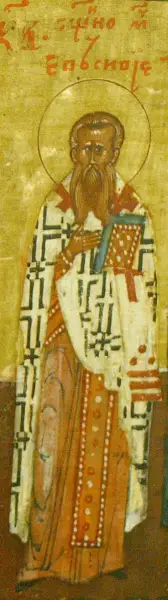
Overview
Eusebius of Samosata presided over the ancient Syrian see of Samosata and stood among the quiet architects of Nicene orthodoxy in the East. Almost everything known of him comes from the correspondence of Basil the Great and Gregory Nazianzen and from incidents recorded by Theodoret. Entrusted in 360 with the official record of Meletius's election to the see of Antioch, he refused to surrender the document when Arian bishops pressed the emperor Constantius II to destroy it, even under threat of losing his right hand. He helped secure Basil's election to Caesarea in 370 and, during Julian's persecution, moved in disguise through Syria, Palestine, and Phoenicia as a soldier, ordaining clergy for the harassed orthodox communities. The Arian emperor Valens banished him to Thrace in 374; after Valens died, Eusebius returned to his flock. While traveling to consecrate a bishop at Dolikha, he was struck on the head by a roof tile hurled by an Arian woman and died of the wound, honored since as a martyr. His feast is kept on 21 June.
The Complete Life
Both Hands Offered
The sources for Eusebius's career are few but weighty: the letters of Basil the Great and Gregory Nazianzen, and a handful of episodes preserved in Theodoret's Ecclesiastical History. Through them he emerges around the crisis year 361, when he became bishop of Samosata, an ancient city of Roman Syria. His office soon placed him at the center of the era's most delicate church politics. Into his keeping had come the official act that recorded Meletius's election to Antioch in 360, an election brought about by Arian bishops who expected Meletius to favor their cause. When Meletius instead proclaimed his orthodoxy, those bishops persuaded Constantius II, a committed Arian, to demand and destroy the record. The emperor demanded the document, threatening the bishop with the loss of his right hand; Eusebius answered by offering both hands, and the threat was withdrawn. The reply revealed the man: a bishop who valued the church's good order and the truth of the faith above his own body, and whose courage disarmed even imperial power. Later generations would see in that episode the whole of his character: meek in manner, immovable in duty, and willing to be maimed rather than to be unfaithful to a trust.
§ Life
A Bishop in a Soldier's Disguise
Eusebius's wider service to Nicene Christianity ran through two great undertakings. The first was political in the best sense: in 370 he joined his weight to that of Gregory Nazianzen to bring about the election of Basil as Archbishop of Caesarea in Cappadocia, securing for the orthodox cause one of its greatest minds at a moment of dangerous Arian strength. The second was pastoral and clandestine. When Julian the Apostate launched his persecution of orthodox Christians, Eusebius went underground in the fullest sense, traveling in disguise across Syria, Palestine, and Phoenicia, dressed as a military officer. In that guise he moved from community to community, ordaining presbyters and deacons so that the churches deprived of their clergy by the persecution would not be left shepherdless. The disguise was a striking choice for a bishop — the uniform of a soldier concealing a shepherd — and it speaks to the mixture of prudence and audacity his friends admired. Under a reign that sought to extinguish the orthodox hierarchy, Eusebius kept it alive, congregation by congregation, and emerged with the eastern church's confidence in him intact.
§ Life
Courage and Discretion
Two small episodes preserved by the tradition show the temper of Eusebius's soul better than any description could. The first is his answer to Constantius's threat: asked to surrender the record of Meletius's election at the price of his right hand, he held out both hands, declaring himself ready to lose either rather than betray his trust. It was the reflex of a man who had already settled in his heart what he owed to God and what he owed to men. The second came in his old age, when an imperial messenger arrived with the order of banishment to Thrace. Eusebius begged him to keep the command confidential, saying that if the people learned of it their zeal for the faith would drive them to rise in arms against the officer, and his death would be charged to the bishop. That same evening, though advanced in years, he left his see. His concern was not his own safety but his people's temptation to violence. Such discretion, joined to unshaken firmness, made him a model of episcopal prudence for a turbulent age.
§ Life
Exile, Restoration, and a Martyr's Death
Under Jovian's brief reign the orthodox enjoyed a respite, but in 374 Valens, the Arian ruler, sent Eusebius into banishment in Thrace, in the Balkan peninsula. The bishop, already old, accepted the sentence at once and departed that very evening, asking only that the order be kept from his people. He remained in exile until Valens died in 378, after which the banished confessors of the eastern church returned to their sees and Eusebius was restored to Samosata. His restoration proved brief. Journeying to Dolikha to consecrate a bishop for that church, he met his death in a manner at once sudden and ignoble: an Arian woman hurled a roof tile that struck his head, and the blow proved fatal. The church counted him a martyr from the first. The Roman Martyrology honors him on 21 June, and the feast is kept on that day in both the Roman Catholic and Eastern Orthodox traditions, under the title of bishop and martyr — a confessor whose blood was shed not in an arena but on ordinary pastoral duty. It was a death worthy of his life — hastening at his age toward one more act of service, and receiving, instead of the episcopal prayer he had come to offer, the crown he had so long deserved.
§ Life
Remembered in the Fathers' Letters
Eusebius of Samosata left no surviving writings, and his memory rests not on books but on the gratitude of the men he served. Basil the Great owed him the archbishopric of Caesarea; the orthodox communities of Syria, Palestine, and Phoenicia owed him the clergy he ordained in the dark years of Julian's persecution; the church of Antioch owed him his defense of Meletius's election. Theodoret thought the episodes of his life worth recording in an ecclesiastical history, and the letters of the Cappadocian Fathers preserve his name with honor. His cult was ancient and universal: venerated in the Roman Catholic and Eastern Orthodox churches alike, entered in the Roman Martyrology, and commemorated each year on 21 June. For later generations he stands for a particular kind of sanctity — the sanctity of the churchman: courage before emperors, discretion before crowds, fidelity in administration, and endurance in exile. He died while making another community's bishop, struck down in the midst of ordinary pastoral duty, and the church has never doubted that such a death was martyrdom. The Eastern churches give him the title of hieromartyr, honoring in him the bishop who sealed with blood the ministry he had exercised in disguise and in exile.
§ Life
Timeline
- 360
Entrusted with the official record of Meletius's election as bishop of Antioch.
§ Life
- 361
Was consecrated bishop of Samosata, the ancient Syrian city.
§ Life
- 362
Traveled incognito through Syria, Palestine, and Phoenicia during Julian's persecution, ordaining clergy.
§ Life
- 370
Helped bring about the election of Basil as Archbishop of Caesarea in Cappadocia.
§ Life
- 374
Banished by the Arian emperor Valens to Thrace; left his see that same evening.
§ Life
- 378
Restored to Samosata after the death of Valens.
§ Life
- 379
Struck down at Dolikha during a consecration journey — a roof tile an Arian woman threw proved fatal.
§ Life
In Their Own Words
If the people should be apprized, such is their zeal for the faith, that they would rise in arms against you, and your death might be laid to my charge.
The Record
- Canonization
- Pre-congregation; honored as bishop and martyr in the Roman Martyrology and the Eastern churches
Prayer
Bibliography
Show 6 sources
- Roman Martyrologium.
- Reynolds, H. R. "Eusebius, bishop of Samosata", A Dictionary of Early Christian Biography, ed. Henry Wace. John Murray, London, 1911.
- Ott, Michael. "St. Eusebius." The Catholic Encyclopedia, Vol. 5. New York: Robert Appleton Company, 1909.
- Butler, Alban. Lives of the Saints, Vol. VI, 1866.
- "Hieromartyr Eusebius the Bishop of Samosata", Orthodox Church in America.
- "Eusebius, Bishop of Samosata", Greek Orthodox Archdiocese of America.
Profile text adapted from the Wikipedia article, licensed CC BY-SA 4.0.
Pray with this saint every day
Save St. Eusebius of Samosata to your favorites, read the full profile, and get feast-day reminders in the Saints app.
Get the Saints AppFree on the App Store for iPhone and iPad