
252 – 362·Feast August 5
St. Eusignius of Antioch
Soldier-Martyr Beheaded under Julian the Apostate
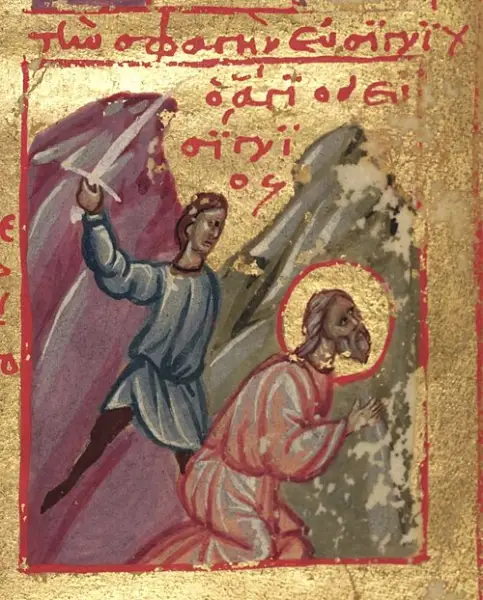
Overview
Eusignius of Antioch, a Roman soldier put to death in 362 at about one hundred and ten years of age, stands among the most long-lived of the martyrs. Born at Antioch in 252, he served in the imperial armies for roughly sixty years, from the reign of Maximian through those of Constantius Chlorus, Constantine the Great, and Constantine's sons. Early in Constantine's reign he was among those who saw the Cross shining in the sky, read as heaven's promise of coming victory, and he had beheld, at the martyrdom of his companion Basiliscus, angels and the Lord Christ welcoming the saint into heaven — an account he afterward gave to the church. In old age he retired from military life and returned to Antioch and gave his days to prayer, fasting, and the church's worship. When Julian the Apostate tried to revive the old gods, a resentful fellow citizen denounced him as a Christian. Summoned before the emperor in 362, Eusignius openly professed his faith and rebuked Julian for his apostasy, reminding him that he was Constantine's nephew. For this he was beheaded — a soldier to the end, executed at last by the empire he had served. He is commemorated on 5 August.
The Complete Life
Sixty Years under the Eagles
Eusignius was born at Antioch in 252, in an age when the church of that great Syrian capital was already old and its confessors numerous. His life ran across the very century whose course was most decisively altered by the fate of the Christians: he was born under the empire's pagan order, lived through the great persecution, and died under its brief pagan revival. According to his hagiography he entered the imperial armies as a young man and served for about sixty years, his career beginning under Maximian and continuing under Constantius Chlorus, Constantine the Great, and Constantine's sons. Soldiering, for Eusignius, was thus a lifelong profession rather than a phase; the Christian who would one day be beheaded by one emperor had given six decades of loyal service to his predecessors. The tradition that numbers him among the military saints rests on this long fidelity in arms, joined to the far greater fidelity he kept when the demand of service and the law of God finally collided in the court of Julian the Apostate. Few saints span so much history in a single lifetime.
§ References
Witness of the Cross and of a Martyrdom
Two great sights marked Eusignius's soldier's life and made him a witness in the fullest sense. The first was the martyrdom of Basiliscus, his companion, at which Eusignius was present; there he beheld angels and Christ himself receiving the saint into heaven, and he afterward gave an account of what he had seen, becoming one of the tradition's eyewitnesses of a martyr's crown. The second came early in the reign of Constantine the Great, when the Cross appeared in the sky as a sign of coming victory — the vision remembered as changing the empire's relation to the Christian name. Eusignius saw it, and carried the memory of it through the rest of his long life. A man thus formed had seen heaven honor both paths: the path of Basiliscus, who died for Christ, and the path of Constantine, who conquered beneath the Cross. His own course would touch both. For most of his years he bore arms as a Christian soldier; at the end, when a soldier's uniform could no longer shelter the faith, he would take the other path and die as Basiliscus had.
§ References
Confession Before the Apostate
When his military service ended, Eusignius did not spend his old age at ease. He retired to his native Antioch and gave his days to prayer, fasting, and the church's worship — the ordinary disciplines by which an old soldier became a monk at heart. He was living in this way when Julian came to the throne in 361 and set about restoring paganism to the empire. The old man's faith was well known in the city, but it took private spite to bring him to ruin: a fellow citizen nursed a grudge over a judgment Eusignius had once handed down, and denounced the old man to the emperor as a Christian. Julian called him before him in 362. The trial, as tradition reports it, was brief and fearless. Eusignius openly professed the faith of Christ, rebuked the emperor to his face for his apostasy, and reminded him whose nephew he was — that he belonged to the family of Constantine, under whom the Cross had shone over the army. No plea of age, service, or kinship was offered for him, and he seems to have wanted none. The confession was his last campaign, and he conducted it standing.
§ References
Beheaded at One Hundred and Ten
The sentence was beheading, carried out at Antioch in 362. Counting his birth from 252, as the tradition does, Eusignius was roughly one hundred and ten years old — among the most aged of all the martyrs, a man whose Christian life was longer than many of his judges' entire lives. He had outlived the persecutions of the third century, the conversion of Constantine, the vigor of his own military decades, and finally the patience of an embittered neighbor; and when the end came he met it with the directness the tradition always ascribes to him. The church enrolled him among the martyrs from the beginning, without any process of canonization, and his feast was fixed on the fifth of August, a date that in the Eastern Orthodox calendar falls within the forefeast of the Transfiguration — fittingly near the feast of the light that shone upon him at Constantine's side. His cult continues in both the Roman Catholic and Eastern Orthodox churches, and the memory of the veteran who died confessing the faith has never faded from either. Between his enlistment and his execution stretched the whole story of the fourth-century church, and he touched it at every turn — as soldier, as eyewitness, as confessor, and at last as martyr.
§ References
A Colonnade Saint of Two Traditions
Eusignius belongs to that company of saints whose testimony spans the empire's whole change of heart toward the Gospel. He linked in one life the age of the martyrs and the age of Constantine: he saw the martyrdom of Basiliscus and the vision of the Cross, served the armies of successive rulers, and finally died under the last pagan emperor, rebuking him for the apostasy that undid Constantine's work. His commemoration on 5 August keeps him in both the Roman Catholic and Eastern Orthodox calendars, and in the East his feast falls in the forefeast of the Transfiguration, so that each year his memory is drawn into the orbit of the shining Cross he claimed to have seen. In Saint Peter's Square his figure stands among the 140 colonnade saints that adorn the colonnade, a soldier of the fourth century keeping watch over the church of later ages. For soldiers, for the aged, and for all who must confess the faith late in life when it costs most, Eusignius remains an enduring example of courage unconquered by time. The longevity that might have made him a mere curiosity became, in the providence the tradition sees, his qualification: he alone could swear to both the vision of the Cross and the glory of the martyrs.
§ References
Timeline
- 252
Born at Antioch.
§ Introduction
- 361
Living in retirement at Antioch when Julian the Apostate took the throne and worked to restore paganism.
§ Introduction
- 362
Denounced as a Christian, professed his faith before Julian and was beheaded at Antioch, aged about one hundred and ten.
§ Introduction
The Record
- Major works
- Eyewitness account of the martyrdom of Basiliscus, given to the church
- Canonization
- Pre-congregation; venerated as a martyr since the earliest centuries
Prayer
Bibliography
Show 4 sources
- "Martyr Eusignius of Antioch". Orthodox Church in America.
- "Martyr Eusignius of Antioch". Ancient Faith Radio.
- "Saint Eusignius". The Newman Connection.
- "Eusygnius the Martyr of Antioch". Greek Orthodox Archdiocese of America.
Profile text adapted from the Wikipedia article, licensed CC BY-SA 4.0.
Pray with this saint every day
Save St. Eusignius of Antioch to your favorites, read the full profile, and get feast-day reminders in the Saints app.
Get the Saints AppFree on the App Store for iPhone and iPad