
died 510·Feast June 10
St. Euspicius
Gallo-Roman archdeacon and first abbot of Micy
Overview
Euspicius was a Gallo-Roman churchman who served as archpriest of Verdun in the turbulent years when the Frankish king Clovis was consolidating power in northern Gaul. During the siege of Verdun he walked into the Frankish camp to plead for mercy on behalf of the Gallo-Roman insurgents, and the courage and dignity of his intercession so impressed Clovis that the king rewarded him with land. Around 508 Clovis granted Euspicius and his nephew Maximinus, better known as Mesmin, the domain of Micy near Orléans, where the Loire meets the Loiret, together with additional estates and a refuge within the walls of Orléans itself. On this ground Euspicius founded Micy Abbey and became its first abbot, building a church dedicated to Saint Stephen. He won contemporary renown as a teacher of the contemplative life, and under him the monastery followed the austere rule of the Eastern desert fathers handed on in the West by John Cassian and Martin of Tours. His monks cleared and drained the neighboring land and encouraged agriculture among the local people, and from Micy monastic life spread through the diocese of Orléans. June 10, 510 brought Euspicius's death; Orléans laid him to rest near the shrine of Saint Aignan, and his nephew succeeded him as abbot. His relics were returned to the abbey after 1029, and he has been honored as a saint since before formal canonization processes existed.
The Complete Life
A Churchman of Verdun
The record of Euspicius begins in the city of Verdun, where he served as archpriest among its Gallo-Roman inhabitants during the last years of imperial rule in Gaul and the rise of the Frankish kingdom. Nothing is preserved of his birth or family beyond the fact that his nephew Maximinus, later famous as Mesmin, followed him into the religious life and became his closest collaborator. Verdun in this period was a contested place: Clovis and his Frankish warriors were extending their authority over the old Gallo-Roman cities, and the loyalties of the local population were caught between the old order and the new. When the city rose in insurgency and the king's army pressed siege against its walls, the Christian community looked to men like Euspicius for protection. It was a role he did not refuse. His standing as archpriest gave him both the standing and the obligation to act as mediator, and the decision he made — to leave the threatened city and walk into the enemy camp unarmed — became the turning point of his whole life. From that single act of intercession flowed the royal favor, the grant of land, and the monastery that would make his name endure among the saints of France.
§ Life
An Audience with Clovis
During the siege of Verdun, Euspicius presented himself before Clovis, king of the Franks, in his war camp, begging that the Gallo-Roman rebels be spared. The gesture was bold to the point of recklessness: he carried no lever but his office and his plea, and he placed himself bodily within the power of a warlord whose army had his own people at its mercy. Yet the petition succeeded beyond any reasonable hope. The king was deeply impressed by the archpriest, and in 508 he expressed that admiration in the most tangible way he could. Clovis conferred on Euspicius and Maximinus, his nephew, the estate of Micy, where the Loiret joins the Loire not far from Orléans, that a monastery might rise upon it. The grant was generous beyond a single estate: on top of the royal villa already standing there, the king bestowed further estates, together with a holding within the city walls of Orléans itself, called the Alleu de Saint-Mesmin, which was to serve as a refuge for the monks in times of trouble. What had begun as an appeal for the lives of others ended in an inheritance of peace, and Euspicius read the gift exactly as it was intended — as a summons to found and govern a house of prayer on Frankish soil.
§ Life
Founding Micy Abbey
On the land granted by Clovis, Euspicius raised Micy Abbey and became its first abbot, with his nephew Maximinus at his side. The abbey church was dedicated to Saint Stephen, the first martyr, a fitting patron for a community born in the aftermath of siege and bloodshed. Euspicius did not govern the new house by novelty; he set before his monks the rule of the Eastern hermits as observed by the followers of Saint Anthony and Saint Basil, the discipline that John Cassian and Martin of Tours had brought from the desert to the Christian West. Under this ancient teaching Micy took shape as a school of the contemplative life, and Euspicius himself gained a reputation as a renowned teacher of that interior discipline. But the mission of the monastery reached beyond the cloister. The monks cleared and drained the lands around the abbey, turning marsh and wilderness into productive ground, and they encouraged the people of the district to take up agricultural work themselves. The monastery thus became a center both of prayer and of practical improvement, and its influence radiated outward: from Micy Abbey, monastic life spread within and around the whole diocese of Orléans, seedling houses and vocations taking root wherever the first community's example reached.
§ Life
Teacher of the Contemplative Life
The spirituality Euspicius taught was inherited rather than invented, and that inheritance was deliberate. The rule followed at Micy was that of the Eastern hermits, the tradition of Saint Anthony and Saint Basil, carried into Gaul by John Cassian and Martin of Tours. It was a discipline of solitude, continual prayer, and renunciation that had crossed from the Egyptian desert into the monasteries of the West, and at Micy it found one of its early Frankish homes. Euspicius became renowned specifically as a teacher of the contemplative life — not merely as an administrator of a rule, but as a man whose own grasp of interior prayer could be communicated to others. This emphasis shaped the character of the abbey he founded: Micy was conceived from the beginning as a place where the silence of the desert could be lived on Gallic soil, at the meeting of the Loire and the Loiret. The contemplative teaching did not turn the community inward at the expense of the world, for the same monks who pursued prayer also drained the wetlands and taught agriculture to their neighbors. Prayer and labor, desert discipline and service to the surrounding countryside, formed a single vision in which the abbot's reputation as a spiritual master and the abbey's practical benevolence were two faces of one life.
§ Life
Death and Burial
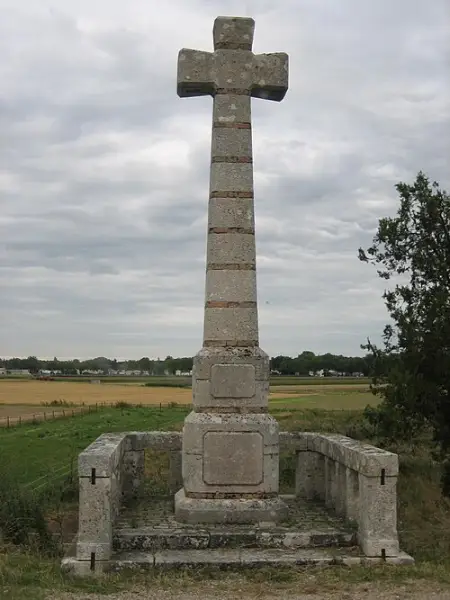
Euspicius did not long enjoy the abbey he had founded. He died on June 10, 510, scarcely two years after the royal grant that brought Micy into being. His death left the young community in the hands of the man he had formed: his nephew Maximinus, known as Mesmin, succeeded him as abbot and carried the house forward into the long history that made the name Saint-Mesmin de Micy famous. Orléans received the abbot's body beside the remains of Saint Aignan, within the Saint-Pierre-aux-Bœufs church — a church that later became the Church of Saint Aignan, so that his tomb remained under a honored roof even as the buildings around it changed. Burial beside the great bishop of Orléans placed Euspicius among the protectors of the city he had served. For more than five centuries the faithful honored him there, until shortly after 1029 his remains were translated back to the abbey he had founded on the Loire, which by then bore his nephew's name. The translation rejoined the founder to his foundation, and at Saint-Pryvé-Saint-Mesmin a cross was raised in memory of both saints, Euspicius and Mesmin, whose lives had been bound together in the founding of Micy.
§ Life
The Spread of Micy
Euspicius's achievement is measured less by the length of his abbacy than by what Micy became after him. The house he founded under royal patronage grew into one of the important monasteries of the Loire, and its distinctive fruit followed: monastic life went out from Micy through the diocese of Orléans and the lands about it. The clearing and draining of land by his monks modeled a partnership between monastery and countryside that encouraged the local population in agricultural work, embedding the abbey in the economy and affection of the region. His successors, beginning with Mesmin, kept the contemplative teaching alive, and the abbey's church, dedicated to Saint Stephen, stood over a community that remembered its first abbot as a saint long before any formal process of canonization existed. The veneration of Euspicius remained attached to the places he had sanctified: his tomb at Orléans, his relics at the abbey after their return shortly after 1029, and the Croix de Micy at Saint-Pryvé-Saint-Mesmin, dedicated jointly to Euspicius and Mesmin. Medieval writers on the monks of the West and historians of the diocese of Orléans preserved his memory, so that the archpriest who once pleaded for mercy at a besieged city's gates is still honored as the quiet founder of contemplative life on the Loire.
§ Life
Timeline
- 508
Went to the camp of King Clovis during the siege of Verdun to plead for mercy for the Gallo-Roman insurgents.
§ Life
- 508
Received from Clovis the domain of Micy near Orléans, with further estates and a refuge inside the city walls.
§ Life
- 508
Founded Micy Abbey with his nephew Maximinus and became its first abbot.
§ Life
- 10 Jun 510
Died on June 10 and was buried at Orléans beside Saint Aignan; his nephew Mesmin succeeded him as abbot.
§ Life
- 1029
Shortly after this year his remains were translated from Orléans back to the abbey, then known as Saint-Mesmin de Micy.
§ Life
The Record
- Major works
- Foundation of Micy Abbey, whose contemplative teaching shaped monastic life in the diocese of Orléans
- Patron of
- Monastic life in the diocese of Orléans·Venerated at Saint-Pryvé-Saint-Mesmin alongside St. Mesmin
- Symbols
- Abbot's habit and crozier·Church of Saint-Mesmin de Micy·Croix de Micy dedicated to Sts. Euspicius and Mesmin
- Canonization
- Pre-congregation canonization; venerated as a saint in the Roman Catholic Church from antiquity.
Prayer
Bibliography
Show 3 sources
- Montalembert, Charles Forbes comte de. The Monks of the West. P.J. Kenedy, 1912, p. 456
- Head, Thomas. "Saintly Patronage and Episcopal Authority at the Abbey of Micy", Hagiography and the Cult of Saints: The Diocese of Orléans, 800–1200. Cambridge University Press, 1990
- Goyau, Georges. "Diocese of Orléans." The Catholic Encyclopedia Vol. 11. New York: Robert Appleton Company, 1911
Profile text adapted from the Wikipedia article, licensed CC BY-SA 4.0.
Pray with this saint every day
Save St. Euspicius to your favorites, read the full profile, and get feast-day reminders in the Saints app.
Get the Saints AppFree on the App Store for iPhone and iPad