
died 118 (legend)·Feast September 20 (Thout 22 in the Coptic Church; October 1 in the Armenian Church)
St. Eustace
Roman general and martyr
Overview
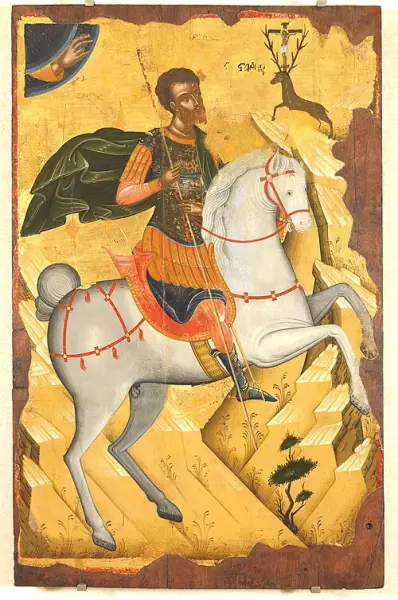
Eustace, known in Greek as Eustathios Plakidas and in Latin as Eustachius, was a Roman general whom the church of East and West has honored as a martyr since antiquity, though modern scholarship regards his story as the work of pious fiction rather than of history. According to the legend, he was a pagan commander under Trajan, called Placidas, whose life turned when, hunting a stag, he saw a cross shining between its antlers and heard the voice of God; baptized that night with his wife and sons, he took the name Eustathios, the steadfast. There followed the trials that gave the tale its shape: stripped of wealth and rank, he fled by ship to Egypt, lost his wife to the ship's captain, and while carrying his two sons across a river saw them snatched, one by a lion and one by a wolf. Unknown to him all three survived. Recalled by Trajan to lead the Roman army, the general unknowingly found his sons among his soldiers, and after the victory the family was restored to one another. Under Hadrian the general refused to sacrifice to the gods; he and his wife and sons were exposed to lions that would not touch them, and were then put to death in a brazen bull, their bodies recovered in secret by Christians. The oldest form of the passion is Greek, written between the fifth and seventh centuries; veneration is attested in the Byzantine church from at least the seventh century and in Rome from the eighth. In the high Middle Ages his story spread through verse, prose, and drama, was fixed by the Golden Legend, and made him one of the Fourteen Holy Helpers, the patron of hunters and firefighters, honored in art from Chartres to Canterbury and remembered in the very name of the island of Sint Eustatius.
The Complete Life
The Legend and Its Versions
The story of Eustace is one of the most traveled plots in medieval literature. Its original form is Greek: the earliest surviving passion, BHG 641, was written between the fifth and seventh centuries, and it already contains every element of the later tale, the pagan general Placidas serving Trajan, the vision of the cross while hunting a stag with the voice that prophesies misfortune, baptism with the family, the loss of estates, the flight to Egypt, the separation and reunion, and the death under Hadrian. The Latin West received the story through a rhythmic Life of 220 verses of the ninth or tenth century, a prose French Vita of the mid-thirteenth century, and a version of 2052 rhyming octosyllabic verses; at least ten medieval plays dramatized it. Scholars class the narrative with the tale-type of the Man Tried By Fate, the stock of chivalric romance such as Sir Isumbras, and a Spanish romance, the Book of the Knight Zifar, reworks the same material. An exemplum in the Gesta Romanorum and distant echoes of a Buddhist separation tale proposed by Gaster complete the genealogy of a story that hagiography shared with entertainment.
§ Variants and adaptations
The Greek Vita
In the Greek account the future saint is stratelates, a general under Trajan, originally called Plakidas. Hunting a stag, he beholds a vision of the cross between its antlers and hears a voice foretelling his trials; baptized, he takes the name Eustathios, steadfast, while his wife Tatiana becomes Theopiste and their sons are named Agapios and Theopistos. Disaster follows: his wealth and estates are gone, the family emigrates to Egypt, the ship's captain demands Theopiste for himself, and Eustathios escapes with the boys by swimming, only to lose them both to wild beasts as he carries them over a river, though unbeknownst to him they live. Years later Trajan summons the general back to war, and among his soldiers march his own sons; after the victory, lodging in an old woman's house, the brothers find each other and the old woman, who had escaped her captor, is Theopiste, and the family is whole again. Hadrian, succeeding Trajan, commands the general to sacrifice; on his refusal the whole family is thrown to the lions, which lie down at their feet, and the emperor has them killed in a brazen bull. Christians recover the bodies in secret and lay them in a well-known place.
§ Greek Vita
Historicity
No evidence substantiates the existence of Eustace, and scholarship has long classed him among the fictitious saints, a didactic tale dressed in the form of a passion. Hippolyte Delehaye rejected the historicity of the saint in 1919, and the Bollandist commentary in the Acta Sanctorum allows only two readings: a wholly invented figure, or some unknown oriental martyr whose original cult vanished without trace. Devotion to him cannot be shown earlier than the seventh century, more than five hundred years after the supposed martyrdom. The legend's geography is vague, apart from a flight to Egypt that mirrors the Holy Family's; the village of Badioson is unknown; the river Hydaspes of his great victory alludes to Alexander the Great and to no real campaign of Trajan, whose Parthian war ended in stalemate at his death in 117; and Hadrian is not known to have persecuted Christians at all, having rather ordered leniency toward them. The likeliest origin of the Greek legend is the East, probably Anatolia and perhaps Cappadocia, where the stag was an object of local cult, and a Celto-Galatian narrative model and a distant Buddhist parallel have both been proposed for parts of the story.
§ Historicity
Veneration and Art
Eustace belongs to the Eastern church first: he is venerated as the Great Martyr Eustathios, and N. Thierry traced the cult to Cappadocia, where frescoes of the Vision fill the early rock-cut churches, with a seventh-century stele at Davit Garedja in Georgia and a relief at Tsebelda in Abkhazia bearing the same scene. In the West, a Roman church of his dedication appears in a letter of Gregory II in the eighth century; the iconography passed into twelfth-century psalters, where the kneeling hunter before the stag illustrates a verse of Psalm 96, and the earliest Burgundian image is carved on a Romanesque capital at Vezelay. Abbot Suger records first relics at Saint-Denis, Philip Augustus rededicated a Parisian church as Saint-Eustache, and the Golden Legend of about 1260 fixed the tale for the whole of Europe: wall paintings at Canterbury and the glass of Chartres show the hunter at the stag's feet. He entered the company of the Fourteen Holy Helpers as the hunter's patron through Bavaria and Austria, lands where Hubert of Liège is otherwise the more customary intercessor, and as protector of firefighters, of those in adversity and family discord, and of Madrid; his horn is his attribute in the Anglican tradition. The feast of 20 September, kept in East and West alike, figured in the Roman Calendar for the eight centuries after the 1100s, until the 1970 reform set it aside on account of the wholly legendary Acts, though the Martyrology still names him and local observance continues, from Tocco da Casauria in Abruzzo to the Caribbean island of Sint Eustatius that bears his name, and to churches in Tamil Nadu in India.
§ Veneration
Timeline
- 118
According to the legend, the pagan general Placidas, hunting near Rome, saw the cross between the antlers of a stag and heard a divine voice; baptized that same night by the Bishop of Rome along with his wife Tatiana and their sons Agapios and Theopistos, he received the name Eustathios, meaning steadfast.
§ Greek Vita
- 118
After a second vision foretold his trials, he lost his estates, wealth, servants, and standing; fleeing by ship to Egypt, he could not pay the passage, and while the captain detained his wife Theopiste, Eustathios escaped with the two boys by swimming, only to see them carried off by a lion and a wolf as he ferried them across a river, though all three were secretly saved.
§ Greek Vita
- 118
Emperor Trajan recalled him to Rome to fight the barbarians; reinstated as general, he raised an army in which, unbeknownst to him, his own sons served, and after the victory, in the house of an old woman who proved to be Theopiste, the family recognized one another and was made whole.
§ Greek Vita
- 118
Under Hadrian the general refused to offer sacrifice to the gods; thrown with his family to the lions, they were untouched, and the emperor then ordered them killed in a brazen bull, dying with bodies unharmed by the flames, while Christians recovered the remains in secret and buried them in a well-known place.
§ Greek Vita
- 600
The oldest surviving version of the passion, the Greek text BHG 641, was composed at some time between the fifth and seventh centuries, already containing the full narrative of the general Placidas, his vision while hunting, and the death of his family under Hadrian.
§ Legend
- 700
Veneration is attested in the Byzantine church from at least the seventh century; a seventh-century Armeno-Georgian stele at Davit Garedja and a relief at Tsebelda in Abkhazia depict the Vision, and scholars trace the cult's origin to Anatolia, perhaps Cappadocia, where the stag was long sacred.
§ Veneration
- 731
A church dedicated to him existed in Rome by this period, mentioned in a letter of Pope Gregory II, the earliest witness to his cult in the Latin West.
§ Veneration
- 1260
Jacobus de Voragine's Golden Legend spread the story through the medieval West; a French prose Vita had been composed about the middle of the thirteenth century, and the tale had already been recast in rhythmic verse, in a poem of 2052 octosyllables, and in at least ten plays.
§ Veneration
- 1970
The commemoration of Saint Eustace and his companions, carried in the Roman Calendar since the twelfth century, was removed that year on account of the wholly legendary character of the Acts, though he is still named in the Roman Martyrology and keeps his feast of 20 September in East and West.
§ Veneration
The Record
- Major works
- The Greek passion (BHG 641), composed between the fifth and seventh centuries·A rhythmic Life of 220 verses (BHL 2771) from the ninth or tenth century·A thirteenth-century French prose Vita and a verse version of 2052 octosyllabic lines·Recast in Jacobus de Voragine's Golden Legend (c. 1260)
- Patron of
- Hunters and huntsmen·Firefighters and protection against fire·Trappers·Against family discord and in difficult situations·Torture victims·Madrid and Matera
- Symbols
- Stag with the cross between its antlers·Bull, from the brazen bull of his martyrdom·Crucifix and horn·Oven
- Canonization
- Pre-Congregation
Prayer
Bibliography
Show 12 sources
- "Given name Eustace". Behind the Name. Retrieved October 29, 2015.
- La Vie de saint Eustace. Version en prose française du XIIIe siècle, éditée par Jessie Murray. Paris, H. Champion, 1929.
- "Saint Eustace". Treasures of Heaven. Columbia University. Retrieved September 25, 2024.
- Muir, Lynette (2007). Love and Conflict in Medieval Drama: The Plays and Their Legacy. Cambridge University Press. p. 14. ISBN 978-0-521-82756-0.
- Hibbard, Laura A. (1963). Medieval Romance in England. New York: Burt Franklin. p. 5.
- H. Delehaye, «La légende» (1919), 181-183.
- Thierry, N. "Le culte du cerf en Anatolie et la Vision de saint Eustathe" in Monuments et mémoires de la Fondation Eugène Piot, 1991, pp. 33-100.
- M. Gaster, Journal of the Royal Asiatic Society (London), 1893, 869-871.
- Krautheimer, R., Corpus basilicarum christianarum Romae (1940) vol. I:216f; Krautheimer, Rome: Profile of a City, 1980:80f, 252, 271.
- Mershman, Francis (1909). "Sts. Eustachius and Companions". In Herbermann, Charles (ed.). Catholic Encyclopedia. Vol. 5. New York: Robert Appleton Company.
- Ælfric of Eynsham (1881). "Of Saint Eustache". Ælfric's Lives of Saints. London, Pub. for the Early English Text Society, by N. Trübner & Co.
- Kehoe, Niamh (2022). "Unsaintly Composure? The Old English Saint Eustace and Models of Holiness in Early Medieval England". The Review of English Studies.
Profile text adapted from the Wikipedia article, licensed CC BY-SA 4.0.
Pray with this saint every day
Save St. Eustace to your favorites, read the full profile, and get feast-day reminders in the Saints app.
Get the Saints AppFree on the App Store for iPhone and iPad