
1559 – 1591·Feast December 10
St. Eustace White
Elizabethan priest and martyr of Tyburn
Overview
Eustace White was an English Catholic priest who gave his life during the persecution of Catholics under Elizabeth I. His birth came at Louth in Lincolnshire in 1559; in 1584 he chose the Roman Catholic Church, forfeiting his father's favor and support. He crossed to Europe to train for the priesthood and was probably ordained at the Venerable English College in Rome in 1588. That same year he returned to an England gripped by anti-Catholic fury in the wake of the Spanish Armada, and for three years he carried out a clandestine ministry. In 1591 a seemingly harmless conversation with a fellow traveler led to his arrest in Dorset. He defended himself articulately before the courts of the West Country, but was sent to London and held in Bridewell Prison, where in October the Privy Council authorized his torture. He was hanged from the wall by his manacles for many hours, an ordeal he described in a surviving letter to Father Henry Garnet. His trial came in December 1591, and on the 10th of that month he suffered the full sentence — hanging, drawing, and quartering at Tyburn — sharing the scaffold with a fellow priest and three laymen. He pardoned his tormentor Topcliffe, named the priesthood as the one treason they could lay against him, and blessed God that his labors had won so happy a crown. He was beatified in 1929 and canonized among the Forty Martyrs of England and Wales in 1970.
The Complete Life
A Son of Louth
Eustace White was born in 1559 at Louth in Lincolnshire, a market town in the east of England, into a family of the Elizabethan settlement when Catholic practice was being steadily suppressed. For his first quarter-century he lived as his neighbors did, within a nation whose religious identity had been fixed by act of parliament and enforced by penalty. The conversion that would define his life came in 1584, when as a young man of about twenty-five he chose allegiance to the Roman Catholic Church. The cost was immediate and personal: his father disowned him, cutting him off from family and inheritance for the sake of the old faith. Such a break, in an age when family was livelihood and protection, marked the depth of his conviction. Rather than remain in England as a layman exposed to the recusant fines and surveillance of the time, he resolved on the priesthood — a resolution that in Elizabethan law amounted to choosing treason. He left England for the continent to study, joining the stream of young Englishmen who trained abroad for the dangerous work of mission at home. Everything that followed — his ordination, his return, his torture and death — flowed from that earliest decision in Lincolnshire to belong openly to the Catholic Church.
§ Life
Ordination and Return
White's path to the priesthood led through the English seminaries of Catholic Europe. He traveled to the continent to study for ordination and was probably ordained at the Venerable English College in Rome in 1588, the institution founded to supply missionary priests for a England where Catholic ordination had become impossible. The year of his ordination could hardly have been worse for a homecoming: 1588 was the year of the Spanish Armada, when the attempted invasion by Catholic Spain ignited anti-Catholic feeling in England to fever pitch. Every seminary priest who landed was presumed a fifth columnist, and the statute law made it high treason for an ordained Catholic to be present in the realm. White returned anyway, later that same year, and so began his ministry precisely when hostility toward his vocation crested. For three years he exercised a hidden priestly work among English Catholics — saying Mass, reconciling converts, sustaining recusant families — under constant danger of discovery. Those three years of ministry between his return and his arrest demanded the quiet heroism of concealment, movement, and disguise that characterized the whole seminary priesthood, and they prepared him, though he could not know it, for the arrest that would end in Tyburn.
§ Life
Arrest and Prison
The end of White's mission came not through betrayal by an informer's design but through an ordinary conversation. In 1591, three years after his return, talk with a fellow traveler on the road led to his arrest in Dorset. Brought before the authorities of the West Country, he mounted a very articulate defense of himself — so able, in fact, that his case did not conclude where it began. He was sent instead to London and committed to Bridewell Prison, the palace-turned-house of correction that held many of the era's religious offenders. There the machinery of the Elizabethan state turned against him at its highest level: in October 1591 the Privy Council itself authorized the use of torture to break him. What followed he recorded in his own hand. On the day after the feast of Saints Simon and Jude he was strung up by manacles locked into a staple, his feet on a stool that was then kicked away, and left hanging from shortly after eight in the morning until past four in the afternoon. His interrogator Topcliffe taunted him with news that the Spaniards had landed at Southwark. The next day he was hanged up again for an hour or two. Through it all he yielded nothing that the torture was designed to extract.
§ Martyrdom
The Prison Letter
The spirituality of Eustace White survives most vividly in a letter he wrote from prison to Father Henry Garnet on 23 November 1591, a few weeks before his death. The letter is remarkable neither for complaint nor for defiance of the ordinary kind, but for its exact, unembittered testimony: he sets down the hours of his hanging at the wall, the stool drawn away, the drums playing in honor of the Lord Mayor while Topcliffe taunted him, and the repetition of the torment the following day — and then he names it plainly, the malicious minds of our adversaries. It is the voice of a man who has looked at his suffering without flinching and committed it to paper as witness rather than grievance. The same spirit governed his final days. In his final hours he pardoned Topcliffe his cruelties and lifted him up in prayer, turning the memory of torture into intercession for the torturer. At the scaffold he told the crowd that the priesthood they punished was his sole treason, and he blessed God for crowning his labors so happily — reading his own butchery in the light of martyr's reward. Forgiveness, thanksgiving, and clear-eyed witness under pain: this was the interior disposition that torture could strain but not overturn, and it is what his surviving words still communicate.
§ Martyrdom
Tyburn, 10 December 1591
White was put on trial in December 1591, the proceedings concluding swiftly in condemnation. The sentence was the full penalty for priesthood: to be hanged, drawn, and quartered. He suffered it at Tyburn on 10 December 1591, at the age of about thirty-two, together with another priest and three laymen who died with him that day. The account of his last moments records both his charity and his agony. He pardoned Topcliffe for the brutalities of the prison and lifted his tormentor up in prayer. To the spectators he declared that the priesthood they punished was his sole treason, and he blessed God for what he called the happy crown of his toil, accepting death as the completion of his missionary work rather than its failure. The execution itself was brutal even by the standards of the punishment: hacked down while still breathing, he gained his feet once more, only to be tripped and hauled to the fire, where two men pinned his arms while the executioner did his butcher's work. He died as he had lived since 1588 — a priest of an outlawed church, faithful to the end of a ministry that had lasted barely three years and cost him everything.
§ Martyrdom
From Beatification to the Altar
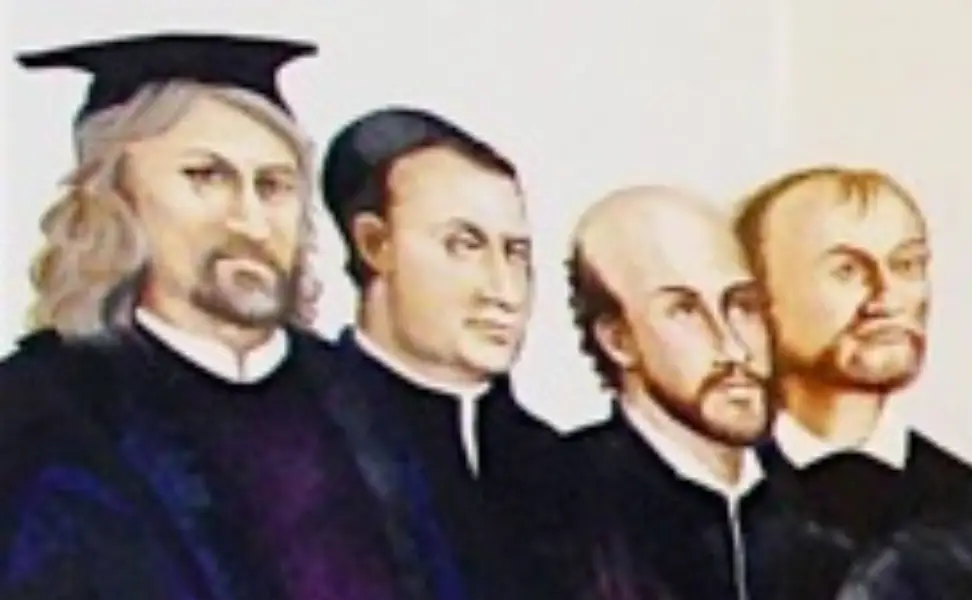
The Church's recognition of Eustace White came in two great acts, separated by four decades. On 15 December 1929, Pope Pius XI beatified him among the host of English and Welsh martyrs whose causes had been gathered over centuries, giving him the title of Blessed and permitting public veneration. Forty-one years later, on 25 October 1970, Pope Paul VI canonized him as one of the Forty Martyrs of England and Wales — the group of men and women, clergy and lay, chosen from the many beatified victims of the Tudor and Stuart persecutions to represent them all in the catalogue of saints. His feast is kept on several days that mark his several dignities: 10 December, the anniversary of his execution; 25 October, with the Forty Martyrs of England and Wales; and 29 October, as one of the Douai Martyrs, the seminary tradition that trained priests like him for the English mission. In art he is shown with the martyr's palm, the noose in his neck recalling his hanging at the wall and at the gallows, and the crucifix that was the whole of his supposed treason. He is depicted in a mural of the English Martyrs Parish in Derby among the companions who died with him.
§ Veneration
Memory in Louth and Beyond
The memory of Eustace White has returned in his own lifetime's geography to the town that disowned him by proxy more than four centuries ago. In St. Mary's Catholic Church in Louth — the town of his birth — a stained glass window portrays the local boy who became a martyr, so that the community once represented by a father's repudiation now honors him in glass and prayer. His story has also drawn modern scholarship: Mark Vickers has written a full-length study, Saint Eustace White: Elizabethan Priest and Martyr, returning attention to a figure whom the great narratives of the seminary priests had treated more briefly than his sufferings deserved. His prison letter remains one of the firsthand documents of the persecution, valued both as historical evidence of the torture practiced under Privy Council warrant and as a spiritual text of endurance. As one of the Forty Martyrs canonized in 1970, he belongs to a company that Roman Catholics of England and Wales hold up as patrons of religious fidelity in a hostile age, and his singular attributes — the palm, the noose, the crucifix — summarize the arc of a life that ran from a Lincolnshire market town to the triple gallows at Tyburn in barely thirty-two years.
§ Veneration
Timeline
- 1559
Born at Louth, Lincolnshire, England
§ Life
- 1584
Converted to the Roman Catholic Church and was disowned by his father
§ Life
- 1588
Ordained a priest, probably at the Venerable English College in Rome
§ Life
- 1588
Returned to England for ministry in the year of the Spanish Armada
§ Life
- 1591
Arrested in Dorset after a conversation with a fellow traveler; later imprisoned in Bridewell, London
§ Martyrdom
- Oct 1591
The Privy Council authorized the use of torture on him; he was hanged at the wall for hours
§ Martyrdom
- 23 Nov 1591
Wrote from prison to Father Henry Garnet, describing his torture a few weeks before his execution
§ Martyrdom
- Dec 1591
Put on trial in London and condemned to death for his priesthood
§ Martyrdom
- 10 Dec 1591
Hanged, drawn, and quartered at Tyburn with another priest and three laymen
§ Martyrdom
- 15 Dec 1929
Beatified by Pope Pius XI
§ Introduction
- 25 Oct 1970
Canonized by Pope Paul VI as one of the Forty Martyrs of England and Wales
§ Introduction
In Their Own Words
The morrow after Simon and Jude's day I was hanged at the wall from the ground, my manacles fast locked into a staple as high as I could reach upon a stool: the stool taken away where I hanged from a little after 8 o'clock in the morning until after 4 in the afternoon, without any ease or comfort at all, saving that Topcliffe came in and told me that the Spaniards were come into Southwark by our means: 'For lo, do you not hear the drums' (for then the drums played in honour of the Lord Mayor). The next day after also I was hanged up an hour or two: such is the malicious minds of our adversaries.
His only treason was his priesthood
The Record
- Major works
- Letter to Father Henry Garnet from Bridewell Prison, 23 November 1591, describing his torture
- Patron of
- Persecuted Christians·Catholic priests laboring in hostile circumstances·Converts to the Catholic faith
- Symbols
- Martyr's palm·Noose about the neck·Crucifix
- Canonization
- Beatified by Pope Pius XI on 15 December 1929; canonized by Pope Paul VI on 25 October 1970 as one of the Forty Martyrs of England and Wales.
Prayer
Bibliography
Show 3 sources
- Whitfield, Joseph Louis. "Ven. Eustace White." The Catholic Encyclopedia. Vol. 15. New York: Robert Appleton Company, 1912
- "CATHOLIC ENCYCLOPEDIA: Ven. Eustace White". www.newadvent.org. Retrieved 21 July 2022
- Vickers, Mark. Saint Eustace White: Elizabethan Priest and Martyr
Profile text adapted from the Wikipedia article, licensed CC BY-SA 4.0.
Pray with this saint every day
Save St. Eustace White to your favorites, read the full profile, and get feast-day reminders in the Saints app.
Get the Saints AppFree on the App Store for iPhone and iPad