
died c. 337·Feast July 16
St. Eustathius of Antioch
Patriarch of Antioch and defender of Nicaea
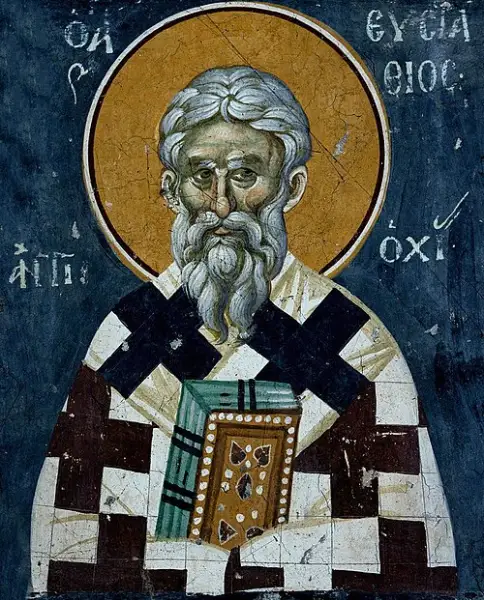
Overview
Eustathius of Antioch, sometimes surnamed the Great, was a fourth-century bishop and patriarch whose career embodied the storms that followed the Council of Nicaea. A native of Side in Pamphylia, he served as bishop of Beroea around 320 and ascended the patriarchal throne of Antioch on the eve of the Council of Nicaea in 325. At Nicaea he distinguished himself by his zealous opposition to the Arians; with Marcellus of Ancyra he joined forces with Alexander of Alexandria, and their theology significantly shaped the formulation of the Nicene Creed. His anti-Arian polemic against Eusebius of Nicomedia earned him enemies among the Eastern bishops, and in 330 a synod at Antioch deposed him on a charge of Sabellianism, a judgment confirmed by the emperor Constantine. When his supporters in the city rose in anger, Eustathius restrained them, urged them to remain faithful, and went humbly into exile accompanied by much of his clergy. Banished to Traianopolis in Thrace, he died there, probably around 337, though some accounts place his death as late as 370. The Eustathian party at Antioch outlived him and later refused to recognize Bishop Meletius, giving rise to the Meletian Schism. His one complete surviving work is the De Engastrimytho contra Origenem.
The Complete Life
From Side to Beroea
Eustathius was a native of Side in Pamphylia, the coastal region of southern Asia Minor, and his rise through the eastern episcopate followed the pattern of a man marked out early for learning and courage. By about 320 he was bishop of Beroea, the see in northern Syria where his abilities first brought him to notice in the years when the Church of the East was convulsed by the teaching of Arius. He had evidently made his position clear before the great council met, for when the episcopal throne of Antioch — among the oldest and most prestigious sees of Christendom — fell vacant with the death of Philogonius, it was Eustathius who was chosen to fill it, becoming patriarch of Antioch shortly before the Council of Nicaea convened in 325. The promotion placed him at the center of the coming struggle. Antioch was a city where the theological currents of the age ran strongest, and its patriarch would be expected to speak for the orthodoxy of the East. Later tradition counted him among the great bishops of the age and surnamed him the Great, an honor that acknowledges the stature he had already attained in the years before Nicaea gathered the bishops of the world to define the faith.
§ Life
Patriarch and Father of Nicaea
Eustathius's defining hour came at Nicaea in 325. There he made his name by the zeal with which he combated the Arian party, standing clearly as a vigorous opponent of Arius and his teaching — though the anti-imperial address sometimes attributed to him, the Allocutio ad Imperatorem, is probably not genuinely his. His importance at the council was constructive as well as polemical. He and Marcellus of Ancyra made common cause with Alexander of Alexandria and Ossius, forming the core of the pro-Nicene party among the Eastern bishops. Modern scholars of the controversy judge that the theology of Eustathius and Marcellus was in a real sense the theology that triumphed at Nicaea: the creed as adopted allowed of a single ousia and a single hypostasis, which was precisely the hallmark of their school of thought. Thus the final wording of the Nicene Creed bore their stamp to a marked degree — the confession that would define Christian orthodoxy concerning the divinity of the Son. As patriarch of Antioch, the senior champion of that confession in the East, Eustathius returned from the council at the height of his authority, holding the second city of the empire for the faith the bishops had just defined.
§ Life
The Quarrel with the Eusebians
The victory of Nicaea was followed within a decade by the undoing of nearly all who had won it. Eustathius's written assaults on the Arianism of Eusebius of Nicomedia earned him the dislike of many brother bishops in the East, and the post-conciliar struggle at Antioch became the first act of the longer controversy. The dispute no longer centered on Arius himself but on the meaning of the creed's key term, homoousios. The Eusebians, led by Eusebius of Caesarea, argued that the term implied Sabellianism, denying the real distinction of the Son from the Father. Eustathius answered by accusing Eusebius, an admirer of Origen, of deviating from the doctrines ratified at Nicaea, while Eusebius professed assent to every Nicene teaching and charged Eustathius instead with hugging the Sabellian error. The fifth-century historian Sozomen preserved this exchange as the immediate aftermath of the council. It was a contest between two readings of the Creed itself, each side accusing the other of the opposite error. Within ten years of the council, all the leading supporters of its creed — Athanasius, Eustathius, Marcellus, and the bishops of their school — had been deposed, disgraced, or exiled, and Eustathius was among the first to fall.
§ Life
Deposition and Exile
The reckoning came at Antioch itself. A synod convened in the patriarchal city in 330 deposed Eustathius on the charge of Sabellianism, and the emperor Constantine confirmed the judgment. His supporters among the people of Antioch rose against the synod's verdict and stood ready to defend him by force of arms — a riot that might have cost the city dear. But Eustathius restrained them, urged them to hold fast to the faith, and went quietly into banishment, a great company of his clergy choosing to walk at their bishop's side rather than remain under his successor. At the behest of Constantine the Great he was banished to Traianopolis in Thrace, on the far frontier of the empire. There the great patriarch lived out the remainder of his life in exile, dying probably about 337, though some traditions hold that he survived until as late as 370. The victors proposed Eusebius himself as the new bishop of Antioch, but the Caesarean declined the honor, and the see passed instead to Paulinus I. Eustathius had lost his church, his city, and his freedom, and had gained the reputation of a confessor of the faith he had helped to define.
§ Life
The Eustathians and the Meletian Schism
Eustathius's party outlived his fall and his death. The Eustathians, the old Catholic party of Antioch, remained loyal to the memory of their deposed patriarch and to the strict Nicene theology he represented. When Meletius became Bishop of Antioch in 360, they refused to acknowledge him, even once the Synod of Alexandria had sanctioned his election in 362. Their intransigence divided the orthodox of Antioch into two communions: the Eustathians, faithful to Paulinus their bishop, and the new Catholic party that followed Meletius. The schism troubled both East and West, for the holiest bishops of the East, such as Basil of Caesarea and Eusebius of Samosata, sided with Meletius, while Damasus and the Western bishops communicated with Paulinus. Meletius asserted three hypostases in the Holy Trinity, which Paulinus and Damasus would not allow for fear of Arianism, nor Basil the opposite formula, lest he be thought a Sabellian. The division — the Meletian Schism — lasted until the second decade of the fifth century, a long shadow cast by the synod of 330. Eustathius's literary legacy was smaller but enduring: his one complete surviving work, the De Engastrimytho contra Origenem, while the Hexameron commentary that bears his name in the manuscripts is of too late a date to be genuine. His feast is kept on July 16 in the Catholic Church and February 21 in the East.
§ Life
Timeline
- 320
Serving as bishop of Beroea in Pamphylia's neighboring Syria around this year.
§ Life
- 324
Became patriarch of Antioch, an office he held until 330.
§ Introduction
- 325
At the Council of Nicaea fought the Arians and, with Marcellus and Alexander, shaped the Nicene Creed.
§ Life
- 330
Deposed for Sabellianism by a synod at Antioch and, at Constantine's behest, banished to Traianopolis in Thrace.
§ Life
- 337
Died in exile at Traianopolis, probably around this year, though some accounts place his death as late as 370.
§ Life
- 360
After his death, his followers refused to recognize Meletius as Bishop of Antioch, sparking the Meletian Schism.
§ Life
In Their Own Words
But we do not believe that atheists can prevail against the Godhead.
At the Council of Nicaea] In the discussion on the meaning of faith, the blasphemous writing of Eusebius was presented as a decisive reference. Read before everyone, this writing immediately provoked a movement of amazement and rejection in the listeners and covered its author with an indelible shame. When the clique gathered around Eusebius was clearly condemned and the wicked writing torn up before everyone's eyes [...], the followers of Arius, for fear of being condemned to exile by such an important and unanimous council, hastened to come forward anathematizing the forbidden doctrine [...].
The Record
- Major works
- De Engastrimytho contra Origenem (his only complete surviving work)
- Patron of
- Defense of Nicene orthodoxy·Patriarchate of Antioch
- Symbols
- Patriarchal omophorion·Gospel book·Scroll of the Nicene Creed
- Canonization
- Pre-congregation canonization; venerated from antiquity in the Catholic, Eastern Orthodox, Syriac Orthodox, and Coptic Orthodox Churches.
Prayer
Bibliography
Show 8 sources
- Hanson, R.P.C. The Search for the Christian Doctrine of God
- Ayres, Lewis. Nicaea and its Legacy, 2004
- Eusebius. Life of Constantine III.59
- Socrates Scholasticus. Ecclesiastical History
- Ott, Michael; "St. Eustathius", Catholic Encyclopedia Vol. 5, New York, Robert Appleton Company, 1909
- Neale, John Mason. A History of the Holy Eastern Church, Volume 1, page 204
- Chisholm, Hugh, ed. (1911). "Eustathius, of Antioch". Encyclopædia Britannica. Vol. 9 (11th ed.). Cambridge University Press. p. 957
- Eustathius Antiochenus, Opera omnia, J.H. Declerck (ed.), Turnhout, Brepols, 2002 (Corpus Christianorum Series Graeca, 51). ISBN 978-2-503-40511-7
Profile text adapted from the Wikipedia article, licensed CC BY-SA 4.0.
Pray with this saint every day
Save St. Eustathius of Antioch to your favorites, read the full profile, and get feast-day reminders in the Saints app.
Get the Saints AppFree on the App Store for iPhone and iPad