
died c. 550·Feast July 29
St. Eustathius of Mtskheta
Persian convert and martyr under Sasanian rule
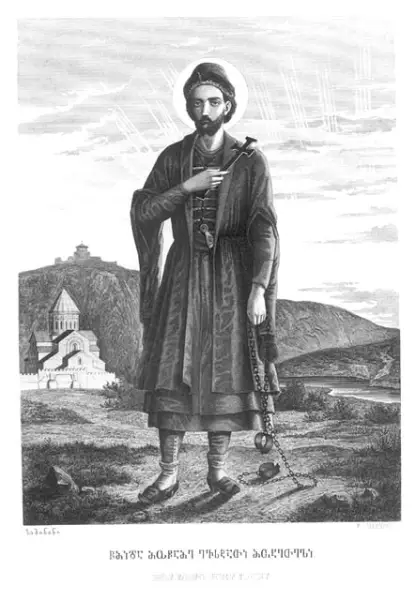
Overview
Eustathius of Mtskheta, known in Georgian as Evstat'i Mtskhet'eli, was a Persian Christian martyr put to death by the Sasanian military authorities in Caucasian Iberia, in eastern Georgia, around 550. Born in the Persian town of Ganzak and originally named Gvirobandak, his father stood among the high priests of the magi, and he himself learned the cobbler's craft. After embracing Christianity he escaped persecution and made his way to Iberia, which then lay under Iranian military rule, arriving in 541 and taking up residence at Mtskheta with a Christian wife. The local Persian cobblers' guild denounced him, together with seven other converts, to the marzban Arvand Gushnasp, who condemned the apostates to a pierced nose and threw them into prison under a death sentence. Half a year later Arvand, recalled to Persia by King Khosrau I, freed them as a parting kindness to the people. Four years on, the new marzban Vezhan Buzmihr had Eustathius seized again; before his tribunal the convert restated his Christian faith in a speech of roughly three thousand words — nearly half of the Passion written about him. Though the marzban was reluctant, he ordered the saint beheaded at Tbilisi. His body was borne back to Mtskheta and laid in the city's chief church. His Passion, composed within thirty years of his death, is one of the earliest works of Georgian literature.
The Complete Life
The Cobbler of Ganzak
Eustathius was born in Persia, in the town of Ganzak, under the name Gvirobandak, into the very heart of the Zoroastrian establishment: his father was a high-ranking priest of the magi. His trade was that of a cobbler, a craftsman's calling that would place him, once he had converted and migrated, in the company of a Persian workers' guild abroad. Nothing is recorded of his youth beyond this double inheritance of priestly lineage and manual craft, but both mattered for what followed. His conversion to Christianity was in Persian eyes not merely a change of private belief but a betrayal of his father's sacred office and of the religion of the state, and the anonymous sixth-century hagiographer who told his story framed his whole life as a passage from the religion of Iran to the church of Iberia. Rather than live as a secret Christian in his homeland, he fled persecution and traveled north to Georgia — Iberia, as it was then known — which, though a Christian kingdom of ancient standing, had fallen under Iranian military authority. In 541 he arrived and settled in Mtskheta, the old capital and its holiest town, where he married a Christian woman and took his place in the Christian community under a new, baptismal name.
§ Life
A New Life in Mtskheta
In Mtskheta, Eustathius built the ordinary life his conversion had made possible: a Christian household, a Christian marriage, and his cobbler's trade practiced among the craftsmen of the town. But the reach of the Persian Empire followed him. Iberia stood under Iranian military authority, administered by a marzban — a Persian military governor — and the Persian residents of the Georgian towns formed their own communities within it. Among these were the Iranian cobblers' guild, the guild to which Eustathius's own trade naturally belonged, and it was from his own colleagues in craft that the blow fell: the guild denounced him before the marzban Arvand Gushnasp alongside seven fellow converts from Zoroastrianism, to be judged as apostates. The charge against him was not anything he had done but what he had become — a Persian born of a magus's house who had accepted Christian baptism. Arvand punished the confessed apostates with a humiliating mutilation, ordering their noses to be pierced, and cast them into prison under sentence of death. Thus within a few years of his arrival Eustathius had been marked for execution in the land of his refuge, awaiting death in a Georgian prison for the faith he had adopted in Persia.
§ Life
Release and Reckoning
Eustathius's first sentence was never carried out. After six months in prison, the marzban Arvand was recalled to Persia by King Khosrau I, and as a parting kindness to the people he freed the condemned converts, sparing their lives as he departed his post. Eustathius returned to Mtskheta and to his trade, and for four years he lived the Christian life for which he had nearly died — a respite whose meaning he must have weighed daily, since the accusation of apostasy remained attached to his name in the records of the Persian administration. The respite ended when a new marzban, Vezhan Buzmihr, arrived to govern Iberia. Eustathius was rearrested, the old charge revived, and this time his case was heard in full before the governor's court. What he offered was not a plea for mercy but a confession: a speech of around three thousand words in defense of his Christian faith, reaffirming his apostasy from Zoroastrianism without qualification. The speech was preserved by the hagiographer and makes up nearly half of The Passion of Eustathius of Mtskheta — the greatest single monument to the man, a layman's reasoned testimony to his new faith spoken in the presence of the power that would kill him for it.
§ Life
Martyrdom at Tbilisi
Vezhan Buzmihr found himself in an uncomfortable position. The hagiography presents the marzban as reluctant to condemn the convert — moved, perhaps, by the man's character or by unwillingness to shed blood without necessity — but the law and the honor of the Zoroastrian religion left him no path to acquittal for a confessed apostate of priestly lineage. The order for execution went out, and Eustathius was beheaded at Tbilisi, in the fortress-town down the river from Mtskheta, around the year 550. The martyrdom closed a life that had spanned two empires and two faiths: a Persian of Ganzak, son of a magus, who died under a Persian governor's sentence in the Christian land of his adoption. The Christians of Iberia claimed his body with honor. His remains were taken to Mtskheta, the town where he had made his home and found his wife, and buried in its principal church — the ancient cathedral of Svetitskhoveli, the traditional burial place of Christ's robe and the spiritual heart of Georgian Christianity. There his tomb became a shrine, and there the Georgian Church has honored him ever since as one of its earliest martyrs, with his feast kept on July 29.
§ Life
A Founding Text of Georgian Letters
Eustathius's death gave birth to one of the foundational monuments of Georgian literature. Within thirty years of his reported death — the internal and linguistic evidence of the work supports so early a dating, though the earliest surviving manuscript, now in the Georgian National Center of Manuscripts, dates from around the year 1000 — an anonymous author composed The Passion of Eustathius of Mtskheta, a work whose full Georgian title speaks of the martyrdom and patience of the saint. It stands among the earliest extant works of Georgian writing, and its importance goes beyond the story it tells. The text preserves the first Georgian rendering of the Ten Commandments and a narrative of Jesus' life that echoes Tatian's second-century Diatessaron, and traces of the influence of the second-century Apology of Aristides — evidence of the theological vocabulary and narrative traditions circulating in the Caucasus in the sixth century. The Passion was first brought to print by Mikhail Sabinin in 1882, and modern scholars such as Donald Rayfield and David Marshall Lang have placed it at the head of the Georgian hagiographic tradition. For the Eastern Orthodox Church the martyr himself is commemorated on July 29, and his shrine at Svetitskhoveli Cathedral in Mtskheta remains the living center of his cult.
§ Life
Timeline
- 541
After converting from Zoroastrianism, fled persecution in Persia and came to Iberia, then under Iranian military authority.
§ Introduction
- 541
Took up residence at Mtskheta, a Christian town, and there married a Christian wife.
§ Introduction
- 550
Beheaded at Tbilisi on the marzban's orders around this year; his remains were buried in Mtskheta's principal church.
§ Introduction
- 1882
The Passion of Eustathius of Mtskheta, an anonymous sixth-century hagiography, was first published by Mikhail Sabinin.
§ Introduction
The Record
- Patron of
- Converts from Zoroastrianism·Christians persecuted for apostasy from their birth religion·The city and cathedral of Mtskheta
- Symbols
- Cobbler's tools·Martyr's palm and crown·Pierced nose as mark of his first punishment
- Canonization
- Pre-congregation canonization; venerated in the Eastern Orthodox Church, commemorated by the Georgian Church since the sixth century.
Prayer
Bibliography
Show 3 sources
- Rayfield, Donald (2000). The Literature of Georgia: A History. Routledge. pp. 44–45. ISBN 0-7007-1163-5
- Lang, David Marshall (1976). Lives and Legends of the Georgian Saints. London and New York: Mowbrays. pp. 95–99
- Rapp, Stephen H. (2014). The Sasanian World through Georgian Eyes: Caucasia and the Iranian Commonwealth in Late Antique Georgian Literature. Ashgate Publishing, Ltd. pp. 46–49. ISBN 978-1472425522
Profile text adapted from the Wikipedia article, licensed CC BY-SA 4.0.
Pray with this saint every day
Save St. Eustathius of Mtskheta to your favorites, read the full profile, and get feast-day reminders in the Saints app.
Get the Saints AppFree on the App Store for iPhone and iPad