
1434 – 1485·Feast January 20
St. Eustochia Smeralda Calafato
Poor Clare abbess and reformer of Messina
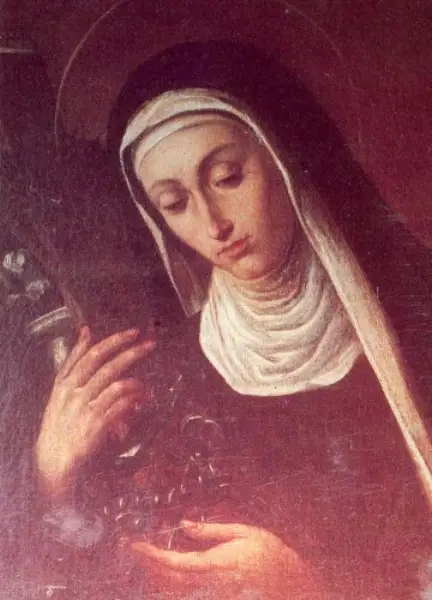
Overview
Eustochia Smeralda Calafato was a Franciscan saint of the Order of Poor Clares and co-patroness of Messina, the Sicilian city that remained her home from birth to death. Born Smeralda Calafato on 25 March 1434 in the village of Santissima Annunziata — where her parents had fled the plague then ravaging Messina — her father being Bernardo Calafato, one of Messina's wealthy merchants, and her mother Mascalda Romano. Noted for her beauty from early youth, at fifteen she resolved against her parents' wishes to become a nun, entering the Poor Clare convent of Basicò despite her brothers' threats to burn the house down. She took the name Eustochia and spent more than ten years at Basicò, known among the sisters for conspicuous devotion, vigils, fasting, and corporal austerities. Convinced that Basicò observed the rule's poverty too loosely, she obtained the approval of Pope Callixtus III and in 1464 founded a new convent at Messina, Montevergine, seen through by the generosity of a well-to-do kinsman. Elected its first abbess, she governed a community that had grown to fifty sisters when death came to her on 20 January 1485 in her fiftieth year. Beatified in 1782, she was canonized in 1988; her incorrupt body rests in her monastery, exposed for veneration every August 22.
The Complete Life
A Child of the Plague Year
Eustochia was born Smeralda Calafato on the Annunciation feast of 25 March 1434 — that year also Holy Thursday — in the small town of Santissima Annunziata near Messina. Her very birthplace was an act of providence's irony: her mother Mascalda Romano was pregnant when plague struck the city of Messina, and her father Bernardo Calafato, a rich merchant of the city, fled with his wife to the countryside, where the child was born safe from the contagion that filled the streets they had left. The girl grew up in comfort as the daughter of wealth, and even as a girl her beauty drew notice — the quality on which a merchant's daughter's future most securely rested in fifteenth-century Sicily. Nearly everything we know of her descends from a memoir set down two years after she died by one of her own sisters in religion, Suor Jacopa Pollicino, daughter of the Baron of Tortorici, a manuscript that lay unknown until its discovery only in the 1940s. Her name, Smeralda — emerald — and her family's standing set her on a course toward an advantageous marriage, but at fifteen she broke with every expectation her parents had formed, resolving to give her life to God as a religious, a decision she would maintain against fierce family opposition.
§ Biography
Against Her Parents' Wishes
At fifteen Eustochia determined to take religious vows, against the wishes of her parents, and fixed on Basicò, a convent of Poor Clares, for her entrance. The opposition her decision provoked was not mere disappointment: her brothers went so far as to vow that they would set fire to the convent should she carry out her purpose — a threat of violence against her chosen house that would have destroyed both the community and her vocation with it. She was not deterred. She entered Basicò, took the name Eustochia, and remained there for over ten years, proving her resolve not in a single dramatic act but in a decade of cloistered fidelity. Among the sisters her devotion and austerities set her apart: she kept long night vigils, practiced frequent fasting, and disciplined her body — the secret labors by which the young woman of legendary beauty quietly dismantled the world's claim upon her. Yet her years at Basicò planted the seed of her life's work. The poverty at the heart of the Poor Clare vocation she cherished deeply, the charism of Lady Jacoba's and Clare's own following of the poor Christ, and she came to judge that her convent fell short of the rule's rigor on this point — a conviction that would eventually carry her out of Basicò to build a house of her own.
§ Biography
Montevergine, the Mountain of the Virgin
Eustochia's dissatisfaction with Basicò's mitigated poverty matured into a plan of reform: rather than quarrel with her first convent, she would found a second that kept the rule whole. After conferring with the community and its superior, she secured the approval of Pope Callixtus III, and in 1464 her new convent was established at Messina. It became known as Montevergine — the Mountain of the Virgin — a name that caught both its site above the city and the Marian devotion at its heart. The building project was apparently seen through by the generosity of a well-to-do kinsman, so that the merchant's daughter's foundation was raised, fittingly, on merchant's money freely given. Once established around 1459 in the sequence of her undertaking, the house on its mountain became the center of a strict Franciscan observance in Sicily and of Eustochia's remaining twenty years. Her sisters chose her as abbess, and under her government the community grew until, fifty sisters belonged to the house when she died. From Basicò's restiveness had come not a schism but a multiplication: a new house of the same order, poorer in fact, richer in observance, and destined to enshrine her incorrupt remains and carry her name through the centuries as the Monastero di Montevergine.
§ Biography
Death at Fifty
Eustochia governed Montevergine until her death on 20 January 1485, in her fiftieth year. The fifty years of her life had described a perfect arc within a few miles of Sicilian ground: born of Messina's wealthy burghers in the neighboring village, schooled in austerity at Basicò, and buried as abbess of the house she had built above the city. By her death the community numbered fifty sisters, a flourishing that testified to the attraction of the strict observance she had won the right to live. Her body was found incorrupt, and it rests to this day in the monastery of the Sanctuary of Montevergine in Messina that she founded — the abbess still present, in the flesh, among the daughters of her foundation. Devotion to her took civic form in the centuries after her death: as joint patroness of the city she is honored each August 22, when her remains are displayed for public veneration and the city government, in solemn ceremony, presents an offering at her shrine. The custom endures to this day; pilgrims may pray at her body two days each week who come to the mountain she raised for the Virgin. She had left the world's wealth, and the city had never ceased to come to her door.
§ Veneration
From Blessed to Saint
The Church's judgment on Eustochia came in two acts separated by more than two centuries. On 14 September 1782, Pope Pius VI beatified her, enrolling the Poor Clare among the blessed and confirming the cult that Messina had long paid her. Nearly a hundred and ninety-nine years later, on 11 June 1988, Pope John Paul II canonized her — choosing, notably, to pronounce the canonization at Messina itself, in the city of her birth, her convent, and her tomb, and preaching the canonization homily in Italian at her shrine city. Her liturgical memory has its own layered history. The Franciscans traditionally celebrated her on 13 February; the post-conciliar reform of the order's calendar struck that observance from the general list, though Traditional Roman Catholics still keep her feast on that date, with a minor commemoration on 22 August. Messina celebrates her on the anniversary of her death, January 20, the day the local Church honors its patroness. She is depicted in art as a Poor Clare nun holding a cross — the single attribute that sums her: the beautiful heiress whose only adornment was the instrument of salvation. Her cultus remains centered in Messina, of which she is co-patroness alongside the city's ancient protectors.
§ Veneration
The Saint of Messina
Eustochia's legacy is inseparable from her city. Messina claims her as co-patroness, keeps her feast on January 20, and has maintained without interruption the August 22 exposition of her body with the municipality's solemn gift — a civic devotion rare in its continuity. The Monastero di Montevergine endures as her foundation and her shrine, where her incorrupt body can be visited twice a week. Even the art of Messina bears her trace: it is thought that she was the model for Antonello da Messina's depiction of the Virgin of the Annunciation, the great panel now in the Palazzo Abatellis at Palermo, so that the face of the beautiful young Clare may gaze out of one of the Renaissance's most celebrated Madonnas. Her historical witness was secured by the biography of Suor Jacopa Pollicino, written two years after her death and rediscovered only in the 1940s, which preserved the details of her austerities, her reform, and her founding. As a reformer she stands in the great Franciscan line of women who demanded that poverty be actual rather than nominal; as a foundress she belongs to the tradition of Italian clarisse whose houses shaped the spiritual geography of their cities. In Messina — a city tested by plague in her mother's womb and by earthquake in later centuries — she remains the local daughter who fled nothing and intercedes for everything.
§ Veneration
Timeline
- 25 Mar 1434
Born at Santissima Annunziata near Messina, where her parents had fled the plague then ravaging the city.
§ Biography
- 1449
At fifteen, against her parents' wishes, determined to take religious vows and entered the Poor Clare convent of Basicò.
§ Biography
- 1459
Around this year founded the Messina monastery later known as the Sanctuary of Montevergine.
§ Veneration
- 1464
With the approval of Pope Callixtus III founded the new convent of Montevergine and was chosen its abbess.
§ Biography
- 20 Jan 1485
Died at Messina aged fifty, leaving the Montevergine community fifty sisters strong.
§ Biography
- 14 Sep 1782
Beatified by Pope Pius VI.
§ Veneration
- 11 Jun 1988
Canonized by Pope John Paul II at Messina.
§ Veneration
The Record
- Major works
- Foundation of the convent of Montevergine at Messina (founded around 1459-1464)·Strict reform of Poor Clare observance in Sicily
- Patron of
- Co-patroness of Messina·Poor Clares
- Symbols
- Poor Clare nun holding a cross
- Canonization
- Beatified by Pope Pius VI on 14 September 1782; canonized by Pope John Paul II at Messina on 11 June 1988.
Prayer
Bibliography
Show 4 sources
- Suor Jacopa Pollicino, biographical account of Eustochia written two years after her death; Archivio Storico Messinese - Anno III - 1903, at page 52
- Breviarium Romano-Seraphicum ad Usum Fratrum Minorum Capuccinorum, Pars Hiemalis, 1955, Rome, pg. 973
- "Eustochia Calafato". Patron Saints Index. Archived from the original on 2007-12-19. Retrieved 2007-12-12
- Visita pastorale a Messina e a reggio Calabria: Canonizzazione della beata Eustochia Calafato, Omelia di Giovanni Paolo II, Messina - Sabato, 11 giugno 1988, vatican.va
Profile text adapted from the Wikipedia article, licensed CC BY-SA 4.0.
Pray with this saint every day
Save St. Eustochia Smeralda Calafato to your favorites, read the full profile, and get feast-day reminders in the Saints app.
Get the Saints AppFree on the App Store for iPhone and iPad