
c. 368 – 419/420·Feast September 28
St. Eustochium
Roman Virgin and Monastic Founder of Bethlehem
Overview
Eustochium, given the full name Eustochium Julia, entered the world at Rome around 368 as the third of the four daughters of Paula and of the senator Toxotius. When Jerome arrived in the city in 382, mother and daughter placed themselves under his teaching, and the young Eustochium resolved to live as a consecrated virgin, taking a formal vow around 384 over Jerome's celebrated letter on the keeping of virginity. In 385 she and Paula left Rome for the East, toured the desert ascetics of Egypt, and in 386 settled permanently at Bethlehem, where they raised four monasteries and a hospice beside the Lord's birthplace. Eustochium was a woman of rare learning who read Latin, Greek, and Hebrew Scripture, and Jerome acknowledged her part in prompting several of his biblical commentaries. After Paula's death in 404 she directed the women's communities through years of real poverty, and in 417 she and Jerome appealed to Pope Innocent I after armed men plundered the Bethlehem houses. She died soon afterwards, probably in 419 or 420, and her niece, the younger Paula, carried on her work.
The Complete Life
A Daughter of the Roman Nobility
Eustochium was born at Rome around 368 and named Eustochium Julia, a name that marked her family's standing in the Julian clan, one of the great houses of the city. Her father was the senator Toxotius, and her mother was Paula, the woman who would become one of the most famous ascetics of her age. She was the third of four daughters, with sisters named Blaesilla, Paulina, and Rufina, and a brother who bore their father's name. Jerome, ever eager to adorn his friends with ancient pedigree, made a series of doubtful assertions about the family's ancestors, tracing Toxotius to the Julian race and Paula to the Scipios and the Gracchi; modern scholars give such claims little weight. What mattered for the girl's future was the household's faith. When her father died around 380, Paula and her daughter embraced a manner of life as severe as anything practiced by the monks of the Egyptian desert, and the Roman aristocracy watched, half scandalized, as the widow's palace turned into something close to a monastery.
§ Biography
The Vow of Perpetual Virginity
Jerome came to Rome from Palestine in 382, and Paula and Eustochium at once put themselves under his spiritual and intellectual direction. The following years fixed the young woman's course. Relatives did what relatives do: her uncle Hymettius and his wife Praetextata tried every argument to coax the girl out of her austerities and into the ordinary pleasures of the world, and every argument failed. About the year 384 Eustochium bound herself by a formal vow of perpetual virginity, and for that occasion Jerome composed the letter that remains among the most famous documents of early Christian asceticism, his treatise on the keeping of virginity, the twenty-second of his epistles. One modern scholar has judged it the finest expression of his whole ascetic doctrine, while another has examined critically the severe views it contains on the female body; the letter itself, addressed to Eustochium, praises rather than reproaches her. A year later Jerome sailed for the East, and within a short time mother and daughter had abandoned Rome to follow him, a step that severed them from their class and their city for good.
§ Biography
Pilgrimage and Foundation at Bethlehem
In 386 mother and daughter went in Jerome's company to Egypt, spending time among the ascetics of the Nitrian Desert so as to learn a discipline they meant to transplant to Palestinian soil. In the autumn of that year they returned and settled at Bethlehem, beside the basilica marking the place of Christ's birth, and there they began at once to build. Between 386 and 389 four monasteries rose, together with a hospice for pilgrims; while the work went forward the family lived in a modest building nearby. One of the houses was given to monks under Jerome's direction; the other three became convents for the many virgins who gathered around Paula and Eustochium, with separate quarters for the two communities and a single oratory in which the whole company of women gathered repeatedly through the day for the Divine Office and common supplication. Jerome bore witness, in his three hundred and eighth letter, that the two noblewomen performed the most menial services for the sisters with their own hands. They lived amid constant study of Scripture, always under Jerome's teaching.
§ Biography
Scholar of Three Tongues
Eustochium's asceticism was inseparable from learning. She spoke Latin and Classical Greek with complete ease, and she could read the Scriptures directly in Hebrew, an accomplishment almost unheard of among Western Christians of her generation and the very skill on which Jerome's great translation labors depended. Her influence on his work was acknowledged openly: many of his biblical commentaries owed their existence to her encouragement, and he dedicated his expositions of the prophets Isaiah and Ezekiel to her. The letters he wrote for her instruction and spiritual advancement were, by his own testimony, very numerous. Modern scholarship has returned repeatedly to this spiritual friendship. One study of his famous letter to her describes the blazing language of ascetic desire within it; others have debated how his doctrine of the body should be judged. Yet the picture the sources give of Eustochium herself is of a woman who combined aristocratic dignity with a taste for obscurity, scrubbing convent floors while correcting the Scriptures in three languages, and who asked for no memorial beyond the libraries and chapels her labor helped to build.
§ Biography
Poverty, Violence, and the Appeal to Rome
Paula died in 404, and Eustochium succeeded her as head of the three convents, an office she held for the rest of her life. The inheritance was spiritual wealth and temporal misery: her mother's lavish almsgiving had drained the community's resources, and the new superior struggled for years against real want, comforted by Jerome's encouragement and advice. The worst blow came in 417, when a mob of marauders stormed the Bethlehem houses, looted them, put one to the flames, and left some of the inhabitants dead or brutalized. It was alleged that the outrage had been instigated by John II, Patriarch of Jerusalem, and by the Pelagians, against whom Jerome had directed his sharpest polemics. Eustochium and Jerome wrote a joint report of the affair to Pope Innocent I, who severely rebuked the patriarch for allowing such violence against consecrated communities. The aged virgin did not long survive the blow. She died shortly afterwards, probably in 419 or 420, and her niece, the younger Paula, took up the supervision of the convents she had governed.
§ Biography
An Ancient and Ecumenical Cult
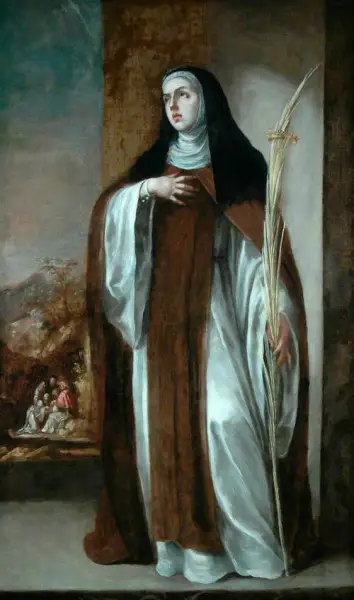
Eustochium was never the subject of a formal canonization process, for she belongs to the first generations of Christians whose sanctity the Church recognized by enduring memory rather than by decree; she stands among the pre-congregation saints venerated from antiquity. The Catholic Church keeps her feast on 28 September, the same date on which the Eastern Orthodox, the Eastern Catholic, and, since recently, the Anglican Communion remember her. Her veneration has continued to grow in the modern era. In 2022 the General Convention of the Episcopal Church added her formally to that church's liturgical calendar, giving her a feast on 28 September together with her mother, Paula of Rome, a recognition that joined the Roman virgin to the roll of witnesses honored across the Anglican world. Art has served her memory as well: Juan de Valdés Leal's Baroque painting of the saint keeps her image before later generations, and iconography resources still gather the artistic tradition of Paula and her daughter, the Roman widows who turned Bethlehem into a school of consecrated life.
§ Veneration
A Family of Saints and Scholars
The community Eustochium governed did not die with her. Her niece, the younger Paula, succeeded to the direction of the convents and maintained the double monastery her grandmother had founded beside the Lord's birthplace, keeping alive the tradition of scriptural scholarship and absolute poverty that Jerome and the two women had planted there. The family's vocation reached further than Bethlehem. Eustochius, the fifth-century bishop of Tours, may have been her nephew, and later genealogical studies have proposed further lateral descendants among the sainted bishops of Gaul, including Perpetuus and Volusianus. Her intellectual legacy endured in Jerome's writings, for the letters composed for her instruction and the commentaries dedicated to her circulated for centuries as masterpieces of patristic exegesis, and historians of early Christianity continue to study her correspondence as evidence for how aristocratic Roman women shaped the ascetic movement from within their own class. A modern painter's image and an Episcopal calendar entry confirm what the sources suggest: the virgin who left Rome for a stable has never lost her hearers.
§ Biography
Timeline
- 368
Born at Rome as Eustochium Julia, third daughter of Paula and Senator Toxotius
§ Biography
- 382
Placed herself and her household under the spiritual direction of Jerome on his arrival from Palestine
§ Biography
- 384
Made a vow of perpetual virginity, occasioning Jerome's famous letter on guarding virginity
§ Biography
- 385
Followed Jerome to Palestine with her mother after his departure from Rome
§ Biography
- 386
Toured the ascetics of Egypt's Nitrian Desert, then settled for good at Bethlehem and began building four monasteries and a hospice
§ Biography
- 389
Completion of the Bethlehem monasteries, whose women's houses she ran with Paula while Jerome led the monks
§ Biography
- 404
Assumed direction of the nunneries after Paula's death, despite the community's impoverished finances
§ Biography
- 417
Rioters pillaged and burned the Bethlehem monasteries; she and Jerome reported the outrage to Pope Innocent I
§ Biography
- 28 Sep 420
Died at Bethlehem on 28 September, probably in 419 or 420, soon after the attack; her niece Paula succeeded her
§ Biography
- 2022
Added to the Episcopal Church's liturgical calendar with a feast on 28 September, alongside her mother Paula
§ Veneration
The Record
- Major works
- Four monasteries and a hospice at Bethlehem, founded with Paula (386-389)
- Canonization
- Pre-congregation: venerated as a saint since antiquity by the Catholic, Orthodox, Eastern Catholic, and Anglican churches
Prayer
Bibliography
Show 6 sources
- Clark, Elizabeth A. (1982). Jerome, Chrysostom, and friends: essays and translations. Edwin Mellen Press. ISBN 0-88946-542-8. OCLC 827946924.
- Miller, Patricia Cox (1993). "The Blazing Body: Ascetic Desire in Jerome's Letter to Eustochium". Journal of Early Christian Studies. 1 (1): 21-45. doi:10.1353/earl.0.0133.
- Cohick, Lynn H.; Hughes, Amy Brown (2017). Christian women in the patristic world: their influence, authority, and legacy in the second through fifth centuries. Baker Academic. ISBN 978-1-4934-1021-7.
- Herbermann, Charles, ed. (1913). "St. Eustochium Julia". Catholic Encyclopedia. New York: Robert Appleton Company.
- "St. Paula and St. Eustochium in Art". christianiconography.info.
- T. S. M. Mommaerts & D. H. Kelley, "The Anicii of Gaul and Rome", in Fifth-century Gaul: a Crisis of Identity?, ed. John Drinkwater and Hugh Elton (Cambridge University Press, 1992), 120-121.
Profile text adapted from the Wikipedia article, licensed CC BY-SA 4.0.
Pray with this saint every day
Save St. Eustochium to your favorites, read the full profile, and get feast-day reminders in the Saints app.
Get the Saints AppFree on the App Store for iPhone and iPad