
275 – c. 349·Feast September 18
St. Eustorgius I
Bishop of Milan and Bearer of the Magi's Relics
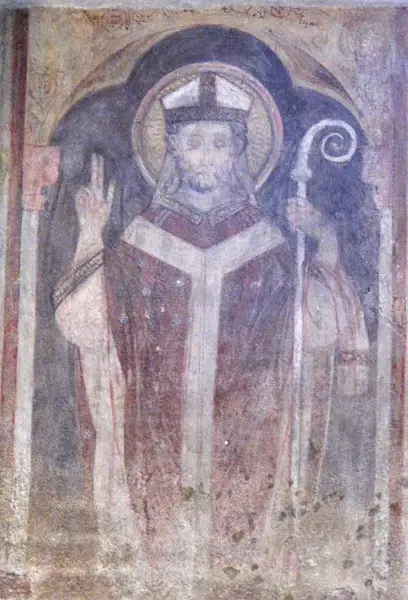
Overview
Eustorgius I, a noble Greek by tradition's account, was born around 275 and led Milan as its bishop from 343 until roughly 349. Chosen to succeed Protasius, he traveled to Constantinople to have his election confirmed by the Emperor, and on that journey he received a gift of immeasurable consequence for Western Christendom: the relics of the Three Magi, which he carried back to Milan. During his episcopate he convened two synods, in the mid-340s, and set in motion the building of churches and basilicas across the city. Athanasius praised him as one who stood guard over the faith, placing his name among Arianism's opponents, while Ambrose honored him with the title of confessor. His name entered the Ambrosian Rite, and by the fourteenth century Milan counted five churches under his patronage, chief among them the Basilica of Sant'Eustorgio, where his relics rest in the main altar. The Magi's remains were carried off to Cologne by Barbarossa in 1164, though a portion came home to Milan in 1904. The Church keeps his memory on 18 September.
The Complete Life
A Noble Greek in Northern Italy
The sources that survive for Eustorgius reach him through tradition rather than through contemporary documentation, and they agree on his origin: he was a noble Greek, born around 275 in the eastern half of the Roman Empire. How a man of that background rose to the legateship of Milan, the imperial city where emperors increasingly resided in the early fourth century, the record does not say; the title suggests he served the church there as an official representative before his elevation. What can be affirmed is the esteem he had earned by the time the see fell vacant. When Bishop Protasius died in 343, the clergy and people of Milan turned to Eustorgius as successor, at a moment when the episcopate of northern Italy stood close to the center of imperial politics. His Greek birth made him a bridge between the two halves of the Christian world, a fact that would soon bear extraordinary fruit when his journey east for imperial confirmation put within his reach treasures no Western bishop had yet possessed.
§ Life
Election and the Gift of the Magi
Eustorgius took up the bishopric of Milan in 343 upon Protasius's death, but his election required a formality that carried him far: the new bishop traveled to Constantinople to obtain the Emperor's confirmation of his appointment. There, tradition records, the Emperor bestowed on him the relics of the Three Magi, and Eustorgius translated them from the eastern capital to Milan, installing them in his city with the honor their journey to Bethlehem had always demanded. A legend built around this translation, preserved in a vita whose written form dates from the twelfth century and survives in some twenty manuscripts, tells that a great marble sarcophagus enclosing the remains was drawn by two small cows, an image still carved on the old stone reliefs of the basilica. A verse tradition from around the year 700 sings of the bishop who built the mighty urn at Caesar's command and could not have carried it without the Almighty's help and the little oxen. Whether fact or pious embroidery, the story fixed Eustorgius in Milan's memory as the man who brought the Magi to the West.
§ Legend
Synods and Stones
The six years of Eustorgius's episcopate were industrious. He held two synods, one between 345 and 346 and a second between 347 and 348, gatherings that tied the Milanese church into the broader discipline of the Latin Church in the generation after Constantine. He likewise began the construction of churches and basilicas across the city, a program of sacred building that gave Milan some of the monumental Christian architecture for which it would be remembered. The most enduring monument bearing his name is the Basilica of Sant'Eustorgio, which stood beyond the city's Roman walls on the highway toward Pavia, where tradition places his burial ground. The deepest doctrinal currents of the age ran through his episcopate as well: the Arian controversy, which would soon seize the whole empire, was already dividing bishops, and Eustorgius stood with those who resisted it. Athanasius of Alexandria, the great champion of Nicene orthodoxy, bore him witness as one who stood guard over the faith, setting his name among the Arian party's opponents, testimony from the man best placed to know who had stood firm and who had yielded.
§ Life
Confessor of the Faith
Two ancient judgments define Eustorgius's spiritual standing. Athanasius, writing amid the Arian crisis, bore him witness as a man who stood guard over the faith, ranking him with the bishops who resisted the teaching that denied the Son's full divinity; to be named by Athanasius was to be numbered among the orthodox without qualification. Ambrose, bishop of Milan barely a generation later, granted him the honorable title of confessor, an honor given to those who had confessed Christ steadfastly in trial without winning the crown of martyrdom, and Ambrose's verses concerning Milan, composed around the year 700 in just that spirit, kept the designation alive. The Roman Martyrology, for 18 September, preserves the same note of ancient witness, recording the bishop of Milan as rendered illustrious by the testimony of blessed Ambrose. His cult was woven into the Ambrosian Rite itself, where his name appears in the liturgical books for his feast day. A fifth or sixth century song testifies that he was accounted a famous holy man, honored for the great sarcophagus he had raised over the pilgrim kings who first adored the Lord.
§ Life
Death and Burial
Eustorgius died at Milan on 18 September, probably in the year 349, after an episcopate of some six years, and the succession passed to Dionysius. Tradition lays him in the burial ground belonging to Sant'Eustorgio, beyond the walls on the Pavia highway, and holds that his remains were afterwards translated into the church he himself had dedicated. There they remain: his relics are honored today in the basilica's main altar, so that the founder and his foundation share one sanctuary. A medieval legend adds a curious detail to his memory, for a fifth or sixth century song relates that two little cows, by the power of the Almighty, hauled the enormous shrine he had constructed, a humble image that bound the bishop's work to the patient labor of ordinary creatures. The basalt of his story thus ends where it began, in the soil of Milan, among the pilgrims' roads and the tombs of the Christian dead, under the altar of the church that still bears his name.
§ Life
Feast and Ancient Cult
Eustorgius belongs to the company of bishops the Church has honored from the first centuries without any formal process, a pre-congregation saint of both East and West. He is venerated in the Catholic Church and the Eastern Orthodox Church alike, and his feast falls on 18 September, the day of his death. The Roman Martyrology commemorates him on that date with the notice that Ambrose's own testimony renders the bishop illustrious. His cult in Milan is documented with unusual clarity: a fourteenth-century inventory of the city's saints, the Liber notitiae sanctorum Mediolani, records no fewer than five churches dedicated to him within the diocese, and the best known, the Basilica of Sant'Eustorgio, remains one of Milan's great pilgrimage churches. His name was incorporated into the Ambrosian Rite, where the missal of 18 September offers the Mass of Saint Eustorgius, bishop and confessor, a liturgical remembrance attributed to the age of Ambrose himself. Few fourth-century bishops of the West can show a cult so continuously attested, so richly housed, and so intimately woven into the prayer of a living rite.
§ Life
The Long Journey of the Magi
No relic in Western Europe traveled farther than the gift Eustorgius brought to Milan. According to the legend told around his name, the empress Helena had herself gathered the bodies of the Magi from their scattered graves and carried them to Constantinople, where they remained in honor until the emperor Manuel's day. There they waited for Eustorgius, and after him they waited again: in 1164 the Holy Roman Emperor Frederick Barbarossa seized the relics from Milan and delivered them to Rainald of Dassel, Archbishop of Cologne, and their grand gothic Shrine of the Three Kings, begun under Philipp of Heinsberg, still stands in Cologne Cathedral. Stefan Lochner's great painting of the Adoration of the Magi, executed in 1445, is among the artistic glories that grew from the cult. Yet the story came home: in 1904 part of the relics was returned to the Basilica of Sant'Eustorgio in Milan, restoring a bond fourteen centuries old. The bishop's legend, his basilica, his five churches, and his name in the Ambrosian Rite keep him among the most vividly present of Milan's ancient shepherds.
§ Legend
Timeline
- 275
Born in Greece, according to tradition into a noble family of the Roman Empire
§ Life
- 343
Elected bishop of Milan on the death of Protasius and traveled to Constantinople for the Emperor's confirmation
§ Life
- 344
By legend, translated the Magi's remains out of Constantinople into Milan, the marble shrine drawn by two small cows
§ Legend
- 345
Presided over the first of his two synods, held between 345 and 346
§ Life
- 347
Convened a second synod, meeting between 347 and 348, while pressing forward the construction of Milan's churches
§ Life
- 18 Sep 349
Died at Milan around this date; buried near Sant'Eustorgio outside the walls on the road to Pavia
§ Life
- 1164
Emperor Frederick Barbarossa carried the Magi's relics off from Milan and gave them to Cologne's archbishop Rainald of Dassel
§ Legend
- 1904
Fragments of the Magi's relics were returned from Cologne to the Basilica of Sant'Eustorgio in Milan
§ Legend
In Their Own Words
At Milan, St. Eustorgius I, Bishop of that city, rendered by the testimony of blessed Ambrose.
The Record
- Major works
- Basilica of Sant'Eustorgio and the beginning of church construction across Milan·Two diocesan synods (345-346 and 347-348)
- Canonization
- Pre-congregation: venerated as a saint by the Catholic Church and the Eastern Orthodox Church from antiquity
Prayer
Bibliography
Show 5 sources
- Ruggeri, Fausto (1991). I Vescovi di Milano. Milano: NED. p. 10. ISBN 88-7023-154-2 (in Italian).
- Cazzani, Eugenio (1996). Vescovi e arcivescovi di Milano. Milano: Massimo. pp. 15-16. ISBN 88-7030-891-X (in Italian).
- Muratori, Ludovico Antonio, Rerum Italicarum scriptores 2, 2, Versus de Mediolano, Bologna 1975, page 689.
- Hofmann, Hans, Die Heiligen Drei Könige, 1975, ISBN 3-7928-0376-3.
- Sauser, Ekkart (2000). "Eustorgios I.: heiliger Bischof von Mailand". Biographisch-Bibliographisches Kirchenlexikon (BBKL). Vol. 17. Herzberg. col. 356. ISBN 3-88309-080-8 (in German).
Profile text adapted from the Wikipedia article, licensed CC BY-SA 4.0.
Pray with this saint every day
Save St. Eustorgius I to your favorites, read the full profile, and get feast-day reminders in the Saints app.
Get the Saints AppFree on the App Store for iPhone and iPad