
died 518·Feast June 6
St. Eustorgius II
Archbishop of Milan and Ransomer of Captives
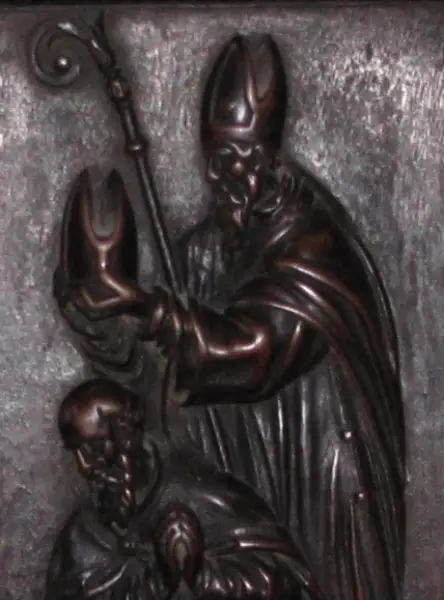
Overview
Eustorgius II governed Milan as its archbishop from about 511 until his death on 6 June 518, in the years when Italy passed under the rule of the Ostrogothic king Theodoric the Great. Two letters of Theodoric concerning him survive, and both show a bishop trusted across confessional and political lines: one directs a royal official to place the Milanese church's Sicilian estates under his protection, the other entrusts him with restoring a bishop of Aosta who had been unjustly denounced for treason and with judging the clergy who had slandered him. Avitus of Vienne thanked him in writing for money given to free Italian captives taken by the Arian Burgundians, and Ennodius, bishop of Pavia, records that he restored the water ducts of the Baptistery of Santo Stefano, whose ruins still lie beneath the Cathedral of Milan. He died on 6 June 518 and was buried in the chapel of Saint Sixtus beside the basilica of Saint Lorenzo Maggiore. The Catholic Church venerates him, keeping his feast on 6 June and joining him to all the sainted bishops of Milan on 25 September.
The Complete Life
Archbishop in an Ostrogothic Kingdom
Eustorgius II took charge of the church of Milan around the year 511, succeeding Lawrence I in one of the most storied sees of the West, the city of Ambrose and of the Ambrosian Rite. He led it at a delicate moment: Italy had lately passed to Theodoric the Great, the Ostrogothic king who, though an Arian, governed his Catholic subjects with a famous measure of fairness and corresponded with their bishops as civic leaders. Into that world Eustorgius brought whatever formation his earlier life had given him, though the sources preserve nothing of his origins or of the road that carried him to the archiepiscopal throne. His election placed him among the Catholic hierarchy of a kingdom where orthodoxy and royal power had to be held in balance, and the evidence of his nine years in office shows a man who managed that balance with such skill that the king himself wrote letters on the affairs of his church as matters deserving royal attention.
§ Life
The King's Letters and the Ransomed Captives
Two letters of Theodoric the Great survive that concern Eustorgius, and together they sketch the scope of his responsibilities. One, written to Count Adilas, a senator, directs that the Sicilian estates belonging to the Milanese church be placed under the archbishop's guard, acknowledging him as protector of his flock's temporal livelihood across the sea. The other begs him to reinstate the bishop of Aosta, falsely charged with treason by members of his own clergy, and to sit in judgment on the slanderers themselves, an extraordinary commission of both mercy and discipline. Beyond the royal correspondence, Avitus of Vienne, who died in 518, thanked Eustorgius in a letter of his own for the financial help the Milanese archbishop had given to free Italian prisoners who had fallen into the hands of the Arian Burgundians. Captives, wrongly accused clerics, scattered estates: the record shows a shepherd whose charity and justice reached well beyond his own province.
§ Life
Death and Burial at Saint Lorenzo
The last work of Eustorgius recorded by the sources is also the most tangible. Ennodius, the bishop of Pavia who died in 521, relates that the archbishop restored the water ducts of the Baptistery of Santo Stefano, and the ruins of that structure remain visible beneath the Cathedral of Milan to this day, a rare case where a saint's labor can still be traced in the city's stones. Eustorgius died on 6 June 518, closing an episcopate of about seven years, and his body was laid in the chapel of Saint Sixtus, next to the basilica of Saint Lorenzo Maggiore, one of the great ancient churches of Milan. His successor in the see was Magnus, who would himself be numbered among the saints. The date of his death became the date of his feast, and Milan has kept 6 June for him ever since, while gathering him each year with the whole chorus of its holy bishops on 25 September, the common solemnity of the Ambrosian church's saints.
§ Life
Memory Among the Saints of Milan
Eustorgius II is honored as a saint in the Catholic Church by ancient tradition rather than by any formal decree, one of the long line of holy archbishops who governed Milan from the age of the martyrs through the Gothic kingdom. His principal feast is kept on 6 June in the basilica of Saint Lorenzo Maggiore, near the chapel where his body rests, and joins the annual commemoration of 25 September, when every holy bishop of the Milanese see is honored at once, a calendar that runs from the apostolic age through the Middle Ages. His name also endures in the episcopal roll of his city, where he stands between Lawrence I and Magnus in the succession of the see. Historians of the Ostrogothic period return to the two royal letters that mention him as evidence of how a Catholic bishop could hold the confidence of an Arian king, and the masonry of the baptistery he repaired still lies under the cathedral, where every generation of Milanese faithful walks, unknowingly, over the work of his hands.
§ Life
Timeline
- 511
Appointed Archbishop of Milan around this year, succeeding Lawrence I in the Ambrosian see.
§ Introduction
- 6 Jun 518
Died on 6 June and was buried in the chapel of Saint Sixtus beside the basilica of Saint Lorenzo Maggiore.
§ Life
The Record
- Major works
- Restoration of the water ducts of the Baptistery of Santo Stefano in Milan
- Canonization
- Pre-congregation: honored as a saint in the Catholic Church since antiquity
Prayer
Bibliography
Show 3 sources
- Ruggeri, Fausto (1991). I Vescovi di Milano. Milano: NED. pp. 17-18. ISBN 88-7023-154-2 (in Italian).
- Pasini, Cesare (1988). "Eustorgio II, santo (+518)". Dizionario della Chiesa Ambrosiana. Vol. 2. Milano: NED. pp. 1169-1170. ISBN 88-7023-102-X (in Italian).
- Cazzani, Eugenio (1996). Vescovi e arcivescovi di Milano. Milano: Massimo. pp. 34-35. ISBN 88-7030-891-X (in Italian).
Profile text adapted from the Wikipedia article, licensed CC BY-SA 4.0.
Pray with this saint every day
Save St. Eustorgius II to your favorites, read the full profile, and get feast-day reminders in the Saints app.
Get the Saints AppFree on the App Store for iPhone and iPad