
3rd century·Feast March 2 (Orthodox and Byzantine Catholic); August 27 (Roman Catholic)
St. Euthalia of Sicily
Virgin Martyr Beheaded by Her Own Brother
Overview
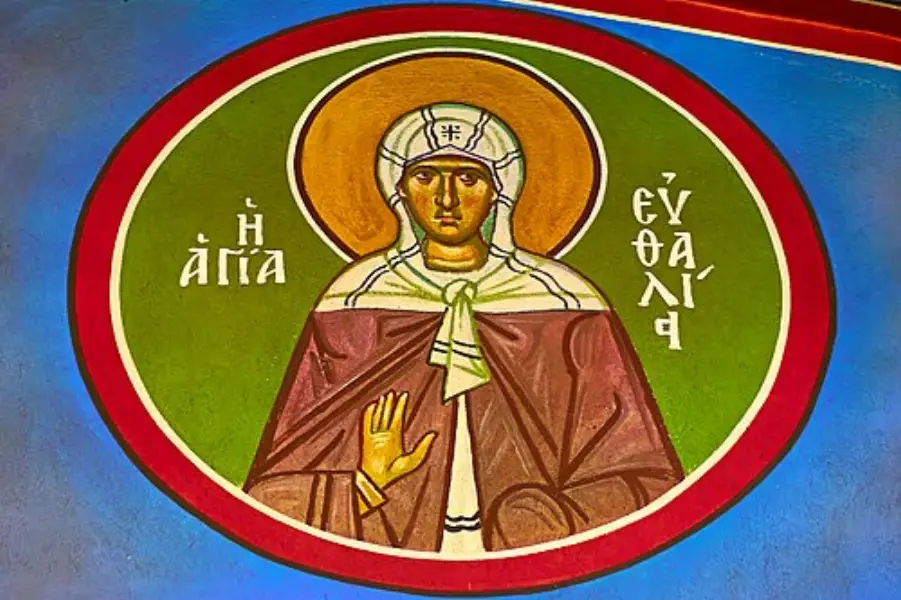
Euthalia belonged to a pagan family of Leontini, an ancient city of southeastern Sicily, in the third century of the Christian era. Her path to holiness began not through her own seeking but through her mother's cure: Eutropia experienced a miraculous healing that led her to embrace the Christian faith, and her daughter followed her into the Church. The conversion filled mother and daughter with joy, yet it enraged one of the sons of the household, who saw the new religion as a disgrace to the family. He demanded that the two women renounce their faith in Jesus, and both refused. Eutropia escaped the house by flight, but Euthalia made the deliberate choice to remain, standing in the family home while threats of violence gathered around her. She held steady through torment and suffering, and in the end her own brother beheaded her. The Eastern Orthodox and Byzantine Catholic Churches commemorate her on 2 March, and the Roman Catholic Church keeps her memory on 27 August, remembering her among the virgin martyrs of the early Church.
The Complete Life
A Healing That Turned a Household
The faith of Euthalia entered her family through her mother. Eutropia, a woman of Leontini, received a miraculous healing that became the door to her conversion, and the record notes that her daughter became a Christian in the wake of that cure. For the two women, the new faith was an occasion of great joy: the healing they had witnessed and the baptism they embraced bound mother and daughter together in a common hope, within a city and a family still rooted in the old religion. That joy, however, was not shared by the whole house. One of the sons regarded the conversion as a grave affront to the family, an insult to its gods and its name, and his resentment hardened into open hostility. The decision that followed set the shape of Euthalia's sanctity. When her mother fled the family home to escape the storm, Euthalia elected to stay behind, under the same roof as the brother who demanded that she give up her Lord. The sources give no other name for her, no title and no date, only the stark figure of a young woman keeping faith inside a hostile house.
§ Euthalia of Sicily
Standing Firm Under Threat
What followed in the household of Leontini was a persecution in miniature, carried out within the family itself. The brother pressed his demand that Euthalia and her mother renounce their faith in Jesus, and the women refused outright. Eutropia answered the threat by flight, leaving the home to preserve her life; Euthalia instead chose to remain, although she understood what remaining meant, for she was threatened with physical harm from the outset. The ancient account praises the composure with which she bore agony and abuse, enduring violence without surrendering the confession that had brought her such joy at her conversion. The trial her story records is one the early Church knew well but seldom named so starkly: betrayal not by the state or the mob, but by a brother's hand. When the end came, Euthalia was beheaded by him, sealing with her blood the refusal she had already spoken. The brevity of the record only sharpens its witness, for it preserves exactly what matters: the demand, the refusal, the torment endured, and the sword.
§ Euthalia of Sicily
Commemoration East and West
Euthalia was never canonized by any process, for she belongs to the virgin martyrs of the Church's first centuries, whose memory the faithful kept from the beginning. Her cult divided its date between the great families of Christendom: the Eastern Orthodox Church and the Byzantine Catholic Churches commemorate her on 2 March, while the Roman Catholic Church keeps her feast on 27 August, so that East and West honor the same Sicilian witness on different days of the year. The brevity of her ancient notice has not prevented her remembrance from surviving to the present; modern Orthodox directories still list her among the martyrs, and learned collections of saintly women, such as Agnes Dunbar's dictionary of 1904, preserve her story for each new generation. She stands in the calendar beside her mother Eutropia, the woman whose healing began it all, as a memorial of how the gospel entered one Sicilian household and how, when it divided that house, the daughter who stayed behind proved stronger than the sword that silenced her.
§ References
The Record
- Canonization
- Pre-congregation: honored as a martyr since the early centuries of the Church
Prayer
Bibliography
Show 3 sources
- "St. Euthalia of Syria". Self-Ruled Antiochian Orthodox Christian Archdiocese of North America. Retrieved 2009-02-17.
- Dunbar, Agnes (1904). A Dictionary of Saintly Women. London: George Bell & Sons. p. 300.
- "The Martyr Euthalia". sojourner7's blog. Bakersfield.com.
Profile text adapted from the Wikipedia article, licensed CC BY-SA 4.0.
Pray with this saint every day
Save St. Euthalia of Sicily to your favorites, read the full profile, and get feast-day reminders in the Saints app.
Get the Saints AppFree on the App Store for iPhone and iPad