
died 11 March 1458·Feast March 11 (March 24 on the Gregorian calendar)
St. Euthymius II of Novgorod
Archbishop and Great Builder of Medieval Novgorod
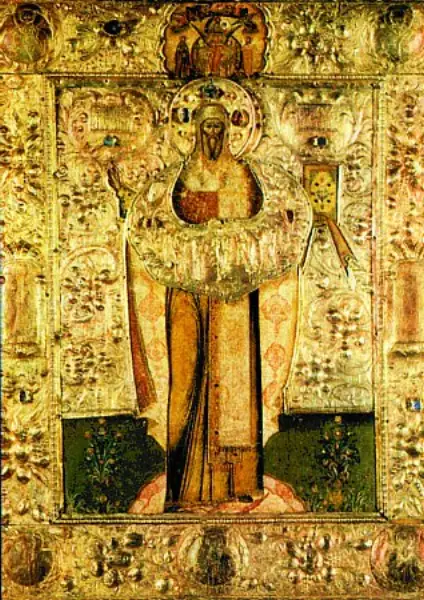
Overview
Euthymius II, baptized Ioann and the son of a priest, entered monastic life at the Listitsa Hill Monastery and later moved to the Vyazhishchsky Monastery northwest of Novgorod, a house that gave him the name by which he is still known. Elected archbishop by the veche in 1429 on the death of Evfimy I, he was not consecrated until 1434, and then at Smolensk by the Metropolitan of Lithuania rather than in Moscow, an act that angered Muscovite authorities. His nearly thirty years in office made him the most prolific builder and cultural patron among all the Novgorodian archbishops: he raised or restored more than a dozen churches on their old foundations, built the Palace of Facets in 1433, and added a belfry and a clocktower to the cathedral precinct. He uncovered the relics of Archbishop Ilya in 1439, canonized several predecessors, and brought Pachomius the Serb to Novgorod to write the lives of its saints. After Novgorod's crushing defeat by Grand Prince Vasily II in 1456 he withdrew from public life, dying on 11 March 1458 and being buried at the monastery of his profession.
The Complete Life
A Priest's Son of Novgorod
The lives of the saint preserve the outline, if not the detail, of where Euthymius came from. In baptism he was called Ioann, or Ivan, the firstborn son of a priest named Fedor and of Fedor's wife Anna, though some versions of his vita give the father's name as Mikheia and describe him as the priest of the Church of St. Fedor the Great Martyr on the Market Side of Novgorod, a site east of the present Aleksandr Nevsky Bridge along the highway leading out of the city eastward. To grow up in the household of a priest on the Market Side was to be raised at the commercial heart of one of medieval Europe's great republics, where the veche gathered, the bells governed, and the archbishop stood among the principal figures of the state. The boy from a clerical family followed the natural path toward the altar's service, but not immediately to the cathedral: he chose the monastic habit, and the monasteries rather than the princely court would shape everything that followed in his life.
§ His Background
Monk and Elected Archbishop
Euthymius received the monastic habit at the Listitsa Hill Monastery, known as Listitsky, and afterwards transferred to the Vyazhishchsky Monastery, some seven miles northwest of Novgorod, the house whose name he carried for the rest of his life and beyond it, for he is remembered as Evfimy Viazhishchskii. His election as archbishop came in 1429, decided by the veche of Novgorod after the death of his predecessor Evfimy I, called Bradatii. His consecration, however, was delayed five years and became an act of politics. Only in 1434 was the office bestowed, and the hands that bestowed it were not those of the Metropolitan of Kiev and All Rus' in Moscow but those of Geronty, metropolitan of Lithuania, acting at Smolensk. The Muscovite authorities took offense, even though the see they defended stood vacant: Fotii had passed away in 1431, and Isidor would not reach Moscow for another six years, in 1437. The episode reveals the delicate position of the Novgorodian church between Moscow and Lithuania, and the new archbishop's willingness, when the metropolitan throne lay empty, to seek consecration through the western hierarchy.
§ His Monastic and Archiepiscopal Life
The Builder of the Republic
Euthymius's archiepiscopate made him one of the greatest cultural patrons and builders in the history of Novgorod. His building program was consciously retrospective: he looked back to Novgorodian history and restored old churches on their old foundations in the old architectural styles. The chronicles credit him with building or rebuilding more than a dozen churches, several of which still stand, among them the Church of the Twelve Apostles, the Church of John the Forerunner at Opoky, the Church of the Assumption, and the Church of St. George at the Market, the last three all originally founded by Prince Vsevolod Mstislavich in the twelfth century and clustered together in the northern Market. His secular works endured as well. The Palace of Facets, raised in 1433 northwest of the Cathedral of Holy Wisdom, still stands; he built the belfry east of the cathedral and a clocktower to its west, the latter collapsing and being rebuilt in 1673. Under his auspices the legends of the city and its archbishops were compiled, preserving the stories that bound Novgorod to its own sacred past.
§ Cultural Patronage
He Who Honors the Saints
Beside his stones and towers, Euthymius undertook a quieter work: the recovery of Novgorod's saints. He canonized a number of his predecessors in the archiepiscopal office and promoted the veneration of the city's holy men generally. In 1439 he discovered the relics of Archbishop Ilya, also called Ioann, and established his commemoration, together with that of eight other bishops and archbishops who had appeared in a vision earlier that same year. To give the new cults their written form he brought Pachomius the Serb to Novgorod, who arrived at the end of the 1430s or the beginning of the 1440s and, under the archbishop's patronage, composed the Life of Varlaam of Khutyn, founder of the Khutyn Monastery, and the celebrated Tale of the Journey of Archbishop Ioann on a Devil to Jerusalem. The partnership bore fruit beyond Euthymius's own lifetime: Pachomius, returning to Novgorod under Archbishop Iona, wrote the Life of Euthymius himself. The builder of churches thus became the builder of memory, and the man who had done so much to patronize culture was made by it into a cultural icon.
§ Cultural Patronage
Defeat, Silence, and Death
The last years of Euthymius's archiepiscopate were darkened by the decline of the republic he had served. His tenure was in some respects a high point of the archiepiscopal office in Novgorod, and the city's culture flourished under his patronage, yet its political fortunes collapsed. In 1456 the armies of Grand Prince Vasily II of Moscow crushed Novgorod in a shameful defeat, and the republic submitted to the harsh terms dictated at Iazhelbitsy, which curtailed its freedom of action in foreign policy: the republic could no longer conclude alliances without the Grand Prince's approval, nor join his enemies. From that moment Euthymius disappears from the record. He is not named among the parties to the peace treaty, and he built no churches after 1456. It may be, the chroniclers suggest, that the disgrace of the defeat touched him personally and that he withdrew from active life in its aftermath. Death came on 11 March 1458; the monks of Vyazhishchsky, the community where he had taken the habit, received his body for burial, so that in death he returned to those who had first formed him.
§ The Decline of the Republic
Canonization and Incorrupt Remains
Euthymius's reputation for holiness hardened quickly into liturgical form. His Life appeared in the monthly books of the lives and services of the saints as early as 1494, barely a generation after his death, and in 1549 the Moscow Council of the Russian Orthodox Church formally enrolled him among the saints. His feast is kept on 11 March according to the old style, corresponding to 24 March on the Gregorian calendar. When his remains were disinterred they were said to have been found incorrupt, the traditional sign of the saint's favor before God. His veneration received new form in the modern era: Metropolitan Aleksei of Leningrad and Novgorod — later Patriarch of Moscow — consecrated the monastery church to his memory on 31 March 1990; there his body rests in a glass-covered sarcophagus, restoring public honor to the archbishop at the close of the Soviet period. A second church, dedicated jointly to Euthymius and Archbishop Gennady, rises in the Kovoleva cemetery east of St. Petersburg, extending his cult beyond the Novgorodian land.
§ Sainthood
The Long Shadow of the Builder
Euthymius left a deeper mark on Novgorod than almost any other occupant of the see. The buildings he raised or restored carried his taste for the city's own architectural past into the centuries that followed, and several of his churches still define the streetscape of the medieval quarter; the Palace of Facets remains one of the oldest surviving civic buildings of its kind in Russia. His literary legacy proved equally durable, for the hagiographic corpus commissioned from Pachomius the Serb shaped how generations of readers understood Novgorod's saints, and the archbishop's own Life, written by the same hand, turned him into an exemplar of the office he had held. Historians of the republic regard his tenure as one of the summits of the archiepiscopate, the more remarkable for ending amid the republic's political humiliation. Pilgrims still pray before his relics in the monastery church at Vyazhishchy, where the glass sarcophagus keeps the incorrupt remains in view, and the church dedicated to him and to Gennady at Kovoleva carries his memory into the neighbourhood of St. Petersburg, a saint honored across the whole northwestern Russian land.
§ Sainthood
Timeline
- 1429
Chosen for the archbishopric of Novgorod by the veche once his predecessor Evfimy I (Bradatii) had died
§ His Monastic and Archiepiscopal Life
- 1433
Built the Palace of Facets northwest of the Cathedral of Holy Wisdom; the building still stands
§ Cultural Patronage
- 1434
Consecrated at Smolensk by Geronty, Metropolitan of Lithuania, rather than in Moscow, angering the Muscovite authorities
§ His Monastic and Archiepiscopal Life
- 1439
Discovered the relics of Archbishop Ilya (Ioann) and began commemorating him and eight other bishops seen in a vision
§ Cultural Patronage
- 1440
Sponsored Pachomius the Serb, newly arrived in Novgorod, who wrote lives of Varlaam of Khutyn and other local saints
§ Cultural Patronage
- 1456
Novgorod suffered a humiliating defeat by Grand Prince Vasily II and signed the restrictive peace of Iazhelbitsy; Euthymius ceased to be active
§ The Decline of the Republic
- 11 Mar 1458
Died on this date; the Vyazhishchsky Monastery, his own house of profession, received him for burial
§ The Decline of the Republic
- 1494
His saint's Life entered a monthly calendar of holy lives and their services no later than this year
§ Sainthood
- 1549
Formally canonized by the Moscow Council of the Russian Orthodox Church
§ Sainthood
- 31 Mar 1990
Metropolitan Aleksei dedicated the Church of St. Evfimy at the Vyazhishchsky Monastery; the saint's body rests there in a glass-covered sarcophagus
§ Sainthood
The Record
- Major works
- Palace of Facets, Novgorod (1433)·Rebuilding of more than a dozen Novgorod churches, including the Church of the Twelve Apostles, the Church of John the Forerunner at Opoky, the Church of the Assumption, and the Church of St. George at the Market·Cathedral belfry and clocktower·Compilation of Novgorodian legends and sponsorship of Pachomius the Serb's hagiographic works
- Canonization
- Canonized by the Russian Orthodox Church's Moscow Council of 1549
Prayer
Bibliography
Show 6 sources
- Taisiia, Zhitiia sviatykh: 1000 let russkoi sviatosti, 2 Vols. (Jordansville, NY: Holy Trinity Monastery, 1983), vol. 1, p. 151.
- Michael C. Paul, "Episcopal Election in Novgorod Russia 1156-1478", Church History (June 2003).
- G. M. Prokhorov, "Pakhomii Serb", in D. S. Likhachev, Slovar' knizhnikov i knizhnosti Drevnei Rusi, vol. 2, p. 167.
- Joel Raba, "Evfimii II Erzbischof von Gross-Nowgorod und Pskov: Ein Kirchenfürst als Leiter einer weltlichen Republic". Jahrbücher für Geschichte Osteuropas 25 (1977): 161-73.
- Michael C. Paul, "A Man Chosen by God": The Office of Archbishop in Novgorod Russia 1165-1478. Ph.D. dissertation, University of Miami, 2003.
- V. A. Nikitin, "Zhitie i trudy sviatitelia Evfimiia arkhiepiskopa Novgorodskogo". Bogoslovskie trudy 24 (1983), p. 260-306.
Profile text adapted from the Wikipedia article, licensed CC BY-SA 4.0.
Pray with this saint every day
Save St. Euthymius II of Novgorod to your favorites, read the full profile, and get feast-day reminders in the Saints app.
Get the Saints AppFree on the App Store for iPhone and iPad