
c. 751 – 831·Feast December 26
St. Euthymius of Sardis
Iconophile Hieromartyr and Confessor of Byzantium
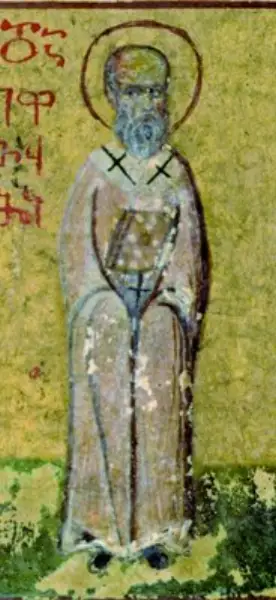
Overview
Euthymius of Sardis, honored in the Eastern Orthodox Church as a hieromartyr and confessor, led the metropolitan see of Sardis in western Asia Minor from roughly 785 until his deposition around 804. Born at Ouzara, most likely in Lycaonia, he embraced monastic life while still young and was raised to episcopal office by Patriarch Tarasios of Constantinople. At the Second Council of Nicaea in 787 he spoke in several sessions on behalf of restoring the honor paid to the holy images and of bishops exiled under the iconoclast regime. When imperial favor turned against him under Nikephoros I, he was banished to Pantelleria, though Tarasios obtained his recall. Under the renewed iconoclasm of Leo V and Michael II he again defended the veneration of icons, suffering arrest, flogging, and repeated exile. He was flogged to death on 26 December 831, on St. Andrew's island off the Bithynian shore, in the reign of Theophilos. Patriarch Methodios I of Constantinople afterwards composed the account of his sufferings.
The Complete Life
A Monk from Lycaonia
Euthymius was born in 751 or 754 at Ouzara, a settlement usually placed in Lycaonia in the high interior of Asia Minor. Nothing is recorded of his family, but while still a youth he withdrew from the world into a monastery, taking up the disciplined life that formed so many of the churchmen of his generation. His years of formation coincided with the uneasy decades that followed the first iconoclast crisis, when the legitimacy of honoring the holy images still divided the empire and its church. Sometime between 784 and 787, Patriarch Tarasios of Constantinople ordained him metropolitan bishop of Sardis, an ancient see in Lydia whose church had endured heavy losses during the iconoclast persecution. The appointment placed a convinced monastic iconophile at the head of an important province at precisely the moment the empire was preparing to resolve the quarrel over the images in a great council, and Euthymius would prove one of the most forthright voices gathered there.
§ Life
Voice of Nicaea
As metropolitan of Sardis, Euthymius took a leading part in the Second Council of Nicaea in 787, the assembly convened to restore the teaching of the church against Byzantine Iconoclasm. He addressed several of its sessions, pleading that the banished bishops Theodore of Amorium and Basil of Ancyra be restored to their sees, that the icons be honored once more as Tarasios and Pope Hadrian I had proposed, and that the iconoclast error and its partisans be anathematized. His prominence at the council made his name, but it also marked him for the troubles that followed. His hagiography preserves the memory of a further service to the empire: between 787 and 790 he is said to have traveled on a diplomatic mission to the Abbasid capital at Baghdad, where his talents so impressed the caliphal government that a peace settlement followed. Historians note that no such mission or treaty is otherwise attested for the period, yet the story itself testifies to the reputation he carried as a churchman of consequence.
§ Life
Disfavor and Exile
Under Emperor Nikephoros I, who took the throne in 802, Euthymius fell into disfavor and around 804 was deposed from his see and exiled to Pantelleria, an island off Sicily. His biographer attributes the emperor's hostility to a striking cause: Euthymius had persuaded a woman whom Nikephoros had desired to become a nun instead. Modern historians judge the true motive more political, pointing to his backing of the revolt that General Bardanes Tourkos raised in 803. Whatever the reason, the aged patriarch Tarasios secured his recall from banishment soon after, though he was never restored to the metropolitical throne of Sardis. The loss of his see did not silence him. When iconoclasm was again imposed as official doctrine, first under Leo V the Armenian and then under Michael II the Amorian, Euthymius once more came forward in defense of the icons, and for this constancy he was repeatedly arrested, whipped, and banished, enduring with patience what he had already once suffered for the same confession.
§ Life
Martyrdom on St. Andrew's Island
In the persecution of his last years no enemy pursued Euthymius more relentlessly than John Grammatikos, the scholar who would later occupy the patriarchal throne of Constantinople. The traditional dating of the saint's death, preserved by Byzantine chroniclers such as Genesios, John Skylitzes, and Theophanes Continuatus, and repeated in older martyrologies and the Catholic Encyclopedia, placed it on 26 December 824, when he was flogged to death at the command of Michael II. Modern research, however, dates his end to 26 December 831, in the reign of Theophilos, on the island of St. Andrew, which lies north of Cape Akritas on the Bithynian shore south of Constantinople. By either reckoning he died as he had lived: refusing to surrender the honor due to the icons of Christ and his saints, and sealing a lifelong confession with his blood. The aged bishop, deposed, exiled, and beaten across four reigns, thus passed from the scene of the second iconoclast persecution as its most distinguished episcopal victim.
§ Life
Memory of a Confessor
The church did not forget what Euthymius had endured. His hagiography was written by Patriarch Methodios I of Constantinople, himself a sufferer under the iconoclasts, and the life remains the principal source for the bishop's career and passion. Further testimony to the esteem in which he was held survives in several letters that Theodore of Stoudios, the great abbot and reformer of the Studion monastery, addressed to Euthymius, and in a panegyric poem composed in his honor by a writer named Metrophanes. In the Eastern Orthodox Church he is venerated as a hieromartyr and confessor of the faith, celebrated on 26 December, the anniversary of his death, and again on 8 March. Medieval memory also kept his image alive in art: a miniature in the Madrid Skylitzes depicts his martyrdom, and a fresco in the Moni Agiou Vissarionos portrays the saint whose quiet endurance outlasted the emperors who persecuted him and the theologians who argued against the icons he defended.
§ Life
Timeline
- 751
Born at Ouzara, probably in Lycaonia in the interior of Asia Minor.
§ Life
- 785
Ordained metropolitan bishop of Sardis by Patriarch Tarasios of Constantinople.
§ Life
- 787
Spoke in several sessions of the Second Council of Nicaea for the restoration of icon veneration.
§ Life
- 789
According to his hagiography, joined an embassy to Baghdad that secured peace with the Abbasid caliph.
§ Life
- 803
Backed the rebellion of the general Bardanes Tourkos, the act modern historians see as the true cause of his disgrace.
§ Life
- 804
Deposed and exiled to Pantelleria by Nikephoros I, then recalled through Tarasios's intervention without restoration to his see.
§ Life
- 815
Under the restored iconoclasm of Leo V, was arrested, whipped, and exiled for defending the holy images.
§ Life
- 26 Dec 824
The traditional chronology, followed by older martyrologies, placed his flogging to death at Michael II's orders on this date.
§ Life
- 26 Dec 831
Whipped to death on 26 December, as modern research dates it, on the island of St. Andrew off the Bithynian coast.
§ Life
The Record
- Canonization
- Pre-congregation; venerated as a hieromartyr and confessor in the Eastern Orthodox Church since the Byzantine era.
Prayer
Bibliography
Show 5 sources
- Kazhdan, Alexander (1991). 'Euthymios of Sardis'. In Kazhdan, Alexander (ed.). The Oxford Dictionary of Byzantium. New York and Oxford: Oxford University Press. p. 756. ISBN 978-0-19-504652-6.
- Winkelmann, Friedhelm; Lilie, Ralph-Johannes, et al. (1999). 'Euthymios (#1838)'. Prosopographie der mittelbyzantinischen Zeit: I. Abteilung (641-867), 1. Band: Aaron (#1) - Georgios (#2182). Walter de Gruyter. pp. 577-579. ISBN 3-11-015179-0.
- Herbermann, Charles, ed. (1913). 'Sardes'. Catholic Encyclopedia. New York: Robert Appleton Company.
- 'Hieromartyr Euthymius the Bishop of Sardis'. OCA - Feasts and Saints.
- Gouillard, Jean, ed. (1987). 'La vie d'Euthyme de Sardes († 831), une œuvre du patriarche Méthode'. Travaux et Mémoires 10. pp. 1-101.
Profile text adapted from the Wikipedia article, licensed CC BY-SA 4.0.
Pray with this saint every day
Save St. Euthymius of Sardis to your favorites, read the full profile, and get feast-day reminders in the Saints app.
Get the Saints AppFree on the App Store for iPhone and iPad