
c. 955 – c. 1024·Feast May 13
St. Euthymius the Athonite
Georgian Monk and Translator of Mount Athos
Overview
Euthymius the Athonite, known to Georgians as Ekvtime Atoneli, was a monk, philosopher, and translator who became one of the most accomplished Eastern Christian scholars of his age. Born around 955 in Meskheti in the Kingdom of the Iberians, he was the son of John the Iberian, founder of the Iviron monastery on Mount Athos, and the nephew of the general Tornike Eristavi. Taken to Constantinople as a political hostage in his youth, he was afterwards released and received the monastic habit at the Great Lavra of Athanasios on the Holy Mountain. He rose to lead the Georgian house of Iviron, governing it as abbot for fourteen years before stepping aside to devote himself entirely to the work of translation. Fluent in Georgian, Greek, and other languages, he rendered religious, philosophical, and legal treatises into his native tongue, among them the Wisdom of Balahvari, the Christianized romance that conquered medieval Europe as the story of Barlaam and Josaphat. He died around 1024 from a fall from a mule.
The Complete Life
A Son of the Iberians
Euthymius came from the leading family of Georgian monasticism. His people were the Georgians, whom the Byzantines knew by the older ethnonym Iberians, and his home lay in Meskheti, in the Kingdom of the Iberians, where he was born around 955. His father was John the Iberian, the founder of the Iviron monastery on Mount Athos, and his uncle was the distinguished general Tornike Eristavi, who had left the imperial court for the monastic habit. Political fortune, however, carried the boy far from his native mountains: he was taken to Constantinople as a hostage, a common fate for the sons of allied or subject houses. The imperial capital, with its libraries and its schools, became in God's providence the school of his mind, and when he was at last released he did not return at once to Georgia. Instead he turned toward the Holy Mountain, where his father's monastery stood awaiting the labor of his son.
§ Euthymius the Athonite Georgian saint
The Holy Mountain
Euthymius received the monastic tonsure in the Great Lavra of Athanasios, the first and most venerable of the houses of Mount Athos, and there he was formed in the ascetic tradition of the Athonite fathers. In time he moved to Iviron, the monastery his father had founded as the Georgian house of the Holy Mountain, and eventually he took charge of it. He governed Iviron as its abbot for fourteen years, guiding a community of Georgian monks at the heart of Byzantine monasticism and making it a center of learning in both tongues. Then, with a humility rare in men of talent, he stepped aside from the burden of administration so that he might give himself without distraction to the work for which Providence had prepared him since his days as a hostage in Constantinople: the carrying of Greek wisdom into the Georgian language, book by book, page by page. Contemporaries reckoned him among the finest theologians and scholars the Eastern Christian world possessed.
§ Euthymius the Athonite Georgian saint
The Great Translation
Fluent in Georgian, Greek, and other languages, Euthymius translated a great body of religious treatises and philosophical works from Greek into his native tongue, preparing Georgian versions of discourses philosophical, ecclesiastical, and legal. Among all this labor one book won a fame beyond his imagining: his rendering of the sibrdzne balavarisa, the Wisdom of Balahvari, a Christianized telling of episodes from the life of Gautama Buddha. Through Euthymius's translation and its descendants the tale passed into the literatures of medieval Europe as the story of Barlaam and Josaphat, where the two idealized saints of a Buddhist prince's legend were honored in their turn as Christian saints. The circuit of that single book, from India through the monastery at Athos into the chivalric literature of the West, displays the reach of his scholarship. Of equal importance in his own church were the careful Georgian versions of Greek thought that gave his nation access to the intellectual heritage of Constantinople.
§ Euthymius the Athonite Georgian saint
Death and Veneration
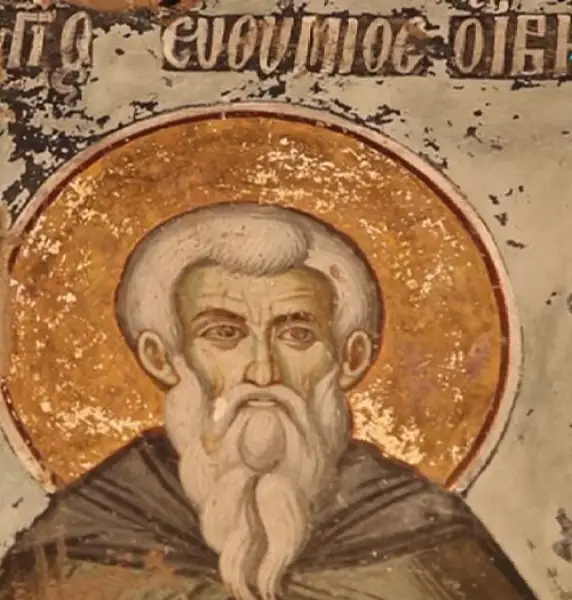
The death of Euthymius came not on the Holy Mountain but on the road near Byzantium. As he rode, his mule was startled by the approach of a beggar and bolted, and the aged monk was thrown to the ground with fatal injuries. He had given his life to the service of others in translation, and it is fitting that the sources remember his end as occurring in an act of ordinary encounter on the way, a small death humbler than his merits. His relics were laid to rest in the Church of Saint John the Baptist at the Iveron Monastery on Mount Athos, where they remain the treasure of the Georgian house he had governed. The Orthodox Church celebrates his feast on 13 May, and both Georgia and the Holy Mountain claim him as their patron. In the Protaton Church at Karyes, the principal church of the Athonite capital, a fresco of Euthymius keeps his image before the monks who follow in his way.
§ Euthymius the Athonite Georgian saint
Timeline
- 955
Born at Meskheti in the Kingdom of the Iberians, son of John the Iberian.
§ Euthymius the Athonite Georgian saint
- 1024
Died near Byzantium from injuries suffered when his startled mule bolted and threw him.
§ Euthymius the Athonite Georgian saint
The Record
- Major works
- Georgian translation of the sibrdzne balavarisa (Wisdom of Balahvari), known in Europe as the story of Barlaam and Josaphat·Georgian translations of Greek philosophical, ecclesiastical, and legal discourses
- Patron of
- Georgia·Mount Athos
- Canonization
- Pre-congregation; venerated in the Eastern Orthodox Church, especially in Georgia and on Mount Athos.
Prayer
Bibliography
Show 5 sources
- 'Ὁ Ὅσιος Εὐθύμιος ὁ Ἀθωνίτης κτήτορας τῆς Ι.Μ. Ἰβήρων'. ΜΕΓΑΣ ΣΥΝΑΞΑΡΙΣΤΗΣ (in Greek). Retrieved 2026-04-02.
- Xintʻibiże, Elguja (1998). Designations of the Georgians and their etymology. Tʻbilisis Universitetis Gamomcʻemloba. p. 73. ISBN 978-5-511-00775-5.
- Salia, Kalistrat (1983). History of the Georgian nation. p. 82.
- 'St. Euthymius of Athos the Translator'. Orthodox Church in America. Retrieved 2026-04-02.
- Dowling, Theodor. Sketches of Georgian Church History. Adamant Media Corporation (October 9, 2003). ISBN 1-4212-2891-2.
Profile text adapted from the Wikipedia article, licensed CC BY-SA 4.0.
Pray with this saint every day
Save St. Euthymius the Athonite to your favorites, read the full profile, and get feast-day reminders in the Saints app.
Get the Saints AppFree on the App Store for iPhone and iPad