
377 – 473·Feast January 20
St. Euthymius the Great
Father of Judean Desert Monasticism
Overview
Euthymius the Great (377 – 20 January 473) ranked among the formative abbots of the Holy Land, and his life shaped monasticism across the Judaean Desert. Born in Melitene in Lesser Armenia to a pious noble family, he was educated and ordained by Bishop Otreius of Melitene, who placed him in charge of the monasteries of the diocese. Drawn to the Holy Land, he settled about 405 in a hermit's cell near the laura of Pharan outside Jerusalem, then withdrew with the monk Theoctistus into the wilderness, where their cave community became the first coenobium of the Judaean Desert. Though he loved solitude above all, his fame as a healer and spiritual father drew disciples, Bedouin converts, and pilgrims, and in time a laura bearing his name arose beside his hermitage. He supported the decisions of the Council of Chalcedon (451) against the opposition of most regional monks, and his authority secured their acceptance in Jerusalem. Cyril of Scythopolis records that he founded several monasteries while remaining at heart a solitary in the Egyptian tradition. He died on 20 January 473.
The Complete Life
Born of Prayer in Melitene
Euthymius was born at Melitene in Lesser Armenia in 377, into a family of noble birth distinguished by its piety. Christian tradition relates that his parents, Paul and Dionysia, had long begged God for a son at the church of Saint Polyeuctus in their city, and when the child was granted they named him Euthymius, a Greek word meaning good cheer. His education was entrusted to Bishop Otreius of Melitene, who discerned the boy's gifts and in due time ordained him, placing the young priest in charge of all the monasteries of the diocese of Melitene. Armenia had received the gospel two generations earlier through Gregory the Illuminator, and its church was rich in ascetic zeal; in that soil Euthymius's vocation took root. Yet he was drawn to the places of the gospel itself. Around 405 or 406, at about thirty years of age, he left his oversight in secret and set out as a pilgrim for Jerusalem, keeping his purpose hidden even from those he served.
§ Melitene
From Pharan to the Wilderness
Arriving in the Holy Land, Euthymius remained five years in a cave he had fashioned into a dwelling close by the laura of Pharan, a settlement of monks about six miles east of Jerusalem at Ein Fara in Wadi Kelt. There he learned the discipline of the Palestinian lauras, which followed the Egyptian model, and there he met Theoctistus, a fellow hermit who shared his longing for deeper solitude. In 411 the two withdrew together into the true wilderness and settled in a bare cavern beside a winter torrent. When disciples began to gather around them they consecrated the cavern as a church and gathered a monastery around it. Because the site could not accommodate a laura of scattered cells, the house developed as a coenobium, a communal settlement, and thus became the earliest communal house the Judaean Desert had seen. Theoctistus served as its hegumen, while Euthymius, who loved quiet more than rule, soon passed the community into his friend's keeping.
§ Monastery of Theoctistus
The Apostle of the Bedouin
The miracle that made Euthymius famous across Palestine concerned a Bedouin boy. Terebon, son of the Saracen chief whom Cyril of Scythopolis calls Aspebetus, was brought to the hermit and cured, and the healing led the chief and his entire tribe to embrace Christianity, Aspebetus receiving baptism as Peter. The tribe settled near the monastery of Theoctistus, and Euthymius, true to his calling, guided the conversion without grasping at the fruit of it. He advised Peter on the building of a monastery for his nomadic people near his own hermitage; Maris, Terebon's uncle, financed the work, the tribe encamped around it in a parembole, the Greek word for camp, and Euthymius prevailed upon Patriarch Juvenal of Jerusalem to ordain Peter. Around 427 the former sheikh became a priest while remaining a phylarch, a tribal chief allied to the empire, and he was later elevated as Bishop of Paremboles, of the Camps, in which capacity he attended the Council of Ephesus in 431. A desert apostolate had borne a bishop.
§ Monastery of the Paremboles
A Solitary at the Center of a Movement
Euthymius remained at heart a philésychos, one who loves his peace and quiet, and his whole manner of life organized itself around that love. When crowds pressed upon him after the fame of his miracles, he retreated with his one close companion, the young Domitian, into the wilderness of Ruba by the Dead Sea, dwelling for a season on the remote mountain the Byzantines called Marda, none other than ancient Masada. The laura that eventually grew around his hermitage he kept deliberately small: twelve monks, himself and eleven followers, with every additional aspirant directed to the coenobium of Theoctistus. Its rule copied that of Pharan and mirrored the Egyptian model, and its cells were built unusually small, expressing his strict conception of the monastic life. Yet strictness did not mean hardness: his houses shared property, personnel, and a hostel in Jerusalem with Theoctistus's coenobium, novices were formed under Theoctistus before joining him, and the pantry filled with bread, oil, and wine for four hundred Armenian pilgrims was counted among his miracles.
§ Laura of Euthymius
Chalcedon and the Long Vigil
Through the doctrinal storms of the mid-fifth century Euthymius stood consistently with the Orthodox faction at the councils of Ephesus in 449 and Chalcedon in 451, though most monks of the region opposed the Chalcedonian decrees. When the Monophysite party gained control of the bishopric of Jerusalem, the aged abbot left his monastery for the desert with a small band of monks, a withdrawal of conscience that lasted two years. He returned in 453 to a position stronger than before, and it was greatly due to his authority that most of the Eastern recluses came to accept the decrees of Chalcedon; the empress Eudoxia too is credited with conversion to Orthodoxy through his efforts. By the 450s his laura stood at the center of a web of monasteries and churches that his associates and pupils had planted, and he was now acknowledged as head of the desert's whole monastic movement. In 457 he welcomed the young Sabbas, directing him to Theoctistus's coenobium. Euthymius kept his health to the age of ninety-four and died on 20 January 473.
§ Laura of Euthymius
Feast and Shrine
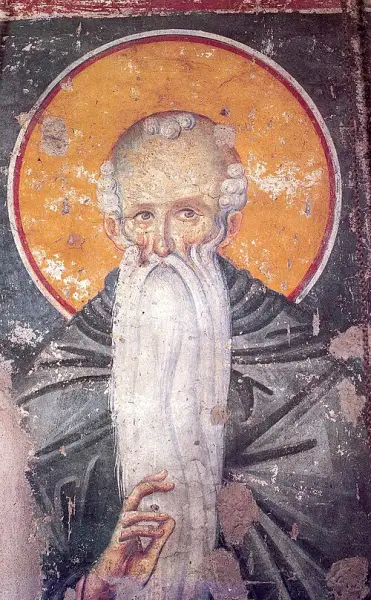
Veneration of Euthymius followed immediately upon his death. He was laid to rest in a tomb constructed for him within his own monastery, which became the shrine of his cult, and his feast was fixed on 20 January, the anniversary of his passing. The Eastern Orthodox Church keeps that date to this day, though for Orthodox Christians following the Julian calendar it falls on 2 February of the Gregorian reckoning; the Roman Catholic Church likewise honors him as a Venerable on the same day. His principal shrine is the Monastery of Euthymius in the Judean Desert, whose ruins still stand on the high ground west of Theoctistus's monastery where he spent his final decades. In art he is shown in the monastic habit holding a scroll, an emblem of the teaching office the desert gave him, as in the Menologion of Basil II and the mosaics of Nea Moni in Chios and Hosios Loukas. The continuity of his cult across East and West for fifteen centuries attests how deeply the desert father entered the memory of the undivided church.
§ Death, burial and feast day
The Desert Made Fruitful
Cyril of Scythopolis, who wrote Euthymius's vita, presents him as a man who planted several monasteries across the Judaean Desert while at heart remaining a solitary after the manner of the Egyptian fathers, and that paradox is precisely his legacy. The coenobium he began with Theoctistus introduced communal monasticism to the desert; the laura that bore his name became the mother house of a whole family of monasteries and churches his disciples established, and other pupils rose to high office in the hierarchy of the Jerusalem church. Among those who passed through his hands was Sabbas, sent to Theoctistus shortly after arriving in Palestine in 457, who would become the renowned archimandrite of the hermits of the country and carry the Palestinian tradition forward for another half century. Euthymius's decisive defense of Chalcedon gave the monastic world of Palestine its orthodox center of gravity. The Euthymiac History, a fragmentary work possibly drawn from an account of his life, shows how early and how widely his story circulated among the monks of the desert.
§ Laura of Euthymius
Timeline
- 377
Born at Melitene in Lesser Armenia to the pious noble couple Paul and Dionysia.
§ Melitene
- 405
Set out secretly on pilgrimage to Jerusalem and built himself an anchoritic cell near the laura of Pharan.
§ Pharan near Jerusalem
- 411
Withdrew into the wilderness with Theoctistus; their cave community became the first coenobium of the Judaean Desert.
§ Monastery of Theoctistus
- 421
Left the monastery of Theoctistus in Theoctistus's charge and departed for quieter solitude with his companion Domitian.
§ Marda and Caparbaricha
- 422
Established the monastery of Caparbaricha in the desert east of Tell Ziph.
§ Marda and Caparbaricha
- 427
Aspebetus, the baptized Saracen chief Peter, became a priest while remaining a tribal phylarch allied to the empire.
§ Monastery of the Paremboles
- 7 May 428
Archbishop Juvenal dedicated the church of Euthymius's new laura on 7 May.
§ Laura of Euthymius
- 431
Peter, bishop of the Paremboles, attended the Council of Ephesus as bishop of the nomadic camps.
§ Monastery of the Paremboles
- 449
Stood with the Orthodox party through the theological conflicts of the councils of Ephesus and Chalcedon.
§ Laura of Euthymius
- 451
Supported the decrees of the Council of Chalcedon against the majority of the region's monks.
§ Laura of Euthymius
- 453
Returned from two years of desert withdrawal during the Monophysite takeover of Jerusalem, his position stronger than ever.
§ Laura of Euthymius
- 457
Received the young Sabbas, later the renowned archimandrite of the hermits, and sent him to the coenobium of Theoctistus.
§ Death, burial and feast day
- 20 Jan 473
Died on 20 January at the age of ninety-five and was buried in a tomb built inside his monastery.
§ Death, burial and feast day
The Record
- Major works
- Monastery of Theoctistus, the first coenobium of the Judaean Desert (with Theoctistus)·Monastery of Caparbaricha·Monastery of the Paremboles for the tribe of Peter·Laura of Euthymius
- Patron of
- Orthodox monasticism in the Holy Land
- Symbols
- Monastic habit·scroll
- Canonization
- Pre-congregation; venerated as a Venerable in both the Eastern Orthodox and Roman Catholic Churches since antiquity.
Prayer
Bibliography
Show 7 sources
- Binns, John (April 2011). 'Euthymius the Great'. In Betz, Hans D.; Browning, Don S.; Janowski, Bernd; Jüngel, Eberhard (eds.). BRILL. Retrieved 8 February 2022.
- Hirschfeld, Yizhar (1993). 'Euthymius and his monastery in the Judean Desert'. Liber Annuus (43). Studium Biblicum Franciscanum: 339-371 (Pls. 19-24).
- Attwater, Donald and John, Catherine Rachel. The Penguin Dictionary of Saints. 3rd edition. New York: Penguin Books, 1993. ISBN 0-14-051312-4.
- 'St. Euthymius'. Catholic Encyclopedia. Retrieved 2023-10-10, via newadvent.org.
- Schwartz, Eduard (1939). Kyrillos von Skythopolis. Leipzig: J. C. Hinrichs. pp. 358-59. Retrieved 30 January 2025, via Internet Archive.
- Fisher, Greg (2019). Rome, Persia, and Arabia: Shaping the Middle East from Pompey to Muhammad. Routledge. pp. 95-96. ISBN 978-1000740905.
- Herbermann, Charles, ed. (1913). 'St. Euthymius'. Catholic Encyclopedia. New York: Robert Appleton Company.
Profile text adapted from the Wikipedia article, licensed CC BY-SA 4.0.
Pray with this saint every day
Save St. Euthymius the Great to your favorites, read the full profile, and get feast-day reminders in the Saints app.
Get the Saints AppFree on the App Store for iPhone and iPad