
823/824 – 898·Feast October 15
St. Euthymius the Younger
Athonite Hermit and Monk of Thessalonica
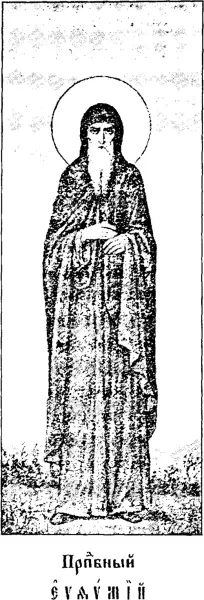
Overview
Euthymius the Younger (823 or 824 – 898), also called Euthymius of Thessalonica and Euthymios the New, was a Byzantine monk and hermit whose ascent led from the Anatolian plateau to the Holy Mountain. Born with the baptismal name Niketas at Opso in Galatia, he left the world in early adulthood and by about 848 was living the ascetic life on Mount Olympus in Bithynia, one of the great centers of Byzantine monasticism. From there he moved on to Mount Athos, then emerging as the principal sanctuary of eastern monasticism, and in the course of his labors he established a double monastery at Peristerai on Mount Chortiatis near Thessalonica, joining the Athonite and Macedonian strands of the monastic revival of his era. Toward the end of his life he returned to strict solitude, living on the small island of Hiera in the northern Aegean, and there he died on 14 or 15 October 898. His disciple Basil wrote his vita, and the Orthodox Church keeps his feast on 15 October.
The Complete Life
Niketas of Galatia
The man the Church would remember as Euthymius the Younger entered the world under the baptismal name Niketas, in the village of Opso in Galatia, in either 823 or 824. Galatia lay in the heart of central Anatolia, a region whose austere plateau had long nourished ascetic ideals reaching back to the earliest centuries of Christianity. The sources preserved in his biography say little of his parents or childhood, a silence typical of Byzantine saintly lives, which habitually pass over the years before conversion as years of no account compared with the life to come. What matters in his story begins when the young Niketas forsook his native province for the monastic centers of the northwest, where the great Bithynian houses drew aspirants from every part of the empire. By around 848, in his mid-twenties, he was living on Mount Olympus, the mountain whose crowded monasteries and hermitages had made it, before Athos claimed the title, the foremost school of Byzantine holiness.
§ Biography
From Olympus to Athos
Euthymius's monastic ascent followed the classic geography of the ninth-century renewal. On Mount Olympus in Bithynia he was formed in the disciplines of the ascetic life, and from there, like many of the holiest monks of his generation, he moved onward to Mount Athos in Greece, the peninsula then gathering within itself the boldest solitaries of the eastern empire. His namesake Euthymius the Great had made the word a title of honor in desert monasticism centuries before, and on the Holy Mountain the younger Euthymius pursued the same ideal under different skies. Yet his vocation did not end in solitary practice. From the Athonite years came the undertaking by which he left a mark on the Macedonian church: the foundation of a double monastery at Peristerai on Mount Chortiatis, within sight of Thessalonica, the empire's second city and a place of ancient Christian memory. There his Athonite formation was transplanted into a community that could receive novices and serve the faithful of the region.
§ Biography
A Monastery for Thessalonica
The double monastery Euthymius established at Peristerai on Mount Chortiatis bound his name permanently to the church of Thessalonica, so much so that tradition knows him as Euthymius of Thessalonica as well as the Younger and the New. A double monastery, housing communities of men and women under a common foundation, required an organizer capable of governing two ways of life at once, and its site on the slopes of Chortiatis placed it within the fertile belt that fed the great city below. Thessalonica in the ninth century had been instructed by the brothers Cyril and Methodius, and the founding of a monastery at Peristerai continued that city's vocation as a center of prayer and learning for the Balkans. The enterprise shows Euthymius as more than a hermit: he was a builder of institutions able to outlast him. When his work of foundation was accomplished, however, the old instinct of his life reasserted itself, and he withdrew once more toward the pure solitude he had first tasted on Olympus and Athos.
§ Biography
The Island of Hiera
Euthymius ended his life where a hermit would wish to end it, in solitude. He settled on the small island of Hiera in the northern Aegean, and there he died on 14 or 15 October 898, in his seventy-fifth year. The Orthodox Church celebrates his memory on 15 October. His passing did not end his influence, for his disciple Basil composed a hagiography of him, surviving as manuscript BHG 655, through which the memory of the ascetic passed to later generations of monks. That vita was written in the high-register Byzantine Greek cultivated by learned hagiographers, and it cites authorities of the caliber of Cyril of Alexandria, Gregory of Nazianzos, Theodore of Stoudios, John of the Ladder, and pseudo-Eustathios of Thessalonica. The company of writers invoked in the text testifies to the literary culture that gathered around Euthymius's memory, joining him to the great masters of monastic teaching whose works the monks of Athos and Thessalonica read and copied in his wake.
§ Vita
Remembered Among the Athonite Fathers
Euthymius the Younger belongs to the formative generation of the monastic movement on Mount Athos, standing in the company of figures such as Athanasius the Athonite, Maximos of Kafsokalyvia, and Niphon of Kafsokalyvia, with whom the tradition of the Holy Mountain groups his memory. His cult endured in the Byzantine and post-Byzantine world: he appears in the commemorations of the Church under 15 October, and the memory of Thessalonica counted him among its own monks under the name of Euthymius of Thessalonica. The double monastery at Peristerai carried his foundation into the centuries after him, and the communities of Mount Chortiatis preserved the tradition of his planting. His disciple Basil's vita, written in high-register Byzantine Greek, passed the account of his asceticism to later generations and joined his story to the literature of the great masters of monastic teaching whom the Athonite monks copied and read. For the Orthodox Church he remains the New Euthymius, evidence that the desert calling of the early centuries could be renewed on the mountains and islands of Greece.
§ See also
Timeline
- 823
Born with the baptismal name Niketas at Opso in Galatia.
§ Biography
- 848
Living as an ascetic on Mount Olympus in Bithynia.
§ Biography
- Oct 898
Died on 14 or 15 October while living as a solitary on Hiera island.
§ Biography
The Record
- Major works
- Double monastery at Peristerai on Mount Chortiatis near Thessalonica
- Patron of
- Monks of Mount Athos and of Thessalonica
- Canonization
- Pre-congregation; venerated as a Venerable in the Eastern Orthodox Church.
Prayer
Bibliography
Show 3 sources
- Kazhdan, Alexander P., ed. (2005). 'Euthymios the Younger'. The Oxford Dictionary of Byzantium. doi:10.1093/acref/9780195046526.001.0001. ISBN 978-0-19-504652-6.
- 'St. Euthymius the Younger - Saints & Angels'. Catholic Online. 2023-10-04. Retrieved 2023-10-18.
- Greenfield, Richard P. H.; Talbot, Alice-Mary Maffry (2016). Holy Men of Mount Athos. Dumbarton Oaks Medieval Library. Vol. 40. Cambridge, Massachusetts: Harvard University Press. ISBN 978-0-674-08876-4.
Profile text adapted from the Wikipedia article, licensed CC BY-SA 4.0.
Pray with this saint every day
Save St. Euthymius the Younger to your favorites, read the full profile, and get feast-day reminders in the Saints app.
Get the Saints AppFree on the App Store for iPhone and iPad