
died 475·Feast May 27
St. Eutropius of Orange
Fifth-Century Bishop Who Worked the Soil
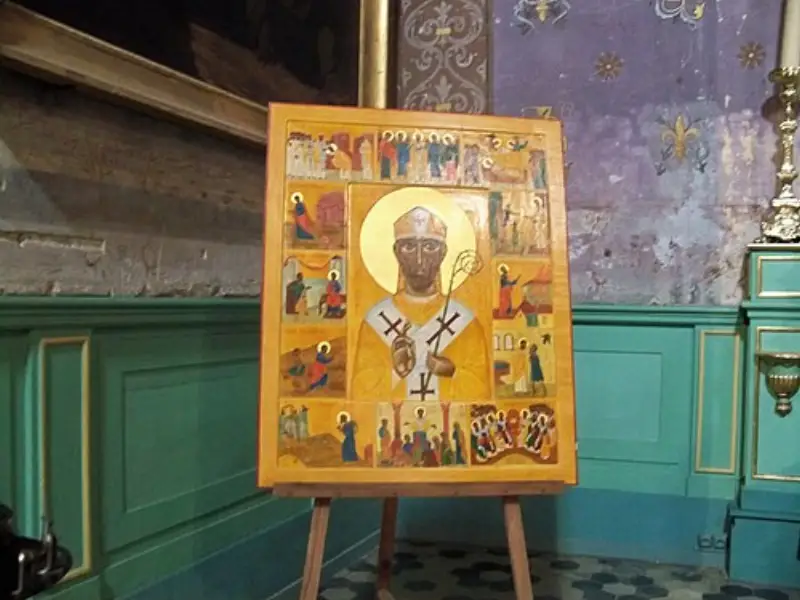
Overview
Eutropius of Orange, in French tradition Saint Eutrope, was bishop of Orange in Provence during the fifth century, probably from 463 until his death on 27 May 475. Born to the nobility of Marseille, he spent a wild and dissipated youth before his conversion, which tradition credits to the influence of his wife. After her death he was ordained deacon by Eustochius and in time elected to the see of Orange in succession to Justus. Overcome at first by the burden of the office, he fled, but was persuaded by a man of God named Aper to return and devote himself to his flock. His episcopate of about twelve years was marked by extreme devotion and humility: he worked the plough in the fields and carried stones at building sites alongside his laborers. He corresponded with Pope Hilarius, enjoyed the friendship of Faustus of Riez, and was praised by Sidonius Apollinaris. He took part in the councils of Arles of 463 and 475, and died as the Visigoths devastated his diocese.
The Complete Life
Conversion in Marseille
Eutropius was born into the nobility of Marseille, the great port city of southern Gaul, and according to the early accounts he wasted his youth in wild and worldly living. The turning of his life came, tradition says, through the least expected of instruments: his own wife, whose faith converted her husband. It was after her death that his path opened toward the church, and Eustochius ordained him a deacon. The outline is familiar from many lives of the Gallic episcopate, where the sons of senatorial families often came late and abruptly to ecclesiastical office, but the detail of a husband converted by his wife gives the story its particular tenderness. Whatever regrets the memory of his first years carried, he seems to have borne them as fuel for devotion rather than despair, for the sources emphasize that what struck contemporaries most in the bishop of Orange was the extremity of his devotion, a word his early biographers used of a man who had learned to give away completely what he had once squandered.
§ Life
The Bishop Who Fled
Elected to the see of Orange probably in 463, in succession to Bishop Justus, Eutropius reacted to his elevation not with triumph but with flight. The sources record that at first the sheer scale of what lay before him broke his courage, and he ran from the charge that had been laid upon him. What recalled him was not compulsion but persuasion: a man of God named Aper, whose very name means wild boar, convinced the runaway to come back and devote himself to the care of his flock. The episode, preserved in the tradition gathered around his life, discloses both the honesty of the man and the standard of the episcopate he came to embody, for which the burden of souls was a weight to tremble at rather than an honor to covet. From his return dates the twelve years of pastoral labor that made his reputation in the church of southern Gaul and won him the friendship of its best minds.
§ Life
Plough, Stones, and Councils
The episcopate of Eutropius lasted about twelve years and was spent, in the telling of his early biographers, as much with his hands as with his voice. He gave himself freely to manual toil: at one hour he stood in a field guiding the plough with his own hands, at another he hauled stones at a building site while the other workmen sat down to eat. The image belongs to a definite moment in the history of Provence, when bishops rebuilt both the fields and the churches of a land exhausted by invasion, and it made him famous among his people. His standing in the church is measured by his company: he corresponded with Pope Hilarius, was a close friend of Faustus of Riez, the foremost theologian of southern Gaul, and was spoken of in the highest and most reverential terms by Sidonius Apollinaris, the aristocratic bishop of Clermont whose letters are a principal ornament of the age. Letters from contemporaries praise his learning and piety alike, and he took his place in the councils of the church at Arles in 463 and again in 475.
§ Life
The Visigoth Storm and Death
The last period of Eutropius's life was darkened by war. The diocese of Orange lay in the path of the Visigoths, whose power under Euric was pressing northward and westward through Gaul, and his diocese was destroyed in their ravages. He did not abandon his people: he attended the Council of Arles in 475, and on 27 May of that year he died, having governed Orange for about a dozen years of invasion and reconstruction. He was buried in the Basilica of St Julien d'Antioch at Orange, a church of his own building, so that the stones he had carried for its construction became the shelter of his tomb. His successor Verus, writing around the year 500, composed his Life and recorded the works of power that prayer at his memory was believed to accomplish: a possessed person set free, a man struck by lightning restored to health, and a fire quenched at his intercession. The bishop who had fought fire and ruin in life was invoked against them in death.
§ Life
Relics and Remembrance
The cult of Eutropius endured long after the fall of the kingdom that had devastated his see. His feast is kept on 27 May, the day of his death, and he is venerated in both the Roman Catholic and Eastern Orthodox churches. His relics, carried far from Provence in the course of the centuries, rest today within the altar of the chapel of St Mary Magdalene at the London Oratory, so that the fifth-century bishop of a small Gallic diocese receives the prayers of English Catholics now. In the city of his ministry his memory remains fixed in art: the stained glass set in the apse of Notre-Dame cathedral at Orange in the nineteenth century shows him among the saints of the place. His Life, written by his successor Verus around 500 and preserved through the editorial labors of later scholars, stands among the early monuments of Gallic hagiography, and the testimony of Sidonius Apollinaris, Faustus of Riez, and the councils of Arles secures him a place in the documented history of the fifth-century church in Gaul.
§ Veneration
Timeline
- 463
Probably became bishop of Orange in succession to Justus and took part in the Council of Arles.
§ Life
- 475
Attended the Council of Arles for a second time in the last months of his life.
§ Life
- 27 May 475
Died on this date after the Visigoths destroyed his diocese.
§ Life
- 500
His successor Verus composed his Life around this year, recording the miracles attributed to him.
§ Life
The Record
- Major works
- Basilica of St Julien d'Antioch at Orange
- Patron of
- Diocese of Orange
- Canonization
- Pre-congregation; canonized by popular acclaim in the early church.
Prayer
Bibliography
Show 5 sources
- Monks of Ramsgate. 'Eutropius'. Book of Saints, 1921. CatholicSaints.Info. 27 January 2013.
- Butler, Alban. Lives of the Saints, 1830.
- Ekkart Sauser (2004). 'Eutropius of Orange'. In Bautz, Traugott (ed.). Biographisch-Bibliographisches Kirchenlexikon (BBKL). Vol. 23. Nordhausen: Bautz. col. 344. ISBN 3-88309-155-3.
- Texte latin édité par Ph. Varin, dans Bulletin du Comité Historique des monuments écrits de l'histoire de France. Histoire-Sciences-Lettres, tome I. Paris, 1849, p. 53-64.
- 'London Oratory'. Archived from the original on April 29, 2016. Retrieved June 8, 2016.
Profile text adapted from the Wikipedia article, licensed CC BY-SA 4.0.
Pray with this saint every day
Save St. Eutropius of Orange to your favorites, read the full profile, and get feast-day reminders in the Saints app.
Get the Saints AppFree on the App Store for iPhone and iPad