
c. 512 – 582·Feast April 6
St. Eutychius of Constantinople
Twice-Exiled Patriarch of Justinian's Capital
Overview
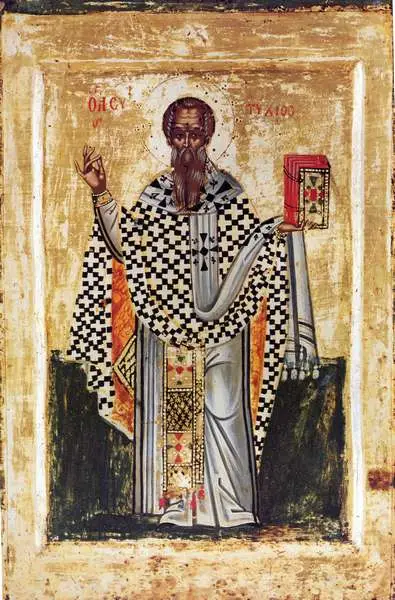
Eutychius of Constantinople (c. 512 – 5 April 582) served twice as patriarch of the imperial capital, from 552 to 565 and again from 577 to 582, in reigns and controversies that tested the independence of the church against both emperor and pope. Born at Theium in Phrygia, the son of a general who had served under Belisarius, at thirty he received the monastic habit at Amasea and in time rose to be an archimandrite respected throughout Constantinople. Emperor Justinian I nominated him to the patriarchal throne on the very day Patriarch Menas died. His first patriarchate presided over the Fifth Ecumenical Council of 553 against the Three Chapters, the consecration of the new Hagia Sophia in 562, and then a head-on collision with the aging emperor, who had adopted the doctrine of the Aphthartodocetae. Refusing to subscribe, Eutychius was arrested at the altar and spent twelve years and five months in exile. Recalled in triumph by Justin II and Tiberius II, he governed the church again until his death, but in his last years he defended an opinion on the resurrection that Pope Gregory the Great opposed, a dispute he settled at the hour of death by confessing the rising of the flesh.
The Complete Life
A Soldier's Son from Phrygia
Eutychius was born around 512 at Theium in Phrygia, in the western highlands of Asia Minor. His father, Alexander, was a general who had served under Belisarius, the most celebrated commander of Justinian's wars, so the boy grew up in a household shaped by the emperor's ambitions for the empire. He did not follow the military road. At the age of thirty he withdrew from the world and received the monastic habit at Amasea on the Black Sea coast of Pontus, a city with a long Christian tradition. His abilities carried him upward through the ecclesiastical world of the capital: he became an archimandrite, a father of monks, at Constantinople, and won the respect of Menas, the patriarch of the imperial city. When Menas died, Justinian I acted at once, nominating Eutychius to the patriarchal throne on that very day. The entire arc of his life is unusually well documented, for his chaplain Eustathius of Constantinople composed a full biography of him that has been preserved intact, a rarity among the lives of the Byzantine patriarchs.
§ Early life
Throne and Pope
Eutychius took possession of the patriarchate of Constantinople in August 552, at a moment when the whole Christian world was awaiting the resolution of the Three-Chapter Controversy. Pope Vigilius was then resident in Constantinople, and to him the new patriarch sent the customary announcement of his appointment together with a wholly orthodox confession of the church's undivided faith. The pope in turn pressed him to convoke the coming council and to preside at it that was to judge the disputed writings of Theodore of Mopsuestia, Theodoret, and Ibas. Vigilius first gave his consent and then withdrew it, but despite the refusal the council met at Constantinople on 5 May 553, with Eutychius sharing first place in the assembly alongside Apollinarius of Alexandria and Domnus of Antioch. When the second session opened, the pope once more pleaded ill health. The subscription Eutychius gave to the acts of the synod, recognized ever afterwards as the Fifth Ecumenical Council and concluded on 2 June 553, amounted to a summary of its decrees against the Three Chapters.
§ First patriarchate
Hagia Sophia and the Emperor's Heresy
For a decade Eutychius stood faithfully at the emperor's side. The decree the council issued against the Three Chapters came from his pen, and in 562 he consecrated Justinian's new Hagia Sophia, the great domed temple Justinian had raised after the Nika riots, the most splendid building in Christendom. Then the collaboration broke. In 564 the aging emperor gave his approval to the doctrine of the Aphthartodocetae, heretics outside the Chalcedonian fold who held that Christ's earthly body was incorruptible and felt no pain. The patriarch answered with a lengthy discourse demonstrating that this teaching could not be squared with Scripture, holding to the Chalcedonian faith he had professed at his enthronement. Justinian demanded his subscription anyway. When Eutychius refused to compromise, the emperor ordered his arrest, and on 22 January 565, while he offered the feast of Saint Timothy in the church next to the Hormisdas Palace, troops burst into the patriarchal dwelling, forced their way into the sanctuary, and carried him off. The pastor who had condemned heresy in council now suffered for the same confession in person.
§ First patriarchate
The Resurrection Disputed
In his last years Eutychius became entangled in a controversy that touched the heart of Christian hope. He maintained that the risen body would be subtler than air and would cease to be a tangible thing. The teaching was condemned as heresy, since it seemed to deny a bodily, physical rising from the grave, and against it stood the future Pope Gregory I, then resident in Constantinople as apocrisiarius, who appealed to the words of the risen Christ in Luke 24:39. Emperor Tiberius II Constantine, who had succeeded Justinian's line, conferred with each man apart and labored for peace, yet the rift would not close. The story of the patriarch's death gave the quarrel its resolution in the eyes of the faithful. On the Sunday after Easter in 582 he died quietly, and some of his friends afterwards told Pope Gregory that a few minutes before the end he had touched the skin of his own hand and confessed that in this very flesh he would rise again. The man who had argued too subtly about a spiritual body died bearing witness to the flesh.
§ Late beliefs and death
Exile and Triumphant Return
Eutychius was taken first to a house called Choracudis; on the following day he was moved to the monastery of St. Osias, close by Chalcedon. Eight days later the emperor summoned an assembly of princes and prelates and called the patriarch before it, but the charges were trifles: that he anointed himself, dined on delicate food, and prayed at excessive length. Summoned three times, Eutychius answered that he would stand trial only before a canonical court, with his rank respected and his clergy about him. Condemned without appearing, he was shipped to the island of Principus in the Propontis and then to his former monastery of Amasea, where twelve years and five months passed. Justinian replaced him with John Scholasticus. When that patriarch died, the Constantinopolitans clamored for their banished bishop to be brought home, and in October 577 the emperors Justin II and Tiberius II sent a delegation to Amasea to bring him home. Riding a young donkey over cloaks laid along the road, he came into the city amid palms and singing in imitation of Christ's entry into Jerusalem; the whole city was illuminated and the crowds acclaimed him with the words of the psalm and the angels. The next day at Hagia Sophia it took him six hours to distribute communion to all who wished to receive it from his hands.
§ Return and second patriarchate
A Saint of the Undivided Church
The church of both East and West reckoned Eutychius among its saints. The Orthodox Church keeps his feast on 6 April, and the Catholic Church preserves his memory in a different but telling way: he is mentioned in the Corpus Juris, the body of canon law, in the Decretum of Gratian, a recognition of the authority his decisions carried in the law of the church. His veneration gathered around the shrine of the San Giorgio Monastery, and his title among the Orthodox is that of holy hierarch, the saintly bishop. The grounds of his sanctity were plain in the tradition: he had governed the first see of the East through the council that defined the faith against the Three Chapters; he had consecrated the Hagia Sophia; he had suffered deposition, public trial on trifling charges, and twelve years of banishment rather than sign a distorted doctrine of Christ's body; and he had returned without revenge to shepherd the same flock that had watched him carried away. He died in his seventieth year, on the Sunday after Easter of 582, with the resurrection of the flesh on his lips.
§ Notes and references
Works and Witness
Eutychius's patriarchates, falling entirely within the reign of Justinian I, were marked by controversy with both imperial and papal authority, and the way he bore both conflicts fixed his historical character as a prelate who served the empire without surrendering to it. His literary remains are slight but real: a letter to Pope Vigilius, preserved in Migne's Patrologia Latina, and a fragmentary Discourse on Easter, together with other fragments in the Patrologia Graeca. More influential than his writings was his school of disciples; his students included Eustratius of Constantinople, who composed a treatise opposing the doctrine that souls sleep after death, a work that stands among the important treatments of the state of souls between death and resurrection. The intact survival of his biography by the chaplain Eustathius made him one of the best-documented patriarchs of Byzantium, and the memory of his arrest at the altar, his long exile, and his entry into Constantinople on an ass's colt entered the historical imagination of the Orthodox East as an icon of episcopal fidelity under imperial pressure.
§ Extant works by Eutychius
Timeline
- 512
Born at Theium in Phrygia, son of Alexander, a general under the commander Belisarius.
§ Early life
- 542
Received the monastic habit at Amasea at age thirty.
§ Early life
- Aug 552
Nominated patriarch of Constantinople by Justinian I on the day Patriarch Menas died.
§ Early life
- 5 May 553
Shared first place at the council that condemned the Three Chapters, concluded on 2 June as the Second Council of Constantinople.
§ First patriarchate
- 562
Consecrated the new church of Hagia Sophia.
§ First patriarchate
- 22 Jan 565
Arrested by soldiers on 22 January for refusing Justinian's Aphthartodocetist edict and sent into exile.
§ Arrest and exile
- 3 Oct 577
Recalled by Justin II and Tiberius II in October and enthroned again amid a triumphal entry into the city.
§ Return and second patriarchate
- 5 Apr 582
Died peacefully on the Sunday following Easter, in his seventieth year, confessing the rising of the flesh.
§ Late beliefs and death
In Their Own Words
I confess that in this flesh we shall rise again
Blessed is he that cometh in the name of the Lord
The Record
- Major works
- Letter to Pope Vigilius·Discourse on Easter (fragment)
- Patron of
- Patriarchate of Constantinople
- Canonization
- Pre-congregation; venerated as a holy hierarch in the Eastern Orthodox and Catholic Churches.
Prayer
Bibliography
Show 5 sources
- Fortescue, Adrian (1909). 'Eutychius I, Patriarch of Constantinople'. In Herbermann, Charles (ed.). Catholic Encyclopedia. Vol. 5. New York: Robert Appleton Company.
- Sinclair, W. M. (1911). 'Eutychius'. In Wace, Henry; Piercy, William C. (eds.). Dictionary of Christian Biography and Literature to the End of the Sixth Century (3rd ed.). London: John Murray.
- Eustathius of Constantinople, Vita S. Eutychii, 4-5, as cited by Fortescue 1909.
- Constas, N. An Apology for the Cult of the Saints in Late Antiquity - Eustratius Presbyter of Constantinople (CPG 7522).
- Gratian, Decretum, I pars., Dist. XVI, Cap. x.
Profile text adapted from the Wikipedia article, licensed CC BY-SA 4.0.
Pray with this saint every day
Save St. Eutychius of Constantinople to your favorites, read the full profile, and get feast-day reminders in the Saints app.
Get the Saints AppFree on the App Store for iPhone and iPad