
died c. 340·Feast September 7
St. Euverte of Orléans
Fourth-Century Bishop and Patron of Orléans
Overview
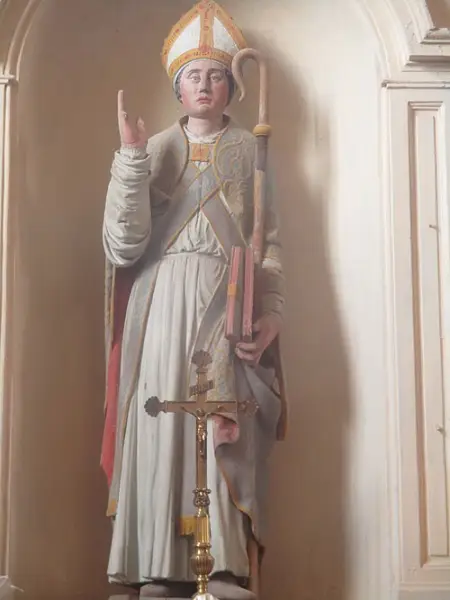
Euverte d'Orléans, also rendered Evurtius, Evortius, or Eortius, was the fourth bishop of Orléans in the fourth century, dying on 7 September, probably around the year 340, during the era of Constantine the Great. According to the account preserved in the martyrologies, he served as a subdeacon of the Church of Rome before crossing into Gaul, where he was chosen to govern the church of Orléans, in one tradition by a miraculous sign of a dove. His episcopate fell in the generation after the persecutions, when the Christian communities of the Loire needed above all shepherds who could order their spiritual life in a hard and uncertain age; Butler records his concern for the souls of his people as the mark of his rule. He chose as his coadjutor Aignan of Orléans, the man who would succeed him and become the second great patron of the city. His name stands in the ancient western martyrologies, his relics received three translations, and an abbey at Orléans bore his name; he remains a patron saint of the city.
The Complete Life
A Subdeacon of the Roman Church
The earliest traditions place Euverte's origins in Rome, where he served the apostolic see as a subdeacon, an order of the minor clergy entrusted with preparation of the altar and reading in the assembly. The Sarum Martyrology preserves the fuller legend in its old English idiom: he was, as written in his legend, the first subdeacon of the church of Rome. However the honorific is weighed, it signals that the church of fourth-century Gaul drew its bishops from the well-ordered clergy of the imperial capital, men formed in Roman discipline at a time when the cities of the Loire were only a few generations removed from paganism. From Rome he came into Gaul, and there his course crossed that of the Christian community of Orléans, a city on the northern frontier of Aquitanian Gaul whose church was seeking a bishop. The ancient western martyrologies received his name into their calendars, keeping the 7 September on which he died, even though the medieval compilers themselves confessed that little of his history could be told with authority.
§ Life
Chosen by a Sign
Euverte crossed into Gaul and was chosen for the church of Orléans, becoming the fourth occupant of the see. The legend transmitted through the martyrologies tells how his election was sealed by a miracle, in a sign of a dove descending upon him, the same heraldry that had marked the choice of the deacon Sixtus and of other bishops of the early centuries; the dove of the story declares what the church believed about the source of pastoral authority. Alban Butler places his flourishing under the reign of Constantine the Great, the emperor whose conversion had brought the churches of Gaul out of hiding and into the public order of the empire. For Orléans the generation of Constantine was the age of foundation: the communities that had survived the Great Persecution of Diocletian now required bishops who could organize parishes, build churches, and form a Christian people where law and custom had recently been their enemies. Into that task the former Roman subdeacon gave the remainder of his life.
§ Life
Shepherd in a Difficult Time
The sources characterize Euverte's episcopate chiefly by his care that the souls entrusted to him should grow in the faith amid hard years. The phrase is modest, but it describes the whole labor of a fourth-century bishop in Gaul: catechizing the crowds who came forward after the peace of the church, ordering the liturgy and the calendar of fasts and feasts, reconciling the lapsed, and defending his flock against the disorders that followed the new freedom of the Christian name. The strongest act of his government that the record preserves is his choice of a coadjutor and successor, Aignan of Orléans, whom he associated with himself in the episcopal office and who would become, after him, the second great patron of the city and the subject of his own medieval cult. In preparing Aignan for the see, Euverte did what the wisest bishops of the age tried to do: he made the continuity of pastoral care, not the fame of the officeholder, the bond by which the church of Orléans endured from generation to generation.
§ Life
The Saint of Orléans
Euverte died at Orléans on 7 September, the day the martyrologies fixed for his anniversary, probably around 340. His cult outlived the Roman empire: his name stands famous in the ancient western martyrologies, three separate translations of his relics were made in the course of the centuries, and a celebrated abbey at Orléans bore his name. The earliest Life of Saint Aignan, composed at some date between 474 and 530, is the first writing to credit him with raising a cathedral of Saint Euverte at Orléans, making him a builder as well as a shepherd in the memory of the city. The Sarum usage, carried to England, remembered him in its martyrology as the first subdeacon of Rome elected bishop by the sign of the dove. In the city he led he remains a principal patron, and his memory is kept alive there still, not least in the Sainte Croix - Saint Euverte primary school that bears his name beside the cathedral quarter of Orléans.
§ Veneration
Timeline
- 7 Sep 340
Died at Orléans on 7 September, most likely around this year, as the fourth bishop of the city.
§ Introduction
- 474
The earliest Life of Saint Aignan, composed at some point between 474 and 530, first attributes a Saint Euverte cathedral at Orléans.
§ Life
The Record
- Major works
- Cathedral of Saint Euverte at Orléans (attributed by the first Life of Saint Aignan)
- Patron of
- City of Orléans
- Canonization
- Pre-congregation; his cult is attested from the ancient western martyrologies.
Prayer
Bibliography
Show 6 sources
- Butler, Alban (1799). The Lives of the Primitive Fathers, Martyrs, and Other Principal Saints: Compiled from Original Monuments and Other Authentic Records. Vol. 9. J. Moir. Retrieved 2021-08-19.
- 'Saint Euverte, évêque d'Orléans (IVe siècle)'. Nominis.
- Monks of Ramsgate. 'Anianus'. Book of Saints, 1921.
- Sarum Martirology, (Richard Whitford, ed.) William Renwick, mmxii.
- 'La Translation de saint Euverte à Orléans, un saint mentionné dans le Guide du pèlerin'. David Parou Saint-Jacques Foundation.
- Duchesne, Louis (1907-1910). Fastes épiscopaux de l'ancienne Gaule. Provinces du Sud-Est.
Profile text adapted from the Wikipedia article, licensed CC BY-SA 4.0.
Pray with this saint every day
Save St. Euverte of Orléans to your favorites, read the full profile, and get feast-day reminders in the Saints app.
Get the Saints AppFree on the App Store for iPhone and iPad