
died 1675·Feast Unknown
St. Evdokia Urusova
Old Believer princess who starved for the old faith
Overview
Princess Evdokia Urusova was a seventeenth-century Russian noblewoman whose loyalty to the old rites carried her, alongside her elder sister, into prison and death by starvation. She was the sister of Feodosia Prokopiyevna Morozova, the best-known woman of the Old Believer movement, and it was Morozova who persuaded her to join the partisans of the ancient usage during the Raskol, the schism that tore Russian Christianity apart in the middle of the seventeenth century. With Morozova and the noblewoman Maria Danilova, she followed the teaching of Archpriest Avvakum, who taught that Nikon had possessed no authority to touch the church's inherited practice, seeing in his novelties the antichrist's corruption of the faith. Seized in 1671 on the tsar's orders, the three women endured prolonged interrogation and torture without recanting, and they turned away the compromise negotiated by Patriarch Pitirim. After Ioakim became patriarch in 1674 they were cut off from all support and slowly starved in an underground cellar of the St. Paphnutius Monastery at Borovsk. All three died in 1675. Old Believers honor Urusova as a martyr, and her memory is bound to that of her sister.
The Complete Life
A Princess Takes the Old Rite
Urusova belonged to the highest ranks of Muscovite society, sister to Feodosia Morozova, the wealthy boyarina who had married into the family of the tsar's tutor and kept a place at court after her husband's death. Her conversion was a family matter before it was a public scandal: because Archpriest Avvakum served as Morozova's confessor, Morozova had entered the Old Believer movement during the Raskol, and she in turn played the decisive part in convincing Princess Evdokia to join it. The noblewoman Maria Danilova made the same choice, and the three women formed a small community of conscience within the aristocracy. What bound them was the conviction, preached by Avvakum, that Patriarch Nikon had possessed no authority to change rites handed down from antiquity, and that his innovations — above all the correction of the liturgical books and the imposition of the three-fingered sign of the cross in place of the old two-fingered gesture — amounted to the faith's corruption by the antichrist. For a woman of her rank, adherence to the party of the old rites meant choosing defeat, disgrace, and persecution in the world's terms; Urusova made the choice anyway and never withdrew it, even under torture.
§ Life
The Cellar at Borovsk
After many misfortunes the three women were seized by order of Tsar Alexis in 1671 and subjected to a long course of interrogation and torture, yet none of them would say the words of recantation. When Patriarch Pitirim attempted to reach a compromise, the prisoners refused it. Their endurance was tested further by private grief: while Morozova lay under arrest, her son Ivan died. The tsar is said to have weighed burning Morozova at the stake before choosing a slower and quieter punishment, and the princesses were confined with Danilova in an underground cellar of the St. Paphnutius Monastery at Borovsk, where they suffered considerable deprivation. The accession of Patriarch Ioakim in 1674 removed even the remnants of mercy: the women were deprived of every form of support and left to starve. One by one they succumbed during 1675. The manner of their death — confinement, darkness, hunger accepted rather than faith denied — gave the Old Believers their most precious company of female martyrs, and the place of their imprisonment became, in time, a place of pilgrimage and remembrance.
§ Life
Remembered Among the Three Martyrs
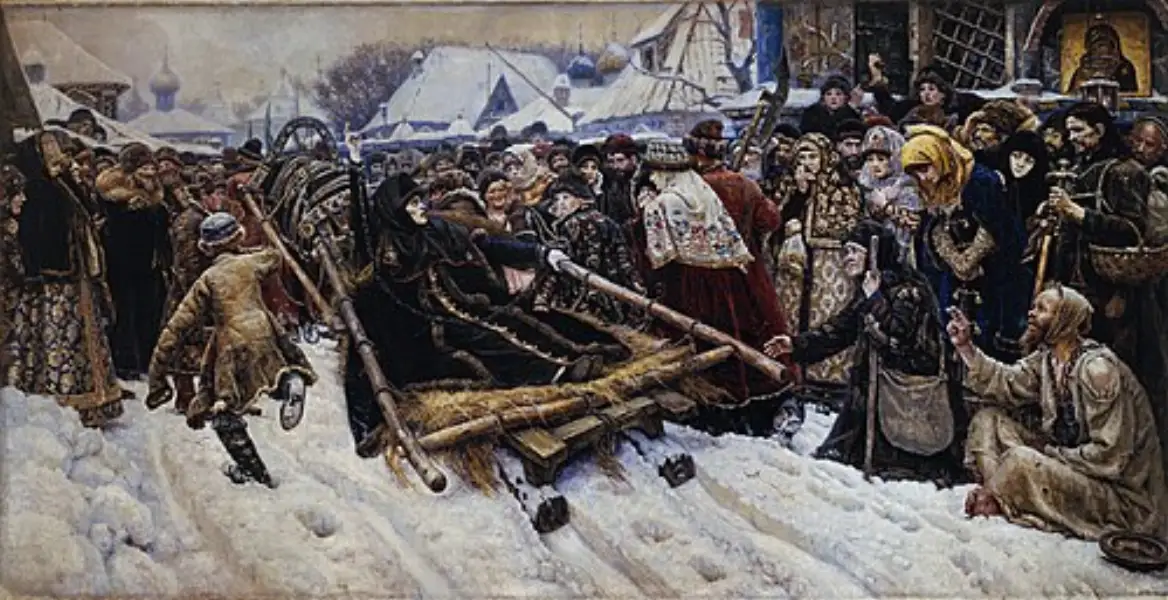
Avvakum himself composed a Lament for the three martyrs, and an unknown author's hagiography, the Tale of Boiarynia Morozova, gave a full account of the sisters' witness as martyrs. The story circulated widely, miracles were credited to Morozova by the Old Believers, and many communities continue to venerate the two princesses and Danilova as saints of their confession. Urusova's fame has always been shared with her sister's — it is Morozova whom the world remembers chiefly, painted by Vasily Surikov at the moment of her arrest with the two fingers of the old blessing raised against her captors — but the Lament and the Tale preserve all three women together as a single chorus of constancy. In the nineteenth century nationalist writers took up the martyr of the old faith as an emblem of Russian identity and tradition, and later radicals claimed her as a figure of resistance to state power, while Soviet-era authors — among them Anna Akhmatova, Varlam Shalamov and Fazil Iskander — claimed her, in one account's phrase, for their own causes of resistance. In 2002 a chapel was raised to mark the prison site where the sisters ended their lives, closing three centuries of remembrance with stone.
§ Reputation
Timeline
- 1671
Arrested with her sister Feodosia Morozova and Maria Danilova by order of Tsar Alexis for opposing the Nikonite reforms.
§ Life
- 1674
After Ioakim became patriarch, the three prisoners were deprived of all support and began to starve.
§ Life
- 2 Nov 1675
Starved to death with her sister and Danilova in the underground cellar of the St. Paphnutius Monastery at Borovsk; Morozova died on this date.
§ Life
- 2002
A chapel was raised on the site of the prison where the sisters perished.
§ Reputation
The Record
- Patron of
- Venerated as a martyr by Old Believer communities
- Symbols
- The two-fingered sign of the cross of the Old Believers
- Canonization
- Venerated as a holy martyr by Old Believer communities; no formal canonical act recorded
Prayer
Bibliography
Show 6 sources
- Clements, Barbara Evans (June 29, 2012). A History of Women in Russia: From Earliest Times to the Present. Indiana University Press. pp. 51–52. ISBN 978-0-253-00104-7.
- Ermokhin, Daniil (October 22, 2018). "Boyarinya Morozova". The Russian Orthodox Old Believer Church, official website of the Moscow Metropolitanate.
- "Boyarina Morozova", The State Tretyakov Gallery.
- Kizenko, Nadieszda (2004). "Review of Margaret Ziolkowski, ed. Tale of Boiarynia Morozova: A Seventeenth-Century Religious Life". H-Net: Humanities & Social Sciences Online.
- Ziolkowski, Margaret (2000). Tale of Boiarynia Morozova: A Seventeenth-century Religious Life. Lanham, MD: Lexington Books. pp. 10–11. ISBN 978-0-7391-0177-3.
- Ageeva, E. A. (2013). "Feodosia Prokopiyevna Morozova". Great Russian Encyclopedia (in Russian). Vol. 21. p. 141. ISBN 978-5-85270-355-2.
Profile text adapted from the Wikipedia article, licensed CC BY-SA 4.0.
Pray with this saint every day
Save St. Evdokia Urusova to your favorites, read the full profile, and get feast-day reminders in the Saints app.
Get the Saints AppFree on the App Store for iPhone and iPad