
died c. 700·Feast July 9
St. Everilda of Everingham
Wessex noblewoman who founded a Yorkshire convent
Overview
Everilda, in Old English Eoforhild, was a seventh-century Anglo-Saxon saint who founded a convent at Everingham, in Yorkshire's East Riding, and nearly everything known of her comes from her legend in the York Breviary. According to that tradition she was of the nobility of Wessex and was brought to Christianity in 635 by Saint Birinus, the missionary who converted King Cynegils of the West Saxons. Called to the religious life, she fled from her home to become a nun, joined by two companions, Saints Bega and Wuldreda; Saint Wilfrid of York received their vows at a place called the Bishop's Dwelling, afterwards known as Everildisham and identified with present-day Everingham. There Everilda gathered a community of some eighty women and governed it until, her mission accomplished, she died peacefully around the year 700. Her name passed into the Martyrology of Usuard and the church calendars of York and Northumbria, and her cultus left a mark on the landscape: three churches in the East Riding still bear her dedication. Her feast is kept on 9 July, and she stands among the virgin founders of Anglo-Saxon monasticism whose lives survive only in the breviary lessons of the medieval church.
The Complete Life
Converted by Birinus, Called from Home
Everilda's story begins in the south, among the nobility of Wessex, in the generation when the West Saxon kingdom was turning to Christ. The York Breviary's legend places her conversion in the year 635, when Saint Birinus, the Roman missionary sent to the darkest corners of England, baptized King Cynegils of Wessex and with him many of his people; Everilda, a noblewoman of that court, was converted in the same harvest. What the breviary records next is the pattern familiar from a hundred Anglo-Saxon lives: the young woman of rank who hears a stricter call and will not be stayed by family or boundary. She ran from her father's house to take the veil, and the going was not solitary — Saints Bega and Wuldreda, her companions, went with her, a small band of women crossing from the southern kingdoms into the north where the monastic movement flourished. It was Saint Wilfrid of York, the great and contentious bishop of the Northumbrian church, who received them and made them nuns at a place known simply as the Bishop's Dwelling. There the noble runaway of Wessex became, in the sight of the church, a founder.
§ Biography
Eighty Women at the Bishop's Dwelling
The place where Wilfrid clothed the three women kept their founder's name: it came to be called Everildisham — the water-meadow of Everild — and has been identified with the present village of Everingham in the East Riding of Yorkshire. There Everilda gathered and governed a community that the breviary numbers at some eighty women, a substantial double monastery by the standards of seventh-century England and a sign of how quickly a holy founder's reputation drew recruits. The legend compresses decades of administration, teaching, and prayer into a single sentence, but the shape of the work is clear: a convent of noble and common women living under a rule in the heart of Northumbria, planted by a southerner converted by the apostle of Wessex and professed by the apostle of the North. The breviary adds only the ending, and makes it the measure of the whole — her death, when it came, was a peaceful one: the work assigned to her had been brought to completion. Around the year 700, with her house established and its future secure, the founder laid down the burden; the community she left behind carried her memory into the breviaries and calendars of the northern church.
§ Biography
Three Churches and a July Feast
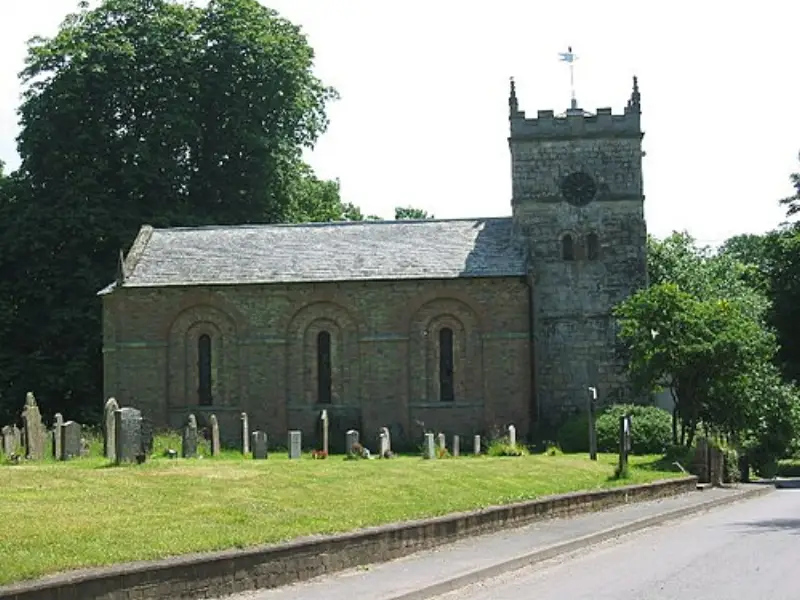
Everilda's cultus was never spectacular, but it was durable, and its witnesses survive. Her name entered the Martyrology of Usuard, the ninth-century list of saints used across the medieval West, and found a place in the calendars of the churches of York and Northumbria — the region of her work. Her fullest life was set out in the lessons of the York Breviary, the liturgical book of the northern metropolitan see, which is at once her hagiography and the only source for it; the Acta Sanctorum preserved those lessons, and antiquarian studies such as Frances Egerton Arnold-Forster's work on English church dedications carried them into modern scholarship, alongside the entries of David Farmer's Oxford Dictionary of Saints and the old monthly compendium of Butler's Lives. Most tangibly, the landscape of the East Riding still testifies to her: three churches are dedicated to Saint Everilda — St Everilda's Church at Nether Poppleton, St Everilda's Church at Everingham, and Ss Mary & Everilda, Everingham — a concentration of dedications that marks the geography of her convent and its sphere. Her feast of 9 July keeps her among the founders of Anglo-Saxon monasticism, a woman known almost entirely by the church she built.
§ Veneration
Timeline
- 635
Converted to Christianity by Saint Birinus together with King Cynegils of Wessex.
§ Biography
- 700
Died peacefully at Everingham when her mission was accomplished, c. 700.
§ Biography
The Record
- Major works
- The convent at Everingham (Everildisham), East Riding of Yorkshire
- Patron of
- Patron saint of Everingham and of the Yorkshire churches bearing her name
- Symbols
- Abbess's staff·Convent at Everingham
- Canonization
- Pre-congregation; ancient cultus attested by the York Breviary, the Martyrology of Usuard, and the calendars of York and Northumbria
Prayer
Bibliography
Show 3 sources
- "Everilda" in Frances Egerton Arnold-Forster, Studies in Church Dedications: or, England's Patron Saints, 1899, p. 403f, based on Acta Sanctorum, "setting forth three lessons on the saint". Also Everildis.
- Farmer, David (1 January 2011), "Everild", The Oxford Dictionary of Saints, Oxford University Press. doi:10.1093/acref/9780199596607.001.0001/acref-9780199596607-e-615. ISBN 978-0-19-959660-7. Retrieved 2 April 2025.
- Butler, Alan (1866). "July 9 St. Everildis, Virgin, in England". Butler's Lives of the Saints. Retrieved 2 April 2025, via Bartleby.com.
Profile text adapted from the Wikipedia article, licensed CC BY-SA 4.0.
Pray with this saint every day
Save St. Everilda of Everingham to your favorites, read the full profile, and get feast-day reminders in the Saints app.
Get the Saints AppFree on the App Store for iPhone and iPad