
dates not recorded·Feast Not recorded
St. Evin
Abbot of Rosglas on the River Barrow
Overview
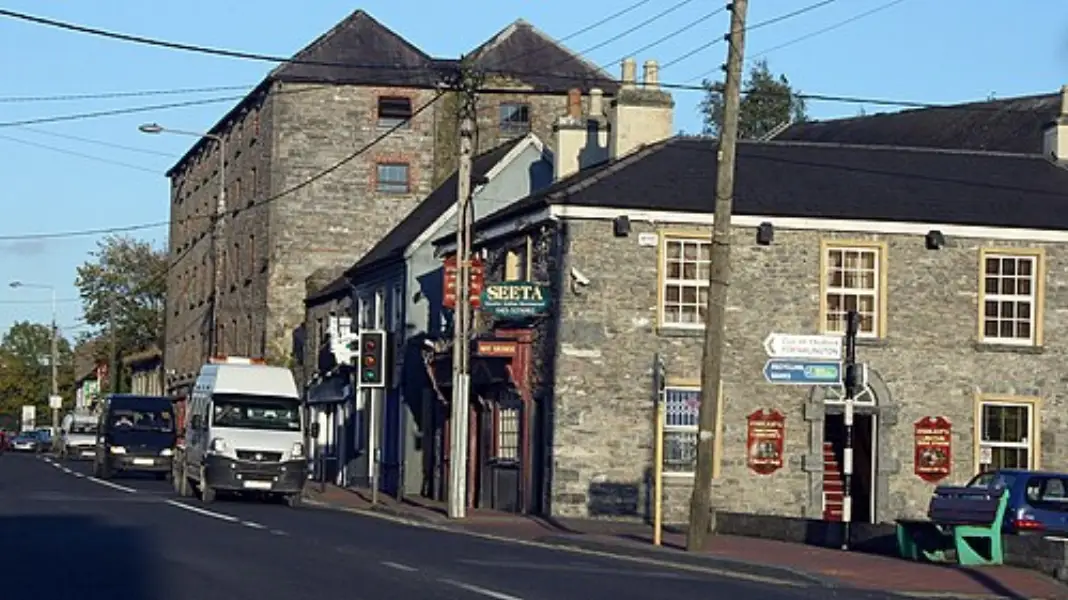
Evin, also called Éimhín, was an early Irish abbot whose name endures in the town of Monasterevin, County Kildare, which grew up around his monastery. A native of Munster, he bore a diminutive form of the adjective eimh, meaning swift or active, Latinized in church use as Eminus. His mentor was Saint Abban of New Ross, counted among the contemporaries of Saint Patrick, who placed in Evin's hands a monastic settlement beside the River Barrow at Rosglas. Evin arrived with companions drawn from his home province, and their presence gave the house its early name of Rosglos-na-Moinneach, meaning the greenwood of the men of Munster. His contemporaries judged him remarkably shrewd in worldly affairs: he obtained special standing for the district, setting it outside the common law as a place of sanctuary, and his celebrated bell was called for by the tribes of the region whenever oaths had to be sworn and peace treaties guaranteed. A share in composing the Tripartite Life of St. Patrick is credited to him, and further writings attributed to his hand, among them the Cain Emhin, are known to survive. The community he founded faded around the time of the Viking raids on Ireland, yet the site kept its importance: the Battle of Ballaghmoon in 903 was waged over possession of his church, and a Cistercian abbey later rose on the same ground, carrying his memory onward.
The Complete Life
A Munsterman on the Barrow
Evin was a Munsterman by birth, and the memory of that origin stayed attached to his foundation for as long as it stood. His name, Éimhín, is a diminutive built on the adjective eimh, meaning swift or active, and it was Latinized in ecclesiastical use as Eminus. The record of his early years is slight, but his path crossed that of one of the great figures of the Irish church: Saint Abban of New Ross, reckoned a contemporary of Saint Patrick. Abban had settled a monastic community on the Barrow's banks at Rosglas, ground that now lies within County Kildare, and he placed it in the charge of his protégé. For a young churchman the trust was a substantial one. Rosglas stood at a crossing of the Barrow, a position that had drawn travellers since prehistoric times and that would give the community standing long after its founder's death. Evin did not come to it alone. He brought a number of monks with him out of his native province, and the house became known accordingly as Rosglos-na-Moinneach, the greenwood of the men of Munster, a name that preserved in a single phrase both the place itself and the provenance of the community that served it.
§ Middle Ages
Abbot of Rosglas
Evin's vocation unfolded within the familiar pattern of early Irish monasticism, in which a founder-elect received a site from a senior abbot and gathered a community about a rule of prayer and labour. At Rosglas he took up exactly such a charge, accepting from Saint Abban the settlement on the Barrow and shaping it into a house with a distinct identity of its own. The monks who accompanied him from Munster gave the community its early character, and the settlement grew in consequence into a notable religious centre on a crossing point of strategic value. His role, however, was never confined to the cloister. Early Irish abbots acted as figures of authority in the world around them, and Evin proved unusually capable in that sphere. The memory of the district honours him as politically astute, so much so that one modern writer remarks that he would be called a spin doctor today. His dealings with the neighbouring peoples bore that judgment out. He secured for the Monasterevin area a special status, setting it outside the common law and constituting it a sanctuary, a protection of real weight in a country of competing kin groups. Travellers, fugitives and disputants alike could claim the peace of the holy place, and the standing of the monastery rose with that privilege.
§ Middle Ages
Bell, Sanctuary and Book
Two instruments of Evin's authority are recorded with unusual clarity: his bell and his books. His famous bell served for the swearing of oaths and was much in demand among the tribes of the region, who called upon it to guarantee peace treaties concluded among them. In early Ireland the bell of a revered abbot carried the weight of the saint himself, and to swear upon it was to place a dispute under the eye of heaven; that the peoples of the Barrow country sought out Evin's bell for their covenants is a measure of the reverence his person commanded. His literary work shows the other face of his mission. He is credited as co-author of the Tripartite Life of St. Patrick, one of the chief narrative lives of Ireland's apostle, and further writings attributed to him survive, including the Cain Emhin. A churchman who could help compose a life of the national apostle and put forth a text of his own stood at the centre of the learned culture of his age. Between the sanctuary he had won for his district, the bell that sealed its treaties, and the writings that carried his name further afield, Evin's influence reached well beyond the walls of Rosglas, and the settlement on the Barrow took its place among the noteworthy houses of the early Irish church.
§ Middle Ages
The Abbey After Evin
Evin's monastery did not outlive the Viking age; the community is said to have died out about the time of the Norse raids on Ireland. The ground, however, kept its worth. In 903 the Battle of Ballaghmoon was fought nearby over who should possess his church, a plain measure of how much the site still mattered to the powers of the region. A new religious establishment appeared in the twelfth century, when a Cistercian abbey was founded on the spot under the patronage of Dermot O'Dempsey, drawing Rosglas into obedience to Mellifont in County Louth and to Baltinglass in County Wicklow. The O'Dempseys, rulers of the territory of Clanmaliere, remained bound to the abbey for generations and supplied its final abbot, Hugh O'Dempsey. The abbots of Monasterevin, as the place had come to be called, inherited something of their founder's political gift: they sat in the Irish Parliament even as they aided outlaws and rebels against the English crown. By 1427 the community was in hardship, and in 1541 the monastery was yielded up to Henry VIII at the suppression. The town that grew up beside it still bears his name, Mainistir Eimhín, Evin's monastery, and his memory remains fixed in the map of County Kildare.
§ Middle Ages
Timeline
- 903
The Battle of Ballaghmoon was waged nearby over who should possess Evin's church.
§ Middle Ages
- 1427
The monastery of Rosglas had fallen into hardship and decline.
§ Middle Ages
- 1541
The abbey passed into the hands of King Henry VIII at the suppression of the monasteries.
§ Middle Ages
- 1613
The abbey and demesne of Rosglas passed by royal grant from James I to Sir Adam Loftus.
§ Early Modern Era
The Record
- Major works
- Tripartite Life of St. Patrick (co-author)·Cain Emhin
- Symbols
- bell
- Canonization
- Pre-congregation saint of the early Irish Church
Prayer
Bibliography
Show 5 sources
- Saul B. Cohen (ed.), The Columbia Gazetteer of the World: Volume 2: H to O, Columbia University Press, 1998, p. 2021.
- "Mainistir Eimhín/Monasterevin", Placenames Database of Ireland (logainm.ie), Department of Culture, Heritage and the Gaeltacht and Dublin City University.
- Lee, J. J. (1981). "On the accuracy of the Pre-famine Irish censuses", in Goldstrom, J. M.; Clarkson, L. A. (eds.), Irish Population, Economy, and Society: Essays in Honour of the Late K. H. Connell, Clarendon Press, Oxford.
- Mokyr, Joel; O Grada, Cormac (November 1984). "New Developments in Irish Population History, 1700-1850", The Economic History Review 37 (4), pp. 473-488.
- "History of Monasterevin - Kildare Local History.ie", kildarelocalhistory.ie.
Profile text adapted from the Wikipedia article, licensed CC BY-SA 4.0.
Pray with this saint every day
Save St. Evin to your favorites, read the full profile, and get feast-day reminders in the Saints app.
Get the Saints AppFree on the App Store for iPhone and iPad