
died c. 66·Feast May 6 (Catholic Church); September 7 (Eastern Orthodox Church)
St. Evodius of Antioch
First bishop of Antioch in the apostolic succession
Overview
Evodius, active from about 50 to 70, was an early Christian whom ancient writings name as Antioch's first bishop — in some traditions the man who took over from the Apostle Peter himself — and whom later tradition ranked among the seventy disciples of the Lord. He stands among the first identifiable post-apostolic Christians — a man the sources know almost entirely as a name at the head of a succession list. Antioch, the opulent former capital of the Seleucid empire and a trade center of Roman Syria with a large Greek-speaking Jewish population, was among the earliest fields of Christian preaching, and its episcopate was the most storied in the East. Eusebius's fourth-century Church History records that the episcopal list of Antioch began with Evodius and continued with Ignatius; the Apostolic Constitutions has Peter declaring Evodius his appointee; and the ninth-century Chronography of George Syncellus dates the beginning of the episcopate to about the year 45. His episcopate is commonly ended around the year 66, when Ignatius succeeded him. No writings of his survive. In Catholic memory he died a natural death; Orthodox memory honors him as a martyr of Nero's day. He is venerated as a saint across the ancient churches.
The Complete Life
A Name from the First Christian Generation
Almost nothing is recorded of Evodius's origin, family, or conversion — he reaches the sources already in office, a man defined entirely by the church he served. What the sources do give is the city. In the first century Antioch was an opulent and cosmopolitan metropolis, the former seat of the Seleucid kings that had kept its rank as a trading center under Roman rule, and it housed a substantial population of Greek-speaking Jews. It was precisely to such Greek-speaking Jews that the earliest Jewish Christians first carried the gospel, and Antioch became one of the cradle cities of Gentile Christianity — the place where, as the tradition of the age held, the Lord's followers were first called Christians. To lead that church in its first generation was a task of founding weight: no institutions existed yet, no written gospels had circulated, and the transition from apostolic oversight to local ministry had to happen somewhere first. Evodius stands in the sources as the man with whom, at Antioch, it happened. Later writers would fill the silence of his early life — one pious tradition made him among the seventy disciples of the Lord — but the careful historian must leave him, as Eusebius leaves him, a name and a see.
§ Biography
First in the Antiochene Succession
The question of how Evodius became bishop of Antioch is bound up with one of early Christianity's delicate problems: the relation of Peter to that city. Various early writings say Peter visited Antioch, and some make him its leader; but ancient authors often distinguished apostles from bishops, holding that an apostle could create a bishop without being one. In this frame the fourth-century Eusebius preserves a short notice: the first set over Antioch was Evodius, and Ignatius came after him — and the Apostolic Constitutions, a pseudepigraphal work of a fourth-century Syrian author that preserves the traditions of that church, sets out a list of the bishops ordained by the apostles in their lifetime and names Evodius of Antioch as appointed by Peter, with Ignatius appointed by Paul. The ninth-century Chronography of George Syncellus confirms the sequence and supplies a date, placing the first Antiochene episcopate around the fourth year of Claudius, about the year 45. A minority of scholars, following Walter Bauer, have doubted that Evodius held the see at all, reading the ancient lines as making Peter himself the first bishop with Ignatius directly after; a homily of John Chrysostom praising Ignatius as Peter's successor, seemingly passing over Evodius, is their strongest text. The mainstream tradition, however, has always kept Evodius first.
§ Biography
Shepherding the Church in Roman Syria
Of Evodius's governance of the Antiochene church the ancient sources preserve almost no narrative, but its duration and outcome are fixed by the succession: his episcopate is customarily ended in the year 66, when Ignatius of Antioch — the famous God-bearer of the arena — took up the see. Those years, from the mid-century to the eve of the Jewish War, spanned the first and hardest transition of the Christian movement, from the direct oversight of apostles to the settled ministry of bishops, and the Antiochene church that emerged under Ignatius — confident, hierarchical, and ready to die — was the work of Evodius's generation as much as his successor's. Later pious curiosity, gathering details about the apostolic age as Christianity grew popular, expanded the picture: it made Evodius one of the seventy disciples sent out by the Lord himself, and cast Peter's Antiochene stay as a deliberate preparation, with Evodius named successor when Peter departed for Rome. On the manner of his death the traditions part company: Catholic memory judges that he ended his days peaceably, worn out by his years; Orthodox memory instead crowns him with martyrdom in Nero's persecution, a confession crowned in the same years that saw Peter and Paul die at Rome.
§ Biography
Feasts of East and West
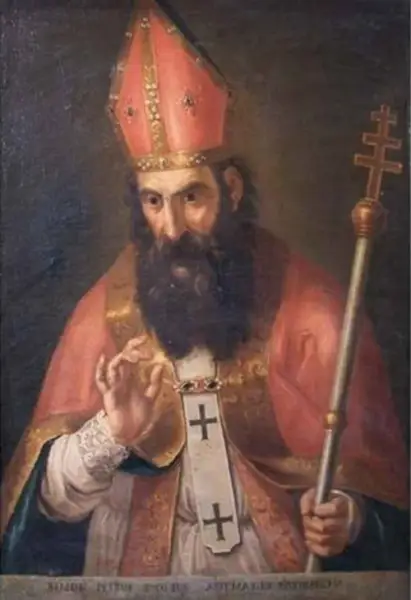
Evodius belongs to the oldest rank of the saints: no process proclaimed him, no dossier survives, but the churches of the first millennium kept his name in their calendars and have never removed it. The Catholic Church honors him on 6 May; the Eastern Orthodox Church keeps 7 September; and his veneration extends across the whole ancient inheritance — he is counted among the saints of the Catholic Church, the Eastern Orthodox Church, Oriental Orthodoxy, the Assyrian Church of the East, and the Ancient Church of the East, one of the few first-century figures honored by every branch of divided Christianity. In the West he appears in the long list of saints who trace their cultus to the earliest generations, and the Catholic enumeration of the disciples made saints places him among them, in the company of the seventy; in the East the Orthodox Church in America's Lives of the Saints commemorates him as Apostle Evodius of the Seventy, with the Russian iconographic tradition pairing him in painted panels with Onesiphorus. His iconographic attribute is simply that of a bishop — the office is the biography. For the ancient patriarchate of Antioch, he remains the first link between the apostles and the long line of Ignatius's successors.
§ Biography
Pseudo-Evodius and the Long Memory
Evodius's name acquired, centuries after his death, a literary shadow of its own. Three apocrypha in the Coptic tongue bear his name without right — homilies on the Dormition of the Virgin, on the Passion and Resurrection, and on the Life of Jesus and His Love of the Apostles — most likely all from one unknown hand, writing somewhere between the sixth and eighth centuries. The texts place their narrator in Rome rather than Antioch, a detail found nowhere else in the tradition, yet they clearly mean the same man, for they call him the successor of Peter. Modern scholars such as Dylan Burns and Timothy Pettipiece have translated and introduced these homilies for the current generation, and they remain a fascinating witness to how far the first bishop's name traveled — into Egyptian monastic literature, Marian devotion, and meditation on the apostles. His primary legacy, though, is older and simpler: he is the point at which the church of Antioch passed from apostolic preaching to episcopal continuity, the first name in one of the oldest successions in Christendom. Nearly two millennia later, when the ancient churches of the East recite their ancestry of faith, they begin it, after Peter, with Evodius.
§ Pseudo-Evodius
Timeline
- 45
The ninth-century Chronography of George Syncellus dates Evodius's establishment as first Antiochene bishop to about this year, the fourth of Claudius's reign.
§ Biography
- 53
According to the traditional reckoning, succeeded Peter as bishop of Antioch, an office he held until c. 66.
§ Biography
- 66
Succeeded by Ignatius of Antioch; Catholic tradition holds he died of natural causes, while Orthodox tradition commemorates a martyrdom under Emperor Nero.
§ Biography
- 300
Eusebius's Church History recorded that the line of bishops at Antioch opened with Evodius and passed next to Ignatius.
§ Biography
- 350
The Apostolic Constitutions, a fourth-century Syrian pseudepigraphon, listed Evodius among the bishops ordained by the apostles — Evodius by Peter, Ignatius by Paul.
§ Biography
- 600
Between the sixth and eighth centuries, three Coptic homilies were composed under his name, probably by a single Pseudo-Evodius.
§ Pseudo-Evodius
- 800
George Syncellus's Chronography affirmed Evodius as the first bishop of Antioch and dated his tenure to Claudius's fourth year.
§ Biography
The Record
- Patron of
- Venerated as a model of apostolic succession by the ancient patriarchate of Antioch
- Symbols
- Bishop
- Canonization
- Pre-congregation; venerated since antiquity by the Catholic, Eastern Orthodox, Oriental Orthodox, and Assyrian churches
Prayer
Bibliography
Show 6 sources
- Parvis, Paul (2015). "When Did Peter Become Bishop of Antioch?". In Bond, Helen; Hurtado, Larry (eds.). Peter in Early Christianity. pp. 263–272. ISBN 978-0-8028-7171-8.
- "St. Evodius of Antioch", Catholic News Service.
- Chapman, John; "Evodius", The Catholic Encyclopedia, Vol. 5, New York, Robert Appleton Company, 1909, retrieved 28 December 2014.
- "Apostle Evodius (Euodias) of the Seventy", Orthodox Church in America.
- Burns, Dylan M. (2020). "A Homily on the Passion and Resurrection: A New Translation and Introduction". In Burke, Tony (ed.). New Testament Apocrypha: More Noncanonical Scriptures. Vol. 2. Eerdmans. pp. 46–47, 53–54. ISBN 978-0-8028-7290-6.
- Pettipiece, Timothy (2020). "A Homily on the Life of Jesus and His Love for the Apostles: A New Translation and Introduction". In Burke, Tony (ed.). New Testament Apocrypha: More Noncanonical Scriptures. Vol. 2. Eerdmans. pp. 23–40. ISBN 978-0-8028-7290-6.
Profile text adapted from the Wikipedia article, licensed CC BY-SA 4.0.
Pray with this saint every day
Save St. Evodius of Antioch to your favorites, read the full profile, and get feast-day reminders in the Saints app.
Get the Saints AppFree on the App Store for iPhone and iPad