
1273 – 1352·Feast Not recorded in the source
St. Ewostatewos
Ethiopian monk and champion of Sabbath observance
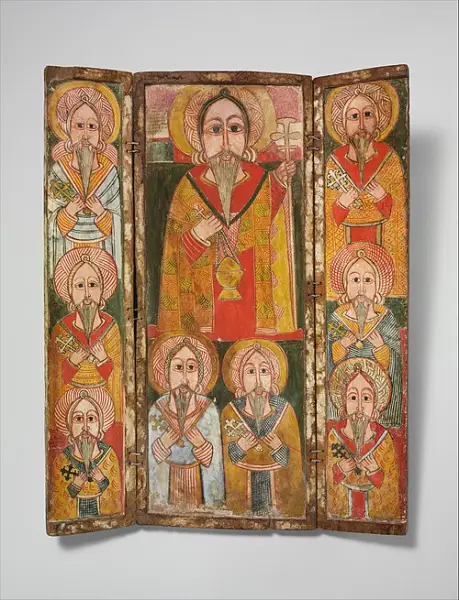
Overview
Ewostatewos was a leading churchman of Ethiopia's Orthodox Tewahedo faith in the first decades of Solomonic rule. Given the birth name Maqaba Egzi, he was sent as a boy to his uncle Abba Daniel, abbot of Debre Maryam Qorqor in Gar'alta, who educated him and introduced him to monastic life. Renamed Ewostatewos when he resolved at fifteen to become a monk, his uncle ordained him, and he went off to raise a monastery of his own at Serae, a district of today's Eritrea, where students gathered to him in numbers. His teaching that both Saturday and Sunday should be kept as Sabbath provoked the opposition of Abuna Yaqob III, and around 1337 he departed with most of his disciples into exile. He traveled through Sudan and Cairo, defended his position before Pope Benjamin II of Alexandria, visited Jerusalem, and finally settled in Cilician Armenia, where he died in 1352. His disciples carried his teaching back to the Horn of Africa, where their movement became a lasting force in Tewahedo Christianity.
The Complete Life
A Childhood in Enderta
Ewostatewos entered the world on 22 July 1273 in the Tsira district northeast of Mekelle, in Enderta Province of the Ethiopian Empire, the child of Sena Heywat and Kristos Moa. His baptismal name, Maqaba Egzi, means roughly the pillar of God, and the 16th-century hagiography written by his pupil Ananya preserves the memory of the place where he was born, not far from ground where he would one day found the monastery of Debre Tserabi. While he was still young, around the year 1280, his family sent him to live with his uncle, the monk known in religion as Zekaryas but called Abba Daniel, who presided over the mountain abbey of Debre Maryam Qorqor in Gar'alta, a district of Enderta. There the boy received the rudiments of learning and his first experience of the ordered rhythm of prayer and labor that governed Ethiopian monasticism. The uncle's influence proved decisive: the child who arrived for schooling became, within a few years, a youth resolved to give his life entirely to God.
§ Early life
A Monk at Fifteen
At the abbey of Debre Maryam Qorqor Maqaba Egzi announced, while still only about fifteen years old, that he intended to become a monk. With that decision came a new name: he was called Ewostatewos, a Ge'ez form of the Greek Eustathios, and it was by that name that his disciples and his opponents would know him for the rest of his life. His uncle Abba Daniel ordained him to the monastic state, completing the formation that had begun in childhood. Yet Ewostatewos did not remain within his uncle's community. After his ordination he departed the abbey and struck out on his own, founding a monastery in Serae, a region lying in what is today Eritrea. There the young abbot's reputation grew quickly. Students gathered to him in large numbers, drawn by his learning and by the intensity of his convictions, and the settlement became a school of disciplined monastic life animated by a distinctive teaching about the Sabbath that would soon test him before the highest authorities of his church.
§ Early life
Preaching in Serae
In his monastery at Serae Ewostatewos explained his views to a growing circle of students and attracted, in the words of the tradition, a large number of them. His central conviction concerned the Sabbath: he held that Christians ought to observe both Saturday, the Lesser Sabbath of the Old Covenant, and Sunday, the Christian Sabbath kept in honor of Christ's resurrection. He grounded this position in the Ten Commandments and in the Canons of the Apostles, and it corresponded to the historic practice of the Tewahedo Churches. The historian Taddesse Tamrat cites evidence that Ewostatewos did not invent this interpretation but transmitted an older usage, one that the Coptic Church of Alexandria had kept up long before his day and that Egypt itself had branded heretical only a few centuries before. Around 1337 the arrival of Abuna Yaqob III, who rejected his teaching, ended the peace of the community. Rather than yield, Ewostatewos left, taking with him most of his disciples, among them Bakamos Marqorewos and Gabra Iyasus, and turning his face toward exile.
§ Career as a religious figure
Two Holy Days, One Lord
The spiritual core of Ewostatewos's teaching was a doubled keeping of holy time. Saturday, he argued, remained the Sabbath of the Old Testament, the day of rest commanded in the Decalogue; Sunday was the Christian Sabbath, consecrated by the resurrection of Christ in the New Testament. Both belonged to God, and neither should be surrendered to ordinary labor. He found warrant for this in the Ten Commandments and in the Canons of the Apostles, authorities no Ethiopian Christian could dismiss lightly. Scholarly judgment, as recorded by Taddesse Tamrat, suggests that he stood in an ancient line: the same practice had flourished in the Coptic Church of Alexandria long before him and had only been declared heretical in Egypt a few centuries earlier. What his opponents read as innovation was therefore, in his own eyes, fidelity. The controversy gave his monasticism its edge, but it also gave his followers their identity. The communities that descended from him guarded this double observance with tenacity for more than a century, until imperial authority and Egyptian acquiescence finally confirmed what the master had preached in the wilderness of Serae.
§ Career as a religious figure
Exile and Death in Armenia
Driven from his monastery, Ewostatewos became a pilgrim through the Christian East. Most of his students went with him, among them Bakamos Marqorewos and Gabra Iyasus; the exiles made their way into Sudan and then on to Cairo, where he came before Pope Benjamin II of Alexandria, the head of the Coptic Church from which Ethiopia's metropolitans came. There he defended his views on the Sabbath to the church leader himself, an act of remarkable boldness for an exiled Ethiopian monk. From Egypt he made his way to Jerusalem, the great goal of pilgrims, and finally traveled on to Cilician Armenia, an independent Christian kingdom far from every court that had judged him. In that Armenian refuge his long journey ended: he died on 23 September 1352 in the Gregorian reckoning, aged seventy-nine, far from the mountains of Enderta where he had been born. He never saw the triumph of his cause, but the students who had shared his wanderings preserved his teaching and carried it home to the communities of northern Ethiopia.
§ Career as a religious figure
The House of Ewostatewos
The movement Ewostatewos founded outlived him by generations. His disciples, known collectively as the House of Ewostatewos, continued to advocate his religious views after his death. When he had departed Medri Bahri he placed his community in the hands of his eldest disciple, Absadi, who had a hard struggle keeping it together until the other disciples returned after a fourteen-year absence; together they established a community at Debre Mariam in Medri Bahri. Outward from that base his disciples moved across the north of Ethiopia, raising new houses that kept his Sabbath teaching alive and built a religious hierarchy independent of the Abuna, the Egyptian-appointed head of the Ethiopian Church. Their persistence was rewarded in 1450 at the Council of Debre Mitmaq in Tegulet, where Emperor Zara Yaqob persuaded the Egyptian leadership to acquiesce to Sabbath observance, more than a century after the exile's death. The historian James Bruce, visiting Ethiopia in the eighteenth century, found the order still led by the abbot of Mahebar Selassie in the country's northwest, a testimony to the durability of the house the exile from Tsira had built.
§ Influence on the Orthodox Tewahedo
Timeline
- 22 Jul 1273
Born at Tsira near Mekelle in Enderta Province and named Maqaba Egzi.
§ Early life
- 1280
Sent as a boy to his uncle Abba Daniel, abbot of Debre Maryam Qorqor in Gar'alta, for education and monastic formation.
§ Early life
- 1288
Announced at fifteen his resolve to become a monk and took the religious name Ewostatewos.
§ Early life
- 1337
After Abuna Yaqob III arrived opposing his teaching, he left with most disciples, passing through Sudan and Cairo, where he defended his views before Pope Benjamin II.
§ Career as a religious figure
- 23 Sep 1352
Died in Cilician Armenia, aged seventy-nine, after exile travels that had also taken him to Jerusalem.
§ Career as a religious figure
- 1450
His followers won acceptance of Sabbath observance at the Council of Debre Mitmaq, where Emperor Zara Yaqob persuaded the Egyptian leadership.
§ Influence on the Orthodox Tewahedo
The Record
- Major works
- Monastery founded at Serae, in what is now Eritrea·Monastic community established at Debre Mariam in Medri Bahri by his disciples
- Patron of
- House of Ewostatewos, his historic monastic movement
- Canonization
- Pre-congregation; venerated in Oriental Orthodoxy without a recorded formal canonization
Prayer
Bibliography
Show 4 sources
- Gianfranco Fiaccadori, "Ewostatewos" in Siegbert Uhlig, Encyclopaedia Aethiopica: D-Ha (Wiesbaden: Harrassowitz Verlag, 2005), p. 469.
- Tamrat, Taddesse (1972). Church and State in Ethiopia, 1270-1527. Oxford: Clarendon Press. ISBN 978-0-19-821671-1. OCLC 653228.
- James Bruce, Travels to Discover the Source of the Nile (1805 edition), vol. 5 p. 6.
- Olivia Adankpo-Labadie, "An Ethiopian Fugitive Allied with a Nubian King? Ewostatewos and Sab'a Nol at Noba through Hagiographical Narrative", Journal of Nubian Studies, 6 (2019), pp. 9-22. doi: 10.5070/D66146249
Profile text adapted from the Wikipedia article, licensed CC BY-SA 4.0.
Pray with this saint every day
Save St. Ewostatewos to your favorites, read the full profile, and get feast-day reminders in the Saints app.
Get the Saints AppFree on the App Store for iPhone and iPad