
c. 261 – 303·Feast April 19
St. Expeditus
Roman centurion martyr and patron of urgent causes
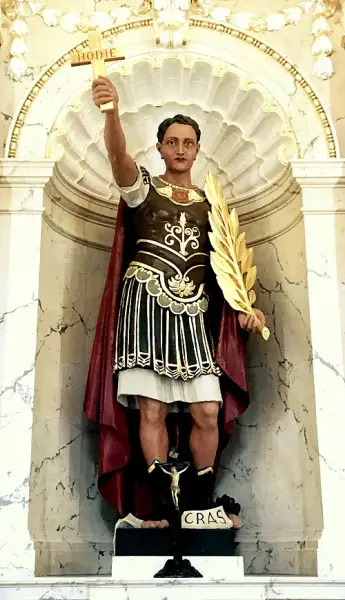
Overview
Expeditus, also called Expedite, is honored as a Roman centurion who died for the faith around April 303 at Melitene in Armenia Minor, in what is now Turkey, executed for converting to Christianity during the Diocletianic Persecution. The Hieronymian Martyrology lists him with six soldiers of the Melitene garrison who died for the faith, and the unit posted there in his day would have been the Legio XII Fulminata. Whatever the facts of his life, his cult proved remarkably durable: it was established in Turin by the Middle Ages, and he entered Italian martyrologies well before 1781. Depicted as a young soldier crushing a crow that cries cras, tomorrow, while raising a cross inscribed hodie, today, he became the patron of procrastinators and of every cause that cannot wait. In 1781 Pope Pius VI named him protector of merchants and seafarers. Today he is venerated across Latin America, Europe, and the islands of the Indian Ocean, and his April 19 feast draws crowds in the hundreds of thousands in Brazil.
The Complete Life
A Soldier on the Euphrates Frontier
Almost nothing certain survives about the early life of Expeditus. The oldest notice appears in the Hieronymian Martyrology, which numbers him with six soldiers of the Melitene garrison who died in the great persecution of Diocletian. Should he truly have been posted at Melitene when the fourth century opened, the unit he served in would have been the Legio XII Fulminata, the force guarding the Euphrates frontier. Later tradition supplied a birthplace and a birth year that the ancient records do not: a birth in the year 261 at Regensburg in Raetia, in what is now Germany. The name itself invites explanation. In Latin, an expeditus was a soldier without the heavy marching pack, a man equipped for speed, and the hagiographical scholar Hippolyte Delehaye argued that the martyr's name may simply be a misreading of Elpidius. On that theory the saint we call Expeditus could be an anonymous Christian soldier remembered under the label of his profession, a nameless legionary whose swiftness of name became, in the devotion of later centuries, a swiftness of intercession.
§ Hagiography
Conversion Without Delay
The legend that made Expeditus the scourge of procrastination belongs to the collection of stories about his martyrdom. According to this tradition he was a Roman centurion in Armenia who resolved to become a Christian. On the very day of his decision, the Devil appeared in the form of a crow, or in some tellings a snake, and counseled delay: put off the conversion until tomorrow. The centurion answered by stamping the bird beneath his foot and killing it, declaring that he would be a Christian that very day. The image fixed itself permanently in his iconography. In art he appears as a young Roman soldier with a crow squashed under his right foot; early versions put a clock in his hand; later images give him a cross marked with the single Latin word hodie, today, and from the crow's beak stretches a banderole reading cras, tomorrow. The lesson needed no commentary. In a single gesture the martyr dramatized the whole spiritual combat between the present grace of conversion and the endless postponements by which souls are lost.
§ Legends
Martyrdom at Melitene
Tradition places the death of Expeditus at Melitene in Armenia Minor around April of the year 303, in what is now the Turkish city of Malatya. He was, on this account, beheaded for his conversion to Christianity in the opening violence of the Diocletianic Persecution, the last and most systematic attempt by the Roman Empire to destroy the Church. The Hieronymian Martyrology preserves him among six soldiers of the same garrison who suffered together, companions in a death that their profession made doubly costly. He is counted today among the martyrs venerated by Catholics, Lutherans, and the Oriental Orthodox Churches. Whatever weight one gives the historical details, the memory of a soldier who laid down his career and his life rather than renounce his baptism took root early and traveled far. Veneration reached Latin America and flourished there; in Brazil, ceremonies in his honor in São Paulo draw crowds that can reach into the hundreds of thousands, and his feast of April 19 is kept with fervor across the whole continent.
§ Legends
An Ancient Cult Under Debate
Expeditus belongs to the era of pre-congregation saints, honored by the Church's continuous tradition rather than by formal canonization process. His cult was already established in Turin in the Middle Ages, he was mentioned briefly in the Acta sanctorum volume for April in 1675, and he appeared in Italian martyrologies before 1781. Yet his cult has always carried a scholarly asterisk. Hippolyte Delehaye, the great student of hagiography, argued that the name Expeditus was a corruption of Elpidius, and that devotion had attached to a misunderstanding. In 1905 Pope Pius X struck the saint's name from the list of martyrs and his image was banned from the churches, but the measure failed in its effect, for the people would not surrender him. Popular stories even circulate about the origin of the cult: in one, a package of relics marked expedite arrived and recipients assumed the label named the saint; in another, set in New Orleans, a crate of statues labeled Expedite gave an unnamed holy figure his identity. Scholarship may doubt; devotion simply continues.
§ Historicity
The Saint of the Hour That Cannot Wait
Wherever time presses hard on the human heart, Expeditus has found clients. Originally invoked for urgent causes, he was proclaimed protector of merchants and seafarers by Pope Pius VI in 1781, and a tradition holds him ready to help settle lawsuits that drag on too long. He is patron of Acireale in Sicily, and a church in Buenos Aires bears his name. In Chile, devotion began when a devotee brought his image to Viña del Mar; local authorities first refused the priests permission to build a shrine, but after nine days of prayer the approval came, and the shrine at Reñaca is now a summer pilgrimage site where rich and poor alike recite novenas. In New Orleans he remains a fixture of Creole folklore, honored with amulets, flowers, and candles. On the French island of Réunion his red-painted roadside altars stand everywhere, tended by devotees of every age and religion, though the officially taboo cult is visited discreetly. There his statues are sometimes found decapitated, defaced in anger at an unanswered request or to break a curse, evidence of a devotion as intense as any in the Catholic world.
§ Cultus
Timeline
- 261
Tradition gives this as his birth year at Regensburg in Raetia, Germany.
§ Introduction
- Apr 303
A Roman centurion in Armenia, he was martyred at Melitene around April 303 during the Diocletianic Persecution, said to be one of six soldiers executed there.
§ Legends
- 1675
Received a brief mention in the Acta sanctorum volume for April.
§ Hagiography
- 1781
Pope Pius VI declared him the patron of merchants and of those who sail the seas.
§ Patronage
- 1781
A relic case marked expedit delivered at a Paris convent, so tradition recounts, led nuns there to begin venerating him as a martyr.
§ Legends
- 1905
Pope Pius X struck his name from the list of martyrs and banned his image from churches, without lasting success.
§ Historicity
In Their Own Words
I'll be a Christian today!
The Record
- Patron of
- Emergencies and urgent causes·Expeditious solutions·Against procrastination·Merchants·Revolutionaries·Navigators·Acireale, Sicily
- Symbols
- Roman centurion's dress·Palm leaf of martyrdom·Cross inscribed hodie (today)·Crow beneath his right foot crying cras (tomorrow)·Clock in early images
- Canonization
- Pre-congregation; his name was struck from the list of martyrs by Pope Pius X in 1905, though popular veneration continued
Prayer
Bibliography
Show 7 sources
- Kuefler, Matthew. "The Convertible Saint: Expeditus Through Time and Space", Journal of Religious History, Vol. 42, No. 1, March 2018. doi: 10.1111/1467-9809.12408
- M'Elderry, R. Knox. "The Legions of the Euphrates Frontier", Classical Quarterly 3 (1909): 44-53.
- Craughwell, Thomas. "A patron saint for procrastinators", The Arlington Catholic Herald, April 11, 2012.
- Zibart, Eve (12 September 2005). "Saints Alive! The Eternal Nawlins". The Washington Post, Washington D.C.
- Thurston, Herbert. "Flotsam and Jetsam", The Month, vol. 108, Simpkin, Marshall, and Company, December 1905, p. 546.
- Harvey, Keri (12 June 2007). "Wild Island Reunion". Expressions magazine.
- Suryanarayan, V. (12 October 2018). "Tamils In Re-Union: Losing Cultural Identity - Analysis". Eurasia Review.
Profile text adapted from the Wikipedia article, licensed CC BY-SA 4.0.
Pray with this saint every day
Save St. Expeditus to your favorites, read the full profile, and get feast-day reminders in the Saints app.
Get the Saints AppFree on the App Store for iPhone and iPad