
died c. 410·Feast September 28
St. Exuperius
Bishop of Toulouse and almsgiver praised by Jerome
Overview
Exuperius, sometimes written Exsuperius, governed the see of Toulouse at the opening of the fifth century and died around 410. Neither the place nor the date of his birth is recorded, though letters of Jerome and Paulinus suggest that he served as a priest at Rome and afterward at Bordeaux before his elevation to the episcopate. Once enthroned, he saw to the finishing of the great basilica honoring St. Saturnin, portions of which now stand within the Basilica of St. Sernin. His fame, however, rests on his charity. Jerome held him up as a model of largesse toward the monasteries of Palestine, Egypt, and Libya, and of compassion for his own afflicted diocese, then suffering under the ravages of Vandals, Alans, and Suevi. So committed was he to the poor that he sold the basilica's altar vessels to feed them, and from then on bore the Sacred Offering in a basket of woven osier and kept the Precious Blood in glass. Out of regard for such virtue, Jerome put his Commentary on Zacharias under the bishop's name; and it was to Exuperius that Pope Innocent I addressed the letter Consulenti Tibi in 405, declaring which scriptures the Church holds as canonical.
The Complete Life
A Priest of Rome and Bordeaux
The origins of Exuperius are veiled. His place and date of birth are unknown, and the sources that might illuminate them are letters written about other matters. From Jerome's letter to Furia, dated 394, and from an epistle of Paulinus to Amandus of Bordeaux written in 397, it seems probable that Exuperius exercised his priesthood first at Rome and afterward at Bordeaux, though the sober historian admits that both letters may be speaking of a different man of the same name. An old opinion of the learned Cardinal Baronius identified the bishop with a rector of the same name who taught Hannibalianus and Dalmatius, nephews of Constantine the Great, but this is usually rejected, since that teacher belonged to an earlier generation. Whatever the precise trail, by the close of the fourth century a priest of proven virtue stood ready for greater burdens. The southwestern Gallic city of Toulouse, prosperous but increasingly exposed to the movements of barbarian peoples pressing into the empire, was about to become the theater of his holiness.
§ Life
Bishop of Toulouse
Exuperius succeeded Sylvius on the episcopal throne of Toulouse, probably not long before the year 400, though the exact date of his promotion is unknown; his occupation of the see is securely attested for February 405 by the papal letter mentioned below. The first deed of his episcopate on record is architectural: he directed that the basilica of St. Saturnin be brought to completion, and a section of that building was later folded into the Basilica of St. Sernin that still dominates the city. Yet the building campaign was secondary to the man. The age in which he shepherded Toulouse was brutal. Vandal, Alan, and Suevian war bands were breaking across the Gallic provinces, and the people of his diocese suffered attack after attack. In that storm the bishop became the steward of his flock's survival, dispersing the resources of his church with a handsomeness that reached far beyond his own city. Word of what he was doing traveled to Bethlehem, where the most acerbic scholar of the age was watching the whole Christian world.
§ Life
Altar Vessels for the Poor
Jerome singled Exuperius out for the open-handedness he showed to monasteries in Palestine, Egypt, and Libya alike, and for the compassion he lavished on his own afflicted people. The bishop's almsgiving went so far that it touched the liturgy itself: the altar vessels of the basilica were sold for the sake of Toulouse's poor, and from then on he bore the Sacred Offering in a basket of woven osier and kept the Precious Blood in glass. It is a picture that has instructed Christians for sixteen centuries, a bishop holding the body of Christ in woven twigs because the gold and silver had become bread for the hungry. Such virtue and such gifts moved Jerome to put his Commentary on Zacharias under the bishop's name. The same correspondence linked the bishop to the Roman see on a question of enduring consequence. Exuperius had written to Pope Innocent I asking for direction concerning the biblical canon and several points of ecclesiastical behavior; the pope replied on 20 February 405 with Consulenti Tibi, a letter setting out which scriptures the Church receives as canonical, the deuterocanonical books among them.
§ Life
Honored from Early Times
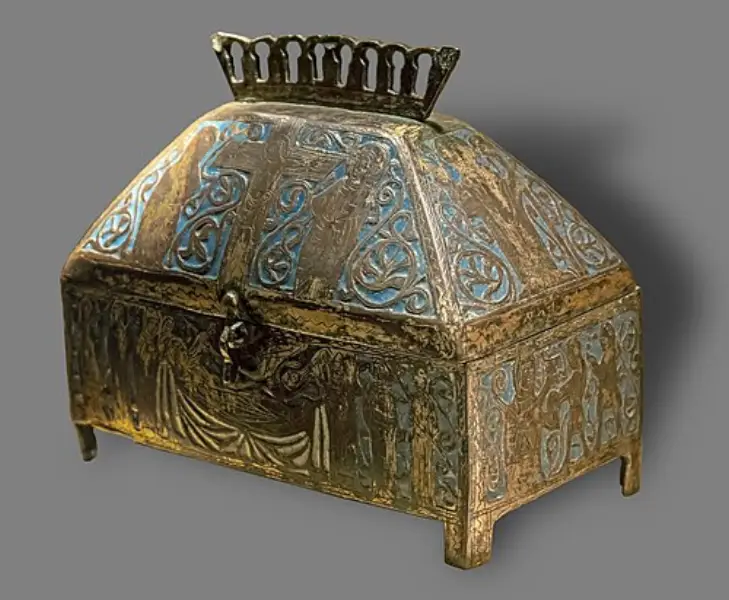
The Church of Toulouse did not wait for any process to recognize her bishop's sanctity. Devotion to Exuperius as a saint goes back to the beginning, and in Gregory of Tours's day, in the sixth century, he was held in veneration equal to that of Saturninus himself, the great apostolic martyr whose basilica he had completed. To stand level with the patron of Toulouse was the highest honor the local church could confer. His feast came to be kept on 28 September, and the first martyrologist on record assigning it to that date was Usuard, the Benedictine monk who composed his celebrated martyrology toward the end of the ninth century. No formal canonization decree was ever needed; the gratitude of the poor he had fed and the faithful he had defended was testimony enough. A thirteenth-century reliquary holding his relics, preserved today in the Musée Paul Dupuy in Toulouse, shows how the city treasured the memory of the bishop who had given away its gold and kept its soul.
§ Life
The Bishop Who Fixed the Canon
The most consequential act of Exuperius's life may have been a question he asked. When he wrote to Pope Innocent I seeking instruction about the biblical canon and points of church discipline, he gave the pope the occasion to reply with Consulenti Tibi on 20 February 405, a letter that set out the list of the canonical scriptures. That list, including the deuterocanonical books, became the authoritative statement of the Catholic biblical canon, and it entered history because a Gallic bishop wanted to know which books the Church actually read. The letter has been cited ever since as a landmark in the history of the Bible. His other monuments were more local but no less real: the completed basilica of St. Saturnin, part of which was taken up into the later Basilica of St. Sernin, and the memory of a charity so lavish that Jerome, a writer who praised almost no one, dedicated a major commentary to him. In the French forms of his name, Saint Exupéry and Saint Soupire, his memory has lived in Toulouse for some sixteen hundred years.
§ Life
Timeline
- 394
Jerome's letter to Furia appears to indicate that Exuperius was then a priest at Rome.
§ Life
- 397
An epistle of Paulinus to Amandus of Bordeaux suggests he was serving as a priest at Bordeaux.
§ Life
- Feb 405
Attested as occupying the See of Toulouse, having succeeded Sylvius there; his promotion had come at some earlier, unrecorded moment.
§ Life
- 20 Feb 405
Received the reply Consulenti Tibi from Pope Innocent I, containing the authoritative list of the canonical scriptures.
§ Life
- 410
Died around this year, after a tenure marked by charity toward a diocese ravaged by Vandals, Alans, and Suevi.
§ Life
- 875
Usuard, writing toward the end of the ninth century, became the first martyrologist to assign his feast to 28 September.
§ Life
The Record
- Major works
- Completion of the basilica of St. Saturnin at Toulouse·Letter to Pope Innocent I requesting instruction on the biblical canon and ecclesiastical discipline
- Canonization
- Pre-congregation; venerated as a saint from early times and held in equal honor with Saturninus by the age of Gregory of Tours
Prayer
Bibliography
Show 3 sources
- Goyau, Georges. "Toulouse." The Catholic Encyclopedia Vol. 14. New York: Robert Appleton Company, 1912.
- "St. Exuperius - Encyclopedia Volume - Catholic Encyclopedia - Catholic Online". Catholic Online. Retrieved 2017-01-10.
- Herbermann, Charles, ed. (1913). "St. Exuperius". Catholic Encyclopedia. New York: Robert Appleton Company.
Profile text adapted from the Wikipedia article, licensed CC BY-SA 4.0.
Pray with this saint every day
Save St. Exuperius to your favorites, read the full profile, and get feast-day reminders in the Saints app.
Get the Saints AppFree on the App Store for iPhone and iPad