
died 127·Feast May 2
St. Exuperius and Zoe
Enslaved spouses martyred with their sons in Pamphylia
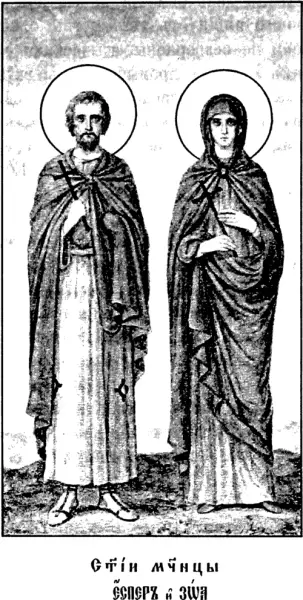
Overview
Exuperius and Zoe were a married couple who suffered martyrdom in the year 127, in the first generations of the Church's history. They were spouses and slaves in the household of a pagan master in Pamphylia, a region on the southern coast of Asia Minor in what is now Turkey. Their faith was lived out in servitude, and their witness came not through preaching but through refusal: when one of their sons was born, they declined to take part in the pagan rites customary on such an occasion, and for that refusal they were murdered, together with their two sons, Cyriacus and Theodolus. The family of four thus joined the long roll of households that perished together for the name of Christ. Honored from the earliest period, before any formal processes of canonization existed, they are venerated today in both the Roman Catholic Church and the Eastern Orthodox Church, and their common feast is kept on 2 May. The Greek synaxaria preserve their memory alongside their children as martyrs of the second century.
The Complete Life
Marriage in Bondage
The world into which Exuperius and Zoe were born offered a Christian slave few choices and fewer protections. In Pamphylia, on the southern shore of Asia Minor, the two belonged to the household of a pagan master, bound to his service in everything that did not touch the worship of God. That they married at all is testimony to some measure of tolerance in the household; that they raised sons, Cyriacus and Theodolus, within that same servitude is testimony to something stronger. Christian tradition has always honored married saints, but the married saints of the servile class hold a special place, for they sanctified a life over which they had almost no control. Their domestic church was a slave quarter; their liturgy was fidelity to Christ in labor ordered by another's will. When the moment of testing came, they had no standing, no property, and no advocate in the courts of the empire. They had only the faith they had practiced in secret, and it proved sufficient for the strangest and most natural of provocations: the birth of their own child.
§ Notes
The Refusal That Cost Everything
The martyrdom of Exuperius and Zoe turned on a rite of the pagan household. In the religious customs of the Greco-Roman world, the birth of a child called for acts of worship toward the household gods, thank offerings and purifications in which the whole family was expected to join. When one of their sons was born, Exuperius and Zoe refused to participate. The refusal was total and, under the law of that age, fatal. For their constancy the couple were murdered, and with them their sons Cyriacus and Theodolus, so that the entire family passed together from the narrow servitude of an Anatolian household into the freedom of the martyrs. They died in the year 127, barely a century after the crucifixion of Christ, at a time when the Church possessed no buildings, no legal recognition, and no process for declaring saints. The holiness of this family was simply recognized by the Christians around them and handed down. The date of their death, 2 May, became the day on which East and West would remember them forever after.
§ Notes
Remembered in East and West
Exuperius and Zoe belong to the vast communion of pre-congregation saints, honored by the continuous tradition of the Church rather than by any decree of canonization. Their cult took root early on both sides of the old division between Rome and Constantinople: they are venerated today in the Roman Catholic Church and in the Eastern Orthodox Church alike, a rare witness to the unity of the undivided Church of the first centuries. The Greek synaxarion preserves their memory under the date of 2 May, recording them as the holy martyrs Hesperos and Zoe together with their children Kyriakos and Theodoulos, for the Greek tradition knows the family under these Hellenized names. Western martyrologies keep the same feast under the names by which they are remembered in Latin, Exuperius and Zoe, with Cyriacus and Theodolus beside them. In an age when canonization was the people's acclamation, the household that died together in Pamphylia was acclaimed together, and fourteen centuries of liturgical memory have kept them paired, parents and children, one feast, one witness.
§ Notes
The Record
- Canonization
- Pre-congregation; venerated from antiquity by the Roman Catholic and Eastern Orthodox Churches
Prayer
Bibliography
Show 2 sources
- "The Holy Martyrs Hesperos and Zoe and their children Kyriakos and Theodoulos". 2 May. Great Synaxaristes (in Greek).
- "St. Exuperius - Saints & Angels". Catholic Online.
Profile text adapted from the Wikipedia article, licensed CC BY-SA 4.0.
Pray with this saint every day
Save St. Exuperius and Zoe to your favorites, read the full profile, and get feast-day reminders in the Saints app.
Get the Saints AppFree on the App Store for iPhone and iPad