
died 286·Feast September 22
St. Exuperius
Standard-bearer of the Theban Legion martyred at Agaunum
Overview
Exuperius, whom some calendars call Exupernis, is numbered among the saints and martyrs of the Catholic Church. Tradition gives him the office of standard-bearer in the Theban Legion, the celebrated all-Christian unit of the imperial army, and thus stood as a close companion of the legion's captain, Saint Maurice. When the legion was put to death at Agaunum in 286 for refusing to persecute fellow Christians, Exuperius was counted among the martyrs of that great sacrifice. His memory found a remarkable second home far from the Alps. In the tenth century the founder of Gembloux Abbey, Saint Guibert, translated the martyr's relics to his new monastery in the Low Countries and dedicated the abbey in honor of Saint Peter and Saint Exuperius. There the soldier-saint enjoyed special veneration for centuries; the abbey's learned monk Sigebert celebrated the Legion's fall in an extended Latin poem written in the martyr's honor. He is depicted in military attire, and the abbey whose church bore his name still stands, its surviving buildings now used by the Agronomical University of Gembloux.
The Complete Life
Bearer of the Legion's Standard
Exuperius belongs to the company of the Theban Legion, the legendary unit of Christian soldiers whose collective martyrdom became one of the most treasured narratives of the early Church. According to the tradition preserved in his cult, he served as the legion's standard-bearer, an office of signal honor and danger: the standard-bearer stood at the heart of the formation, the visible point around which the whole unit rallied. In that rank he was a companion of Saint Maurice, the legion's captain and the most celebrated of its martyrs. Tradition adds a homeland, marking him as a man from Africa, the Roman province that corresponded roughly to modern Tunisia, though the ancient records behind this detail are thin. His feast is kept on 22 September. The core of his story is membership in a body of soldiers who, according to their legend, chose death at Agaunum in 286 over orders to attack innocent Christians, and among the thousands who died there, the standard-bearer would have been among the first targets and the last to fall.
§ Veneration
Martyrdom at Agaunum
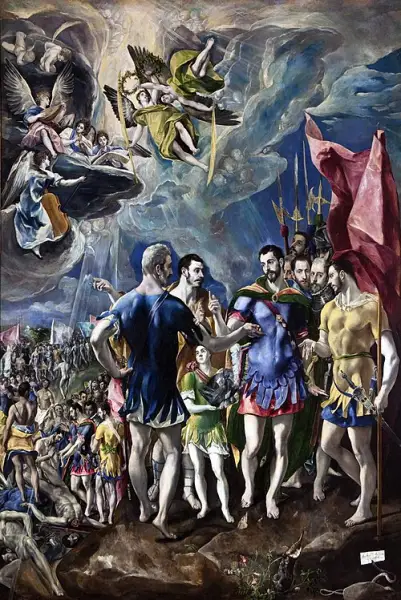
The martyrdom of the Theban Legion took place, by the traditional reckoning, in the year 286 at Agaunum, in the valley of the Rhone beneath the Alps, in what is now Switzerland. The legion, recruited in Roman Egypt and thoroughly Christian, was ordered by the emperor to take part in actions against innocent Christians; when it refused, the unit was decimated and its men put to death. Among them, tradition numbers Exuperius the standard-bearer, who died with his comrades and with Saint Maurice their leader. For that faithfulness the Catholic Church has ranked him among her saints and martyrs since the earliest Christian centuries, without formal canonization, as befitted the martyrs of an age before such processes existed. El Greco's great painting of the Martyrdom of St Maurice, which gives this profile its image of the legion's fate, shows how long and how widely the memory of Agaunum inspired artists and warriors alike, and the standard-bearer rests within that company of soldiers who conquered by dying.
§ Veneration
From the Alps to Gembloux
The afterlife of Exuperius's relics gave his cult an unusually well-documented home. In the tenth century, Saint Guibert, the founder of Gembloux Abbey in the Low Countries, translated the martyr's relics to his new monastery. Guibert dedicated the abbey in honor of two patrons together, Saint Peter the Apostle and Saint Exuperius the martyr, binding the soldier of Agaunum permanently to the community's identity and its property. At Gembloux, accordingly, the martyr received an honor above all others for as long as the abbey endured. From that devotion came one of the monuments of medieval Latin literature: Sigebert, Gembloux's finest scholar, celebrated the Legion's martyrdom in an extended poem, one in which his own abbey's patron figured among the slain. When the monasteries of Europe were dissolved, the buildings of Gembloux largely survived, and they stand today in the service of the Agronomical University of Gembloux, stone walls that once sheltered a martyr's relics now housing laboratories and lecture halls.
§ Veneration
Memory of a Soldier-Saint
The cult of Exuperius illustrates how the martyrs of one region could become the treasures of another. He died, if tradition is followed, on the rocky shoulder of the Alps at Agaunum; yet his deepest roots of veneration grew in the flat farmland of Gembloux, hundreds of miles to the north, where a tenth-century founder's choice of patron and a twelfth-century monk's epic poem kept his name in circulation. As patron of Gembloux Abbey he received the dedication of an entire religious house, a dignity few martyrs of the Legion can claim. His iconography remained that of his profession: military attire, the dress in which he died. The endurance of his feast on 22 September and the survival of the abbey's buildings into the hands of a modern university show the long arc of such a memory, from the decimated ranks of a Roman legion, through the relic chests of a Benedictine foundation, to the quiet campus where students pass daily through structures once raised to the honor of Peter and of a soldier-martyr from Africa.
§ Veneration
Timeline
- 286
Martyred at Agaunum with the Theban Legion, according to tradition as the unit's standard-bearer and companion of Saint Maurice.
§ Introduction
- 950
Relics brought to Gembloux Abbey in the tenth century by its founder Guibert, who placed his monastery under the patronage of Peter and Exuperius.
§ Veneration
The Record
- Patron of
- Gembloux Abbey
- Symbols
- Military attire
- Canonization
- Pre-congregation; venerated as a saint and martyr by the Catholic Church from the earliest centuries
Prayer
Bibliography
Show 2 sources
- Henry Wace, A Dictionary of Christian Biography, Literature, Sects and Doctrines (1880), 439.
- CATHOLIC ENCYCLOPEDIA: Sigebert of Gembloux
Profile text adapted from the Wikipedia article, licensed CC BY-SA 4.0.
Pray with this saint every day
Save St. Exuperius to your favorites, read the full profile, and get feast-day reminders in the Saints app.
Get the Saints AppFree on the App Store for iPhone and iPad