
c. 1120s – 1188·Feast January 26
St. Eysteinn Erlendsson
Archbishop of Nidaros, crowner of kings and church-builder
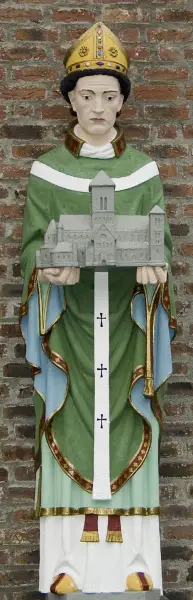
Overview
Eysteinn Erlendsson, known in Norwegian as Øystein Erlendsson and in Latin as Augustinus Nidrosiensis, served as Archbishop of Nidaros from 1161 until his death on 26 January 1188. Born into the nobility of Trøndelag, probably at the farm of Råsvoll in the Verdalen valley, he was educated at Saint-Victor in Paris and, as a priest, served as steward to King Inge Krokrygg of Norway. Appointed archbishop on the death of Jon Birgersson in 1157, he traveled to Rome, where Pope Alexander III confirmed him in 1161. His archiepiscopate fell in the middle of Norway's civil war era. Allied with Erling Skakke, he secured in 1163 both a new law of succession restricting the throne to legitimate sons and the coronation of the young Magnus Erlingsson, the first coronation ceremony in Norwegian history. He drew the Norwegian Church into closer union with Rome, planted houses of Augustinian canons regular, and consecrated Saint Thorlak. He is thought to have written the Passio Olavi, the Latin hagiography of St. Olaf. Recognized as a saint, he is commemorated in the Roman Martyrology, which praises his defense of the Church against princes.
The Complete Life
A Nobleman's Son from Verdalen
Eysteinn's kin belonged to Trøndelag, the district encircling the Trondheim fjord, and through them he was connected with nearly every great family of the region. History records neither the day nor the place of his birth; the likeliest estimate sets it between 1120 and 1130, at the farm called Råsvoll, which lies north of Trondheim along the Verdalen valley. Erlend Himalde was his father's name. His ancestry reached back into the highest circles of the Norwegian kingdom: his grandfather was Tørberg Arnesson, an advisor to several Norwegian kings, and his great-grandfather was Ulv Uspaksson, a councilman under King Harald Hardrada who fell, like his royal master, at the battle of Stamford Bridge in 1066. From such a house the boy might have expected a career at court. Instead his path ran through the schools of the Church. He was educated at Saint-Victor in Paris, the abbey whose canons regular made it one of the great centers of twelfth-century learning and spiritual theology, an education that left its mark in the Latin name he later bore, Augustinus Nidrosiensis.
§ Background
From the King's Steward to the Archbishop's Throne
Returning from his studies in Paris as a priest, Eysteinn entered the service of King Inge Krokrygg of Norway as the king's steward, an office that taught him the mechanics of government in a kingdom sliding toward civil war. The death of Archbishop Jon Birgersson of Nidaros on 24 February 1157 opened the way, and King Inge named Eysteinn to fill the vacant throne. The choice joined in one man the highest ecclesiastical office in Norway and a proven competence in royal administration. Eysteinn then undertook the long journey to Rome, where Pope Alexander III confirmed him in office in 1161; before that year was out he was back in Norway, taking up his see. His program as archbishop was clear from the start: to draw the Norwegian Church into closer union with Rome and to plant in the north the reformed religious life he had seen at first hand. He established communities of Augustinian canons regular in Norway and consecrated Saint Thorlak, extending the new canonical movement to the far corners of the Nordic Church.
§ Ties with Rome
Crowning a King, Reforming a Kingdom
King Inge's reign had opened the civil war era in Norway, and before Eysteinn could return to his seat his royal patron was killed by his nephew, Håkon Herdebrei. The king's supporters rallied under Erling Skakke, whose son Magnus was put forward as candidate for the throne, a precedent-breaking claim, since Magnus's title came through his mother Kristin, daughter of King Sigurd Jorsalfar, rather than from a reigning father. Håkon Herdebrei was defeated and slain in 1162, but the danger of rival claimants endured, and in this crisis the archbishop and Erling became natural allies. For a long time the Church had wanted Norway refashioned along continental lines, chief among its aims the abolition of several co-kings ruling at once, so often a source of war, and the confining of the throne to legitimate sons. In 1163 the new law of agnatic succession was introduced, and in return Bishop Eysteinn crowned Magnus King of Norway, the first coronation ceremony in Norwegian history. Church reform and dynastic settlement, for once, served each other perfectly.
§ Involvement in civil war
A Saint in the Roman Martyrology
The Catholic Church numbers Eysteinn among her saints, and the current edition of the Roman Martyrology, the Church's official catalogue, bears his name under 27 January. His feast is kept on 26 January, the anniversary of his death in 1188. The Martyrology's entry, or elogium, distills his life into a single sentence: at Nidros in Norway, Saint Augustine, or Eystein Erlendsson, a bishop who shielded from hostile princes the flock entrusted to him and with unwearying diligence enlarged it. It is a summary any bishop might envy and few deserve. The Latin text preserves the double name under which he traveled through history, the baptismal Norwegian name and the Latin religious name Augustine, taken from the school of Saint-Victor where he studied and from the canons whose life he planted in Norway. His cult belongs to that medieval generation of northern prelates who were raised to the altars not for miracles but for the governance of the Church in hard times.
§ Veneration
The Written Saint of Nidaros
Eysteinn's most durable monument may be literary. He is thought to have written the Passio Olavi, a Latin account of the holy king Olaf II of Norway that tells his story and dwells above all on his missionary labors; its full title, Passio Et Miracula Beati Olaui, announces both the holy king's sufferings and his miracles. If the attribution holds, the archbishop gave Norway its national saint a liturgical and literary dress that shaped devotion for centuries. His political legacy proved equally durable: the law of succession of 1163, securing the crown to legitimate sons, and the precedent of a crowned king of Norway changed the character of the monarchy, even though the civil wars the reformers hoped to end returned in later generations. The Roman Martyrology entry of 27 January carries his memory across the whole Catholic world. Modern historians, from Erik Gunnes to Sverre Bagge, continue to study him as a statesman and church-builder, the twelfth-century prelate who bound the Norwegian Church to Rome and set the Norwegian kingdom on a European footing.
§ Veneration
Timeline
- 1125
Probably born between 1120 and 1130 at the farm of Råsvoll north of Trondheim, into the Trøndelag nobility.
§ Background
- 24 Feb 1157
Appointed Archbishop of Nidaros by King Inge Krokrygg after the death of Archbishop Jon Birgersson on 24 February.
§ Background
- 1161
Confirmed in office by Pope Alexander III in Rome and returned to Norway to take up his see.
§ Ties with Rome
- 1162
King Inge's rival Håkon Herdebrei was defeated and slain amid the civil war that shaped Eysteinn's politics.
§ Involvement in civil war
- 1163
The new law of agnatic succession was introduced, and Eysteinn crowned Magnus Erlingsson King of Norway, the first such ceremony in the country.
§ Involvement in civil war
- 26 Jan 1188
Died on 26 January after twenty-seven years as Archbishop of Nidaros.
§ Introduction
In Their Own Words
At Nidros in Norway, Saint Augustine (Eystein) Erlandssön, bishop, who defended the Church committed to his care against princes and built it up with the greatest determination.
The Record
- Major works
- Passio Olavi (Passio Et Miracula Beati Olaui), Latin hagiographical work on St. Olaf II of Norway, attributed to him·Law of agnatic succession of 1163·Communities of Augustinian canons regular in Norway
- Canonization
- Recognized as a saint of the Catholic Church; entered in the Roman Martyrology under 27 January
Prayer
Bibliography
Show 6 sources
- "Øystein Erlendsson – utdypning". Store norske leksikon.
- Passio Olavi (with preface by Arne Bakken, chaplain at the Nidaros Cathedral, Oslo: 1995). ISBN 82-521-4397-0.
- Martyrologium Romanum, ex decreto sacrosancti oecumenici Concilii Vaticani II instauratum auctoritate Ioannis Pauli Pp. II promulgatum, editio typica altera, Typis Vaticanis, A.D. MMIV (2004), p. 118. ISBN 88-209-7210-7.
- Gunnes, Erik. Erkebiskop Øystein, statsmann og kirkebygger (Oslo: 1996). ISBN 82-03-22144-0.
- Vandvik, Eirik. Erkebiskop Eystein som politikar (Trondheim: 1961).
- Bagge, Sverre. Mennesket i middelalderens Norge (forlaget Aschehoug, Oslo: 2005). ISBN 82-03-23282-5.
Profile text adapted from the Wikipedia article, licensed CC BY-SA 4.0.
Pray with this saint every day
Save St. Eysteinn Erlendsson to your favorites, read the full profile, and get feast-day reminders in the Saints app.
Get the Saints AppFree on the App Store for iPhone and iPad