
died c. 360·Feast October 1
St. Ezana of Axum
King of Aksum who brought Christianity to Ethiopia
Overview
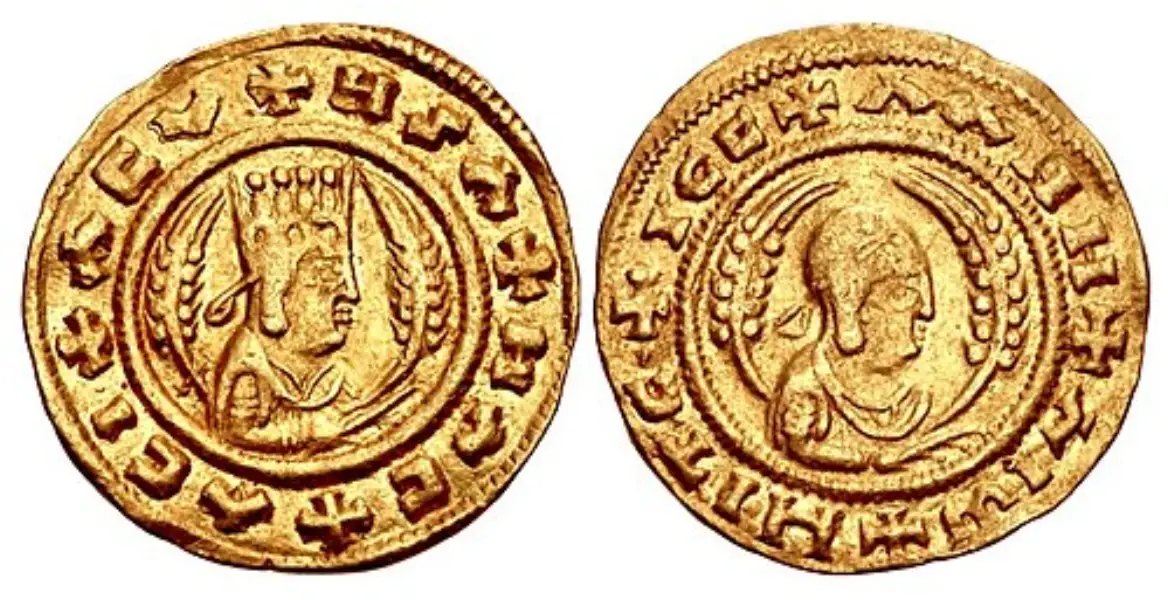
Ezana was ruler of the Kingdom of Aksum from the 320s to around 360 AD and is remembered as the first monarch of that realm to embrace Christianity. He succeeded his father Ella Amida, also called Ousanas, while still a child, and his mother Sofya governed as regent until he came of age. His conversion came through his tutor Frumentius, a Phoenician Christian who had been his childhood teacher and later became head of the Ethiopian Church. Inscriptions from the king's reign record a growing attachment to the Christian faith in place of the older Semitic religion, and the coins minted under him shifted from the pagan disc and crescent to the cross. Ezana recorded several military campaigns in his inscriptions, including stelae in Ge'ez found at Meroe, though scholars debate whether these attest the destruction of the kingdom of Meroe or something less conclusive. No Aksumite ruler before Kaleb is better attested; he is the first king after Zoskales whom contemporary historians mention, defied an imperial Roman request from Constantius II concerning Frumentius, and lent his kingdom its enduring name of Ethiopia. With his brother Saizana he is honored as a saint.
The Complete Life
A Child on the Throne of Aksum
Ezana came to the throne of Aksum in the 320s as a child, succeeding his father Ella Amida, whom the sources also call Ousanas. Because the king was young, his mother Sofya served as regent of the kingdom until he came of age, an arrangement that carried the great trading power of the Horn of Africa through the years of the heir's minority. The court of his boyhood still kept the ancient Semitic religion, and as a young man he counted himself a son of Ares, the old pantheon's god of war. Yet the decisive figure of his childhood was not a priest of the old gods but a foreign captive: Frumentius, a Phoenician Christian who served as the boy's tutor. The teacher who instructed the young king would in time become the first head of the Ethiopian Church, and the pupil who learned his letters from a Christian would grow into the first Christian monarch of Aksum. Tradition also knows the king under the names Abreha and Asbeha, borne by the emperors under whom Christianity was introduced, which may have been Ezana's and his brother's baptismal names or later titles applied to them.
§ Reign
The Conversion of a Kingdom
No ruler of Aksum before Ezana had been a Christian; he was the first, and his conversion came through the least likely of channels, the patient teaching of his slave-educator. Frumentius, the Phoenician who had been his childhood tutor, brought the young king to the Christian faith, and the pupil's faith transformed the state. Ezana's own inscriptions betray the revolution: where the earliest texts show a devotee of Ares, the later ones display a growing attachment to Christianity. The change reached the very money of the realm, for Aksumite coins that had borne the pagan disc and crescent began to carry the design of the cross. So deep was the change that when the Arian emperor Constantius II wrote to Ezana and his brother Saizana demanding that Frumentius be sent to Alexandria for examination of doctrinal errors and replaced by Theophilos the Indian, Munro-Hay assumes the king either refused or simply ignored the request. His tutor stayed; his church stayed; and the Christianity of Ethiopia and Eritrea traces its institutional birth to that fidelity.
§ Reign
Campaigns, Stelae, and Inscriptions
Ezana was a warrior king who recorded his deeds in stone. He launched several military campaigns and committed them to his inscriptions, the primary historical record of his reign. Two Ge'ez inscriptions discovered on a stela at Meroe are taken to witness a campaign there in the fourth century, mounted either by Ezana or by a predecessor such as Ousanas. Interpretation divides the scholars: some authorities see in them confirmation that Ezana's armies shattered the Meroitic kingdom; others object that archaeology shows Meroe already sliding into economic and political decay around the year 300; still others read the stela as a record of help sent to put down a rising of the Nuba. The evidence does not settle the question. What it does show is a king conscious of his place in history, inscribing his victories in the old Ge'ez script and in Greek for the wider world. The same self-presentation appears on his coinage, some of which bore the Greek motto May this please the country, a phrase the numismatist Munro-Hay finds a rather attractive peculiarity, expressing royal concern for the people's wishes and contentment.
§ Reign
Servant of Christ on Stone and Coin
The faith of Ezana is visible in the public documents of his reign rather than in private writings. A Greek inscription preserves his regnal claims in his own voice, enumerating his kingship over the Aksumites, Himyarites, Sabaites, Ethiopians, and many other peoples, and styling him, in the fuller Greek text recovered by Anfray, Caquot, and Nautin, a son of Elle-Amida and servant of Christ. A ruler who had once called himself a son of Ares now signed himself the servant of Christ in stone erected across his dominions. His Christianity was also discerning: he did not merely accept the faith as taught at home but protected its minister when an emperor, himself an Arian, demanded that Frumentius be sent to Alexandria for examination. The coins tell the same story in metal, as the disc and crescent of the ancestral religion gave way to the cross, and mottos in Greek expressed a king's solicitude for his people's welfare. Underlying all of it was the conviction, recorded in the inscription, that the God of the Christians now owned the victories of Aksum.
§ Reign
A Saint of the Tewahedo Churches
Ezana was never canonized by any medieval process; his sanctity rests on the venerable judgment of the churches that carried his memory. Together with his brother Saizana he is enrolled among the saints of the Ethiopian Orthodox Tewahedo Church; the Catholic Church and the Eastern Orthodox tradition honor him as well, remembering the royal pair under whom the Kingdom of Aksum received the Gospel. Two feast days are observed in his honor, the first of October and the twenty-seventh of October, the latter shared in the Ethiopian calendar of saints with other great figures of the church's memory. In the circle of Oriental Orthodox sanctity he stands among the major figures, listed alongside Athanasius of Alexandria, Frumentius his own teacher, the Nine Saints of Ethiopia, and the kings and monks who made the Horn of Africa Christian. The veneration of a fourth-century emperor may strike some as unusual, but in Ethiopian eyes it is entirely fitting: the king who let the cross onto his coins opened his kingdom to the sacraments, and the church that was born in his reign has kept both in gratitude.
§ Veneration
The Best-Documented King of Aksum
Among all the kings of Aksum, Ezana stands out for the fullness of his record: he is the first ruler after Zoskales whom the historians of his own day mention, and Munro-Hay judged him the most celebrated of the line before Kaleb. Curiously, he never appears in the King Lists, though his coins bear his name plainly, a puzzle that continues to occupy historians, who wonder whether the legendary emperors Abreha and Asbeha, under whom Christianity was said to be introduced, were in fact Ezana and his brother under other or baptismal names. His material legacy is everywhere in the highlands: the stelae and obelisks credited to him, the inscriptions that remain primary sources for the period, and the coins that carried his faith across the Indian Ocean. When excavators turned up his coinage at Indian sites in the last years of the twentieth century, the reach of Aksum's commerce with the subcontinent stood confirmed. The monument known as the Ezana Stone still bears his inscriptions, and historians from Munro-Hay to Henze continue to mine his reign for the origins of Christian Ethiopia, the land whose very name, on his coins, he gave to the world.
§ Veneration
Timeline
- 320
Succeeded his father Ella Amida (Ousanas) as ruler of the Kingdom of Aksum while still a child, in the 320s, with his mother Sofya as regent.
§ Introduction
- 320
In or after this year embraced Christianity, converted by his Phoenician slave-teacher Frumentius, who later headed the Ethiopian Church.
§ Introduction
- 360
Reign ended around this year after decades on the throne, during which Aksumite coinage shifted from pagan motifs to the cross.
§ Introduction
- 1998
Coins bearing his name, found at sites in India in the late 1990s, attested Aksum's trade contacts with the subcontinent.
§ Reign
In Their Own Words
I, Ezana, King of the Kingdom of Aksum and Himyarites and of Reeidan and of the Ethiopians and of the Sabaites and of Sileel (?) and of Hasa and of the Bougaites and of Taimo...
May this please the country
The Record
- Major works
- Stelae and obelisks erected at Aksum·Royal inscriptions in Ge'ez and Greek recording his campaigns and Christian faith·Aksumite coinage bearing the cross and the Greek motto 'May this please the country'
- Canonization
- Pre-congregation; regarded as a saint with his brother Saizana by the Ethiopian Orthodox Tewahedo Church and the Catholic Church
Prayer
Bibliography
Show 7 sources
- Stuart Munro-Hay (2002). Ethiopia: The Unknown Land. I.B. Tauris. p. 41.
- Murray, Stuart (2009). The Library: an Illustrated History. New York, NY. pp. 30-31. ISBN 978-1-60239-706-4.
- Munro-Hay, Aksum.
- Henze, Paul B. Layers of Time: A History of Ethiopia (New York: Palgrave, 2000), p. 31 n.18.
- Tabbernee, William (18 November 2014). Early Christianity in Contexts: An Exploration across Cultures and Continents. Baker Academic. p. 252. ISBN 978-1-4412-4571-7.
- Anfray, Francis; Caquot, André; Nautin, Pierre (1970). "Une nouvelle inscription grecque d'Ezana, roi d'Axoum". Journal des Savants. 4 (1): 266. doi: 10.3406/jds.1970.1235.
- Holweck, F. G., A Biographical Dictionary of the Saints. St. Louis, MO: B. Herder Book Co. 1924.
Profile text adapted from the Wikipedia article, licensed CC BY-SA 4.0.
Pray with this saint every day
Save St. Ezana of Axum to your favorites, read the full profile, and get feast-day reminders in the Saints app.
Get the Saints AppFree on the App Store for iPhone and iPad