
flourished 6th century·Feast November 6
St. Faber
Virgin foundress of Boho in Fermanagh
Overview
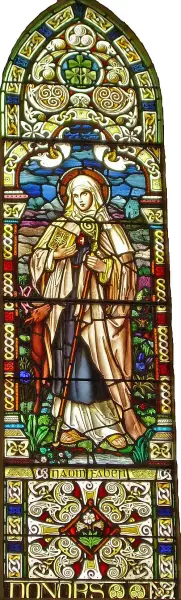
Faber, whose name is also preserved as Feadhbar or Febor, is honoured as patron of the Sacred Heart Church at Boho in County Fermanagh and of the neighbouring parish of Monea. She stands among the early Irish holy women whose lives reach the present chiefly through the calendars of the saints. The earliest witness to her is the poetic martyrology of Oengus the Culdee, written at the start of the ninth century, which ties her to Boho and to the district of Tuath Ratha and records the observance of her feast on the sixth of November; the Donegal calendar of 1630 repeated the same associations. Tradition holds that she founded a monastery or nunnery at Boho, probably near the later church in the townland of Toneel North, and that she brought the Christian faith to that part of Fermanagh. Her memory clings to the landscape itself: in the townland of Killydrum stand her rock-cut basin, the bullán that bears her name, and her holy well. Local lore adds the tale of a pet deer that carried her sacred books, an animal driven into the Sillees River by hounds, whose loss called down the saint's famous curse upon the river. Through martyrology, dedication and legend alike, the virgin of Boho has never left the devotion of her people.
The Complete Life
A Virgin of Botha
Faber belongs to the company of early Irish holy women whose lives reach us chiefly through the liturgical books that preserved their names. The earliest surviving witness is the Martyrology of Oengus the Culdee, the poetic calendar of the saints drawn up by Oengus of Tallaght, which scholars place at the start of the ninth century. Its entry binds the saint to two places in what is now County Fermanagh, Boho and the district of Tuath Ratha, and it records the day kept in her memory, the sixth of November. Nearly eight centuries later the association was still unbroken: the calendar of the saints of Ireland compiled at Donegal in 1630 set down the same pairing of the virgin with her places. Continuity of that kind is rare, and it says much about the tenacity of a local cult handed down within an Ulster community from generation to generation. The martyrologists supply no details of her family or formation; they name her simply as a virgin of Botha, numbered among the consecrated women of the Irish church. Whatever else the centuries have taken, the fact of her consecration and the place of her service have never been lost, and both remain fixed in the written record.
§ Saint Faber
Foundress at Boho
Popular tradition holds that Faber founded a monastery or nunnery at Boho and brought the Christian faith to that corner of Fermanagh, and the landscape gives the tradition a plausible home: the site is thought to have lain near the later church in the townland of Toneel North. From that centre her memory spread through the surrounding countryside. In the townland of Killydrum the pilgrim can still find St Faber's bullán, a basin cut from the rock, and St Faber's well, the twin stations of her presence in the parish. Monuments of this kind served the devotional life of the rural community for centuries, and their survival keeps her foundation within reach of living memory. Her patronage, moreover, has never lapsed: she is revered as patroness of Boho's Sacred Heart Church and of the parish of Monea, and the stained glass of the Sacred Heart Church depicts her with the pet deer of local legend at her side. In a region where early documentary evidence is slight, the patient witness of place names, holy wells and parish dedications carries much of the burden of the past, and it carries the name of Faber faithfully.
§ Saint Faber
The Deer and the River
The most vivid strand of Faber's memory is the legend of her deer. It tells that the saint kept a tame deer which carried the sacred books entrusted to her, and that one day, as she made her way to the castle of Baron O Phelan in Boho, hounds of the hunt harried the animal. To escape its pursuers the deer leapt into the Sillees River, and the books were ruined in the water. The saint then laid a curse upon the river: it would run backwards. Folk belief insists that the curse took effect, for the Sillees, which once flowed from Boho toward the sea, is said to have writhed and recoiled, so that its course now runs toward upper Lough Erne instead. The second part of the curse was darker, that the river would prove good for drowning and poor for fishing — and observers point to dried channels and oxbow-like depressions in the ground as traces of its older routes. A tale of this kind does double duty: it explains a changed landscape, and it honours a saint whose books, the emblems of her learning and her mission, were precious enough for the very waters to be remembered as their enemy.
§ Saint Faber
Timeline
- 1630
The Donegal martyrology of 1630, a calendar of Ireland's saints, repeated the early record binding Faber to Boho.
§ Saint Faber
- 1905
Whitley Stokes issued the martyrology of Oengus the Culdee in print for the Henry Bradshaw Society.
§ References
The Record
- Major works
- Monastery or nunnery at Boho, County Fermanagh
- Patron of
- patron of Boho·patron of Monea
- Symbols
- deer
- Canonization
- Pre-congregation saint of the early Irish Church
Prayer
Bibliography
Show 6 sources
- Oengus the Culdee, Saint (1905). Stokes, Whitley (ed.). The Martyrology of Oengus the Culdee. London: Henry Bradshaw Society, pp. 240-241.
- O'Clery, Fr. Michael (1864) [1630]. Henthorn Todd, James; Reeves, William (eds.). Martyrology of Donegal: a Calendar of the Saints of Ireland. Translated by O'Donovan, John. Dublin: Alexander Thom, p. 299.
- Glassie, Henry (1998). Irish Folk History: Tales from the North. University of Pennsylvania Press, p. 176.
- Glassie, Henry H. (1995). Passing the time in Ballymenone: culture and history of an Ulster community. Indiana University Press, p. 826.
- Donnelly, Colm; MacDonald, Philip; Murphy, Eileen; Beer, Nicholas (2005) [2003]. "Excavations at Boho High Cross, Toneel North, County Fermanagh", Ulster Journal of Archaeology 62, pp. 121-142.
- Boho Heritage Organisation (2009). Edel Bannon; Louise Mclaughlin; Cecilia Flanagan (eds.). Boho Heritage: A treasure trove of history and lore. Nicholson & Bass Ltd, Mallusk, Northern Ireland, p. 246.
Profile text adapted from the Wikipedia article, licensed CC BY-SA 4.0.
Pray with this saint every day
Save St. Faber to your favorites, read the full profile, and get feast-day reminders in the Saints app.
Get the Saints AppFree on the App Store for iPhone and iPad