
died 27 December 399·Feast December 27
St. Fabiola
Penitent Roman matron and foundress of hospitals
Overview
Fabiola of Rome was a physician and a matron of the ancient patrician house of the Fabii, numbered among the noble Roman women who came under the influence of Jerome and turned their lives to asceticism and the service of the suffering. Her first marriage had been a misery: her husband's conduct was so brutal that shared life with him proved impossible, and she secured a divorce under Roman law before entering, against the discipline of the church, upon a second union. When her second consort died, she made a public and unforgettable act of penance at the doors of the Lateran basilica on the eve of Easter, and the pope formally restored her to communion. From that hour she renounced the world. Her immense wealth was poured out for the poor and the sick; she built a fine hospital in Rome and nursed its patients with her own hands, including citizens cast out of society on account of their repulsive diseases. In 395 she withdrew to Bethlehem, studying the scriptures under Jerome's direction in the convent of Paula, until unrest in the East sent her back to Rome. There she joined the ex-senator Pammachius in raising a great hospice for pilgrims at Portus, and she laboured for the poor until her death on 27 December 399.
The Complete Life
A Patrician Marriage
Fabiola belonged to the gens Fabia, one of the oldest patrician families of Rome, and her early life unfolded among the wealth and rank of that house. It was, by the account that has come down to us, an unhappy life. She had been given in marriage to a man whose conduct was so vicious that living with him proved impossible, and she took the step, lawful under Roman jurisdiction, of obtaining a divorce. Then, contrary to the church's discipline she contracted a second union while her first husband still lived. The irregularity placed her outside the communion of the faithful and marked the first chapter of a story that would become famous precisely for its reversal. At the time of Jerome's residence in the city, from 382 to 384, she stood apart from the ascetic company that had gathered around the great scriptural scholar; his circle of noble women, with its fasts and its studies, had not yet claimed her. Only later, and by way of suffering, did the direction of her life change. The death of her second consort left her free, and in that freedom she made the decision that fixed her name in the memory of the Roman church: to renounce the world she had known and to give what remained of her life to penance and to others.
§ Early life
Penance at the Lateran
The turn came on the eve of Easter. Her second consort was now dead, and Fabiola presented herself at the doors of the Lateran basilica in the garb of a penitent, and there, before the assembled Christians of the city, she performed public penance for her sin. The gesture astonished Rome. A woman of the great Fabian house, known to the fashionable world of the capital, kneeling in sackcloth at the basilica's threshold made a profound impression upon the Christian population, and the pope received her formally back into full communion with the church. In an age when public penance was a severe and solemn discipline, undergone by few and dreaded by all, her act required a rare courage. She had nothing to gain in worldly terms and everything to forfeit: standing, credit, the esteem of her class. What she sought instead was reconciliation with God, and she sought it in the most conspicuous manner available. From that day her conversion was complete. She renounced all that the world had offered her, lavished her vast fortune upon the needy and the ailing, and bent her considerable energies to the service of the church. The penitent of the Lateran became one of the most conspicuous Christian benefactors of her generation.
§ Early life
Physician of the Rejected
Fabiola's charity took a form that was, for her age, remarkable. She erected a fine hospital at Rome, one of the earliest institutions of its kind in the Christian city, and she did not content herself with founding and endowing it: she waited upon the inmates with her own hands, serving as nurse and physician to those she had gathered in. Among them were citizens whom polite society had cast out because of their repulsive diseases, sufferers whose afflictions made them objects of dread and disgust, and to these she ministered personally. Her medical skill was not ornamental; she is remembered as a physician, and her practice of medicine, pragmatic in its application, stands as evidence of the part women played in the healing art of the early Christian world. Beyond the hospital she bestowed generous sums upon the churches and religious houses of Rome and elsewhere in Italy, and her interests came to rest wholly upon the church's needs and the relief of the poor and suffering. The patrician's daughter who had fled a brutal husband became, in the city that had watched her penance, the servant of its most abandoned: the sick who had nowhere else to turn found in her house a bed, a physician, and a hand that did not shrink from touching them.
§ Conversion to Christianity and later life
Bethlehem with Jerome and Paula
In 395 Fabiola withdrew from Rome to Bethlehem, the place Jerome had made a centre of scriptural study, and there she entered the hospice of the convent governed by Paula of Rome, the closest of Jerome's disciples. Her purpose was not retreat from labour but the deepening of the life she had embraced: under Jerome's direction she gave herself with zeal to scriptural study and contemplation and to the exercises of ascetic discipline. The school of the Bethlehem monastery was the most exacting of its age, and the company of noble Roman women who persevered in it accepted a regime of study, fasting and prayer far removed from the comforts of their birth. Her stay, however, was not to be permanent. An invasion by the Huns across the empire's eastern provinces unsettled the region, and a bitter quarrel broke out between Jerome and John, bishop of Jerusalem, over the teachings of Origen, a dispute that poisoned the peace of the Palestinian monasteries. Residence in Bethlehem grew unpleasant for the Roman visitors, and Fabiola returned to Italy. The episode left its trace in her story: she had tasted the desert and the scholar's cell, and even her return to Rome did not sever the bond, for she remained in constant correspondence with Jerome until her death.
§ Conversion to Christianity and later life
Portus and the Last Labours
Back in Rome, Fabiola entered upon the final works of her life. From Bethlehem she kept up an unbroken correspondence with Jerome, and at her request the old scholar composed his treatise concerning Aaron's priesthood and the dress of the priestly office, a token of the intellectual friendship that had survived the quarrels of the East. Her charity, meanwhile, took on its last great shape. She united with Pammachius, a former senator who had also embraced the ascetic life, in carrying out a work of mercy on a grand scale: together the two raised at Portus, the harbour city at the mouth of the Tiber, a large hospice to shelter the pilgrims who came flocking toward Rome. The foundation joined her two instincts, hospitality and personal service, and it stood as a monument of cooperation between the aristocratic laity of the eternal city and its poor. To the end she kept up her accustomed personal labours for the sick and needy, until she died on 27 December, by the usual reckoning in 399 though some give 400. The physician of Rome's rejected died, as she had lived, in the midst of works of mercy, and the church she had served counted her loss as a public bereavement.
§ Conversion to Christianity and later life
Veneration of the Roman Church
Fabiola was never the subject of a formal process; her sanctity was recognized by the church of her own city in the days immediately following her death, and she is honoured among the saints of the pre-congregation era. Her funeral became a splendid public display of the gratitude and reverence with which the Roman people regarded her, a public tribute to the woman who had first scandalized and then converted the city by her penance. Jerome, who had known her in the stern intimacy of spiritual direction, wrote a eulogistic memoir of her life in a letter to her relative Oceanus, preserving for posterity the portrait of the penitent turned servant of the poor. Both the great traditions of Christianity received her: she is numbered among the saints of both the Eastern Orthodox Church and the Roman Catholic Church, and her feast is kept on 27 December, the day of her death. In later centuries the church assigned her a distinctive patronage drawn from her own history: divorced people, those caught in difficult marriages, victims of abuse, widows, and the Hospice Movement, of which her hospital and her pilgrim house at Portus stand as early monuments. Few penitents of antiquity have found so direct an audience among the afflicted of every age.
§ Veneration
The Many Faces of Fabiola
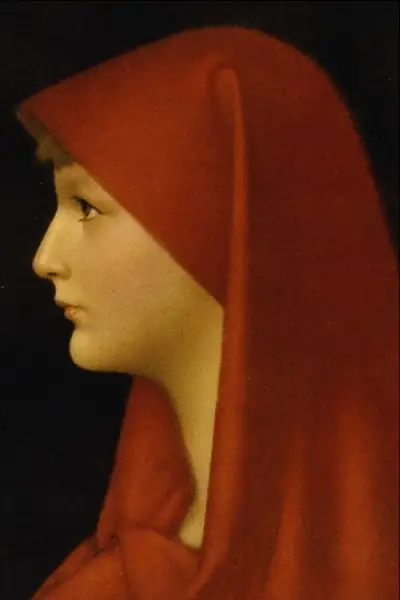
Fabiola's story refused to stay in the fourth century. Cardinal Nicholas Wiseman gave her new life in his novel Fabiola, a work composed in part as an answer to Charles Kingsley's vigorously anti-Catholic Hypatia of 1853 and intended chiefly to hearten the embattled Roman Catholic minority of Victorian England; through the novel her name became familiar far beyond scholarly circles, and it inspired paintings such as Amanda Fougère's Fabiola and Syra of 1859. In 1885 the French painter Jean-Jacques Henner portrayed the saint in an idealized classical profile, and this image, whose original was lost in 1912, was copied by artists around the globe throughout the following century. The copies themselves became a modern legend: in 2008 the contemporary artist Francis Alÿs put together a touring exhibition of more than 300 of them drawn from his own collection, shown first at New York's Hispanic Society of America, then at the Los Angeles County Museum of Art, and from May to September 2009 at the National Portrait Gallery in London. The collection, grown by then to 514 copies, was later displayed in the Byzantine Fresco Chapel of Houston's Menil Collection from 2016 to 2018. A fourth-century penitent thus reappeared, multiplied across centuries and continents, as one of the most represented faces in religious art.
§ Legacy
Timeline
- 382
Jerome took up residence at Rome, where Fabiola had not yet joined the ascetic company around him.
§ Early life
- 395
Fabiola travelled to Bethlehem and settled in the convent hospice governed by Paula of Rome.
§ Conversion to Christianity and later life
- 27 Dec 399
Died at Rome on 27 December; some traditions give the year as 400.
§ Conversion to Christianity and later life
- 1859
Amanda Fougère painted Fabiola and Syra, a work inspired by Wiseman's novel.
§ Legacy
- 1885
Jean-Jacques Henner portrayed the saint in an idealized classical Roman profile.
§ Legacy
- 1912
The original of Henner's portrait was lost.
§ Legacy
- 2008
Francis Alÿs opened a touring exhibition of more than 300 copies of Henner's portrait.
§ Legacy
The Record
- Major works
- Hospital at Rome·Hospice for pilgrims at Portus, founded with Senator Pammachius
- Patron of
- Divorced people·difficult marriages·victims of abuse·widows·against adultery·against unfaithfulness·Hospice Movement
- Canonization
- Pre-congregation; venerated in the Roman Catholic and Eastern Orthodox churches
Prayer
Bibliography
Show 7 sources
- "Saint Fabiola of Rome (+ 399)".
- "CATHOLIC ENCYCLOPEDIA: St. Fabiola", www.newadvent.org.
- Horden, Peregrine. Cultures of Healing: Medieval and After. Routledge, 2019.
- Ogilvie, Marilyn Bailey (1986). Women in Science: antiquity though the 19th century. Massachusetts Institute of Technology.
- Nunn, Christopher A. (2024). Der Bischof und die Asketinnen. Augustins Korrespondenz mit Frauen. Jahrbuch für Antike und Christentum, Ergänzungsband Kleine Reihe 18. Münster: Aschendorff, pp. 466-504.
- Wheeler, Michael (2006). The Old Enemies: Catholic and Protestant in Nineteenth-century English Culture. Cambridge, UK: Cambridge University Press, pp. 70-71.
- "Francis Alÿs: The Fabiola Project", The Menil Collection.
Profile text adapted from the Wikipedia article, licensed CC BY-SA 4.0.
Pray with this saint every day
Save St. Fabiola to your favorites, read the full profile, and get feast-day reminders in the Saints app.
Get the Saints AppFree on the App Store for iPhone and iPad